TLDR;
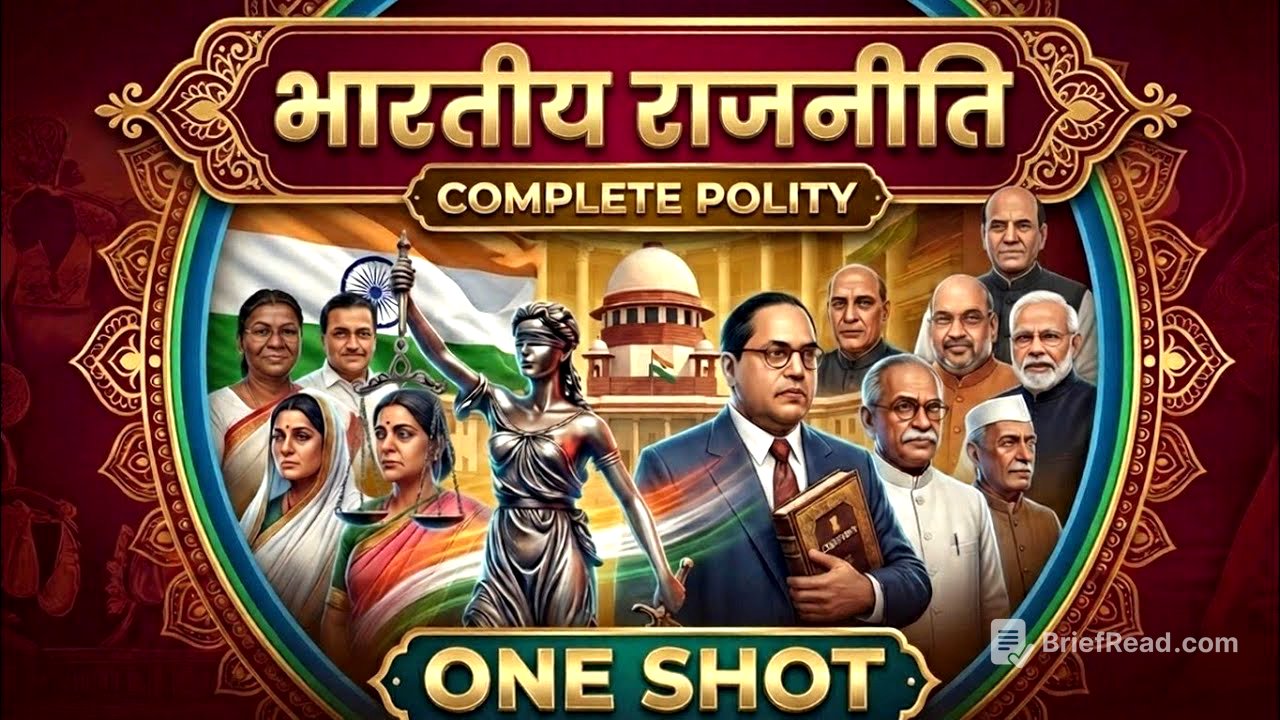
This YouTube video by SolStudy Vickey provides a comprehensive master class on Indian Polity, covering its historical development, key constitutional features, and significant amendments. The lecture aims to equip viewers with a thorough understanding of the Indian political system, essential for competitive exams and informed citizenship.
- The video begins with an overview of the historical development of the Indian Constitution, starting from 1773.
- It then discusses key aspects such as fundamental rights, directive principles, and the roles of various constitutional bodies.
- The lecture also covers significant amendments and contemporary issues like the reorganization of Jammu and Kashmir.
Introduction [0:00]
The class aims to provide a comprehensive understanding of Indian political science, covering topics in a systematic manner relevant for various competitive exams. Understanding political science is crucial for citizens to grasp their rights, duties, and the ongoing developments in the country, enabling them to form informed opinions. Additional classes on other static subjects are available, and viewers are encouraged to share the video. The class includes questions to maintain engagement, with viewers invited to respond in the comments.
Historical Development of the Indian Constitution (1773-1947) [1:46]
The historical journey of the Indian Constitution begins in 1757, tracing the East India Company's transformation from a trading entity to a governing power. The narrative emphasizes the evolution of laws and acts, each building upon the shortcomings and necessities of its predecessors, creating a cause-and-effect chain. Key events include the battles of Plassey (1757) and Buxar (1764), which led to the Company's de facto rule over Bengal, Bihar, and Orissa. The corruption and disorder within the Company's administration prompted British parliamentary intervention, leading to the enactment of the Regulating Act of 1773. This act marked the British government's initial step in controlling the Company's operations, officially recognizing its administrative and political functions, and laying the foundation for a centralized administration in India.
Key Acts and Their Features [3:17]
The Regulating Act of 1773 was a milestone with three main features: British government control over the company, official recognition of administrative and political functions, and the establishment of a central administration in India. The Governor of Bengal was redesignated as the Governor-General of Bengal, with Lord Warren Hastings becoming the first. The governors of Madras and Bombay were placed under his authority, centralizing power. In 1774, a Supreme Court was established in Calcutta, comprising one chief justice and three other judges. The Act also prohibited company employees from engaging in private trade and accepting bribes, addressing a major issue of the time. The Pitt's India Act of 1784 introduced a dual administration system, dividing responsibilities between the Board of Directors for commercial affairs and the Board of Control for political matters, effectively placing real power with the British government.
Charter Acts and the 1857 Revolt [4:48]
The Charter Act of 1813 ended the company's trade monopoly, except for tea and trade with China, and allowed Christian missionaries into India, significantly impacting the socio-economic landscape. The Charter Act of 1833 marked the peak of centralization, with the Governor-General of Bengal becoming the Governor-General of India, a position first held by Lord William Bentick. The company's commercial activities ceased, transforming it into an administrative body. Section 87 of this act aimed to eliminate discrimination based on religion, birth place, or color in government service, laying the groundwork for future fundamental rights. The Charter Act of 1853 separated the legislative and administrative functions of the Governor-General's council and introduced competitive exams for civil service recruitment, leading to the establishment of the Macauly Committee in 1854. The 1857 revolt was a turning point, leading the British government to take direct control of India through the Government of India Act, 1858, which ended the East India Company's rule.
Government of India Act, 1858 and Subsequent Acts [7:02]
The Government of India Act, 1858, also known as the "Act for the Good Government of India," abolished the East India Company's rule and changed the designation of the Governor-General to Viceroy, with Lord Canning becoming the first. A new position, the Secretary of State for India, was created in London. The Indian Council Act of 1861 marked the initial inclusion of Indians in the law-making process, with Lord Canning nominating three Indians to the Legislative Council. The Act also granted the Viceroy the power to issue ordinances during emergencies. The Act of 1892 laid the foundation for an indirect election system and allowed members to discuss the budget. The Morley-Minto Reforms of 1909 introduced a separate electorate for Muslims, a move that was criticized for promoting a divide-and-rule policy.
Montagu-Chelmsford Reforms and the Government of India Act, 1935 [9:29]
The Montagu-Chelmsford Reforms, or the Government of India Act, 1919, introduced dyarchy in the provinces, dividing subjects into reserved and transferred lists. Reserved subjects, such as finance and police, remained under the Governor's control, while less critical subjects were transferred to Indian ministers. A bicameral legislature was established at the center. The central budget was separated from the state budgets, and the Public Service Commission was formed in 1926. Limited numbers of women were granted the right to vote. The Government of India Act, 1935, served as a blueprint for the Indian Constitution, envisioning an All-India Federation and granting autonomy to the provinces by abolishing dyarchy. Powers were divided into three lists: the Federal List, the Provincial List, and the Concurrent List. The Reserve Bank of India and a Federal Court were established.
Indian Independence Act, 1947 and the Constitution Assembly [11:11]
The Indian Independence Act of 1947 declared India an independent and sovereign nation on August 15, 1947, creating the two dominions of India and Pakistan. The task of creating the constitution was assigned to the Constituent Assembly, formed under the Cabinet Mission Plan of 1946, with an initial membership of 389, which reduced to 299 after partition. The first meeting was held on December 9, 1946, with Dr. Sachchidanand Sinha as the temporary chairman. Key committees included the Drafting Committee, chaired by Dr. B.R. Ambedkar, the Union Power Committee, chaired by Pandit Jawaharlal Nehru, and the Provincial Constitution Committee, chaired by Sardar Vallabhbhai Patel. The assembly included 15 women members, such as Sarojini Naidu, Sucheta Kriplani, and Rajkumari Amrit Kaur.
Formation and Objectives of the Constitution Assembly [13:31]
The Constituent Assembly faced the significant challenge of creating a modern, democratic, and inclusive constitution for India, emerging from centuries of colonial rule. On December 11, 1946, the assembly elected Dr. Rajendra Prasad as its permanent chairman and chose two vice-chairmen, H.C. Mukherjee and V.T. Krishnamachari, to ensure representation of India's diverse regions and communities. On December 13, 1946, Jawaharlal Nehru presented the Objectives Resolution, outlining the vision of a sovereign, democratic republic and serving as the soul of the constitution. Adopted unanimously on January 22, 1947, it set India on the path of democracy, justice, and equality, later shaping the Preamble.
Drafting Committee and Key Figures [15:42]
On August 29, 1947, the Drafting Committee was formed, led by Dr. B.R. Ambedkar, comprising seven members, including N. Gopalaswami Ayyangar, Alladi Krishna Swamy Iyer, K.M. Munshi, Syed Mohammad Saadullah, N. Madhava Rao, and T.T. Krishnamachari. Dr. Ambedkar's initial election to the Constituent Assembly was from Bengal, but after partition, that area became part of Pakistan, leading to his re-election from Bombay. The constitution took 2 years, 11 months, and 18 days to complete, with a total cost of approximately ₹63,96,729.
Interim Government and the First Cabinet of Independent India [17:18]
The interim government of 1946 included members of the Muslim League, with Liaquat Ali Khan as the finance minister. However, the first cabinet of independent India in 1947 aimed to create a national government, incorporating talents from outside the Congress party. Dr. Ambedkar was appointed as the law minister, and Dr. Shyama Prasad Mukherjee as the industry minister, signaling a message of a strong, united India. On November 26, 1949, the constitution was adopted, enacted, and given to themselves, with some articles related to citizenship, elections, and the interim parliament being implemented immediately.
Adoption of the Constitution and Key Facts [18:59]
The Constituent Assembly's seal featured an elephant. The Preamble, considered the identity card of the constitution, drew inspiration from the American constitution for its idea and the Australian constitution for its language. In the Berubari case of 1960, the Supreme Court stated that the Preamble was not a part of the constitution but a key to understanding the minds of its makers. However, in the landmark Kesavananda Bharati case of 1973, the Supreme Court reversed its decision, declaring the Preamble an integral part of the constitution and introducing the doctrine of basic structure, which prevents the parliament from altering the fundamental framework of the constitution.
Integration of Princely States and Linguistic Reorganization [20:37]
The integration of over 550 princely states was a significant challenge, led by Sardar Vallabhbhai Patel and V.P. Menon. While most states agreed to join India, Junagadh, Hyderabad, and Jammu & Kashmir initially resisted. Junagadh was integrated through a referendum, Hyderabad through police action (Operation Polo), and Jammu & Kashmir through the signing of the Instrument of Accession by its Maharaja. The demand for the reorganization of states based on language was initially rejected but later accepted in 1956 based on the recommendations of the Fazal Ali Commission.
Fundamental Rights: Article 19-22 [22:41]
The discussion transitions to the fundamental rights, specifically Articles 19 to 22, which concern the right to freedom. Article 19 is described as a bouquet of freedoms, originally containing seven but now comprising six after the 44th Amendment in 1978 removed the right to property. These six freedoms include the freedom of speech and expression, the freedom to assemble peacefully, the freedom to form associations or unions, the freedom to move freely throughout the territory of India, the freedom to reside and settle in any part of India, and the freedom to practice any profession or to carry on any occupation, trade, or business. The Supreme Court has broadly interpreted the freedom of speech and expression to include the freedom of the press, the right to information, and even the right to remain silent.
Limitations and Safeguards of Freedoms [24:33]
These freedoms are not unlimited and are subject to reasonable restrictions under Article 19(2), allowing the state to impose restrictions in the interest of the sovereignty and integrity of India, the security of the state, friendly relations with foreign states, public order, decency or morality, or in relation to contempt of court, defamation, or incitement to an offence. Article 20 provides safeguards for individuals accused of crimes, including protection against ex post facto laws, double jeopardy, and self-incrimination. Article 21, considered the most vibrant article, guarantees the right to life and personal liberty, encompassing the right to live with dignity, the right to privacy, the right to a clean environment, and the right to travel abroad. Articles 20 and 21 cannot be suspended even during a state of emergency.
Right to Education and Protection Against Arrest [26:21]
The 86th Amendment in 2002 added Article 21A, making free and compulsory education a fundamental right for children aged 6 to 14 years. Article 22 provides protection against arrest and detention, including preventive detention, which allows for arrest based on suspicion before a crime is committed. Laws like MISA, TADA, and POTA are examples of preventive detention. Articles 23 and 24 address the right against exploitation, prohibiting human trafficking and forced labor, as well as the employment of children under 14 in hazardous occupations. Articles 25 to 28 guarantee religious freedom, reflecting India's secularism, while Articles 29 and 30 protect the rights of minorities to conserve their language, script, culture, and educational institutions.
Constitutional Remedies and the Role of the Supreme Court [27:30]
Article 32, described by Dr. Ambedkar as the soul and heart of the constitution, provides constitutional remedies, allowing citizens to directly approach the Supreme Court for the enforcement of their fundamental rights. The Supreme Court can issue five types of writs: Habeas Corpus, Mandamus, Prohibition, Certiorari, and Quo Warranto. Habeas Corpus requires the production of a detained person before the court, Mandamus commands a public official to perform their duty, and the other three writs are related to the functioning of the judiciary. A power struggle has occurred between the parliament and the judiciary regarding the amendment of fundamental rights. In the Golaknath case of 1967, the Supreme Court ruled that parliament could not amend fundamental rights, but this decision was later challenged.
Basic Structure Doctrine and Directive Principles [29:05]
The Kesavananda Bharati case in 1973 resulted in the enunciation of the basic structure doctrine, which allows parliament to amend the constitution but not alter its fundamental framework, such as democracy, secularism, and judicial review. The Minerva Mills case in 1980 established a balance between fundamental rights and directive principles of state policy (DPSP). While fundamental rights establish political democracy, DPSPs aim to achieve social and economic democracy, promoting a welfare state. However, DPSPs are non-justiciable, meaning they cannot be enforced by the courts, and serve as moral obligations for the government rather than legal mandates.
Key Directive Principles and Fundamental Duties [30:20]
Key DPSPs include Article 40, which organizes village panchayats; Article 44, which promotes a uniform civil code; Article 50, which separates the executive from the judiciary; and Article 51, which promotes international peace. Fundamental duties were added through the 42nd Amendment in 1976, based on the recommendations of the Sardar Swaran Singh Committee, reminding citizens that rights come with responsibilities. The discussion then shifts to the federal executive, starting with the President of India.
The President and the Council of Ministers [31:17]
Article 52 establishes the office of the President, who is elected indirectly through an electoral college using proportional representation and a single transferable vote system. The President has appointment powers, veto powers, and emergency powers, including the pocket veto. However, real power lies with the Prime Minister and their Council of Ministers. Article 74 states that there shall be a Council of Ministers with the Prime Minister at the head to aid and advise the President. The 91st Amendment in 2003 limited the size of the Council of Ministers to 15% of the Lok Sabha's total strength. The Council of Ministers is collectively responsible to the Lok Sabha, forming the basis of the parliamentary system.
Parliamentary System and Government Accountability [32:27]
The principle of collective responsibility means that if a no-confidence motion is passed, the entire Council of Ministers, not just the Prime Minister, must resign. This ensures the government's accountability to the people. The discussion concludes by emphasizing that the constitution creates a balance between rights, duties, and powers, with fundamental rights empowering citizens, directive principles guiding the state, and the executive leading the country forward.
Prime Minister and Council of Ministers [33:34]
The Prime Minister and the Council of Ministers run the country, Parliament makes laws, and the judiciary protects the Constitution. The Prime Minister is the head of the Council of Ministers, aiding and advising the President, who is bound to follow this advice, making the Prime Minister the de facto executive head. The President appoints the Prime Minister, who is the leader of the majority party in the Lok Sabha, and appoints other ministers on the Prime Minister's advice. The principle of collective responsibility dictates that if a no-confidence motion passes against one minister, the entire government must resign.
Responsibilities and Powers of the Prime Minister [36:04]
The Prime Minister has a constitutional duty under Article 78 to keep the President informed of all decisions related to administration and law-making, acting as a bridge between the Council of Ministers and the President. The Prime Minister also chairs important institutions like the NITI Aayog and the National Integration Council, enhancing their powers. Examining the tenures of various Prime Ministers provides insights into Indian politics. Jawaharlal Nehru, the first Prime Minister, served for about 17 years, providing initial stability. Lal Bahadur Shastri and Indira Gandhi both died in office, highlighting the centralized leadership in the early years.
Evolution of Prime Ministerial Roles and Coalition Politics [37:25]
Morarji Desai became the first non-Congress Prime Minister, marking a milestone in Indian democracy. Chaudhry Charan Singh never faced the Lok Sabha, reflecting the instability of coalition politics. Vishwanath Pratap Singh was the first Prime Minister to be removed by a no-confidence motion, underscoring the importance of parliamentary confidence. P.V. Narasimha Rao was not a member of either house of Parliament when he became Prime Minister, showcasing the system's flexibility. Atal Bihari Vajpayee's 13-day tenure was the shortest, illustrating the potential instability of the Prime Minister's position, which depends on a fragile majority in the Lok Sabha.
Parliament: Structure and Functions [38:40]
Parliament, the soul of democracy, consists of the President, Rajya Sabha (Council of States), and Lok Sabha (House of the People), as per Article 79. The President is an integral part of Parliament, without whom no bill can become law. The Rajya Sabha represents the federal structure, with members elected by state legislative assemblies, and 12 members nominated by the President from fields like art, literature, science, and social service. The Rajya Sabha is a permanent body, with one-third of its members retiring every two years, ensuring continuity.
Powers and Functions of the Rajya Sabha [40:12]
The Rajya Sabha is often considered a weaker house, especially regarding money bills, but it possesses two exclusive powers. Under Article 249, it can authorize Parliament to legislate on a state list subject if it deems it of national importance. Under Article 312, it can initiate proposals for creating new All India Services like the IAS or IPS. The Lok Sabha is the more direct and powerful representation of the people, with the real power to form and dismiss governments, as the Council of Ministers is collectively responsible to it. A quorum of 10% of the total members is required to conduct proceedings.
New Parliament Building and Joint Sittings [42:10]
The new triangular-shaped Parliament building, part of the Central Vista project, symbolizes the needs of future India, with the Lok Sabha hall themed after the national bird, the peacock, and the Rajya Sabha after the national flower, the lotus. It has increased seating capacity, with 888 seats in the Lok Sabha and 384 in the Rajya Sabha. A joint sitting can be called by the President when the Lok Sabha and Rajya Sabha disagree on an ordinary bill, presided over by the Lok Sabha Speaker. However, joint sittings are not allowed for money bills or constitutional amendment bills.
The Supreme Court: Powers and Functions [43:43]
The Supreme Court is at the apex of India's integrated judiciary. Its decisions are final and binding. The complex process for removing judges ensures judicial independence. The Supreme Court has original jurisdiction over cases between the center and states, advisory jurisdiction to advise the President on legal matters, appellate jurisdiction to review lower court decisions, and the power to act as a court of record, with its decisions serving as precedents. High Courts operate at the state level.
High Courts and the Role of the Governor [46:11]
A key principle is "Audi alteram partem," meaning both sides must be heard. The Governor is the constitutional head of the state executive, appointed by the President and serving at their pleasure. The Governor has a dual role, acting as the state's constitutional head, advised by the Council of Ministers, and as an agent of the central government, often leading to conflicts, especially when different parties govern the center and the state.
State Executive and Legislative Branches [48:38]
The Governor is the constitutional head of the state, while the Chief Minister is the real head of government. The 91st Constitutional Amendment of 2003 limits the size of the Council of Ministers to 15% of the total members of the legislative assembly, with a minimum of 12 members for smaller states. Article 167 mandates that the Chief Minister inform the Governor of all decisions related to administration and the Council of Ministers. Six states have a bicameral system: Uttar Pradesh, Karnataka, Maharashtra, Bihar, Andhra Pradesh, and Telangana.
Legislative Council and Assembly [52:59]
The Legislative Council (upper house) has a unique composition, with members elected by legislative assembly members, local bodies, graduates, teachers, and some nominated by the Governor. The minimum age for membership is 30 years. The Legislative Assembly (lower house) has a minimum age of 25 years, with a maximum of 500 and a minimum of 60 members, though there are exceptions. The Legislative Assembly has supreme power over money bills.
Union Territories and Center-State Relations [54:20]
Union Territories are administered directly by the President, while Delhi has a special status as the National Capital Region (NCR) with its own legislative assembly. The Seventh Schedule divides powers between the Union, States, and Concurrent Lists. Article 249 allows Parliament to legislate on state list subjects in the national interest. The Sarkaria and Punchhi Commissions' recommendations are crucial for writing answers on center-state relations.
Constitutional Bodies: Election Commission and UPSC [55:25]
The Election Commission, under Articles 324-329, consists of a Chief Election Commissioner and two other commissioners, with a tenure of six years or until the age of 65. The Chief Election Commissioner can only be removed through a process similar to that of a Supreme Court judge. The Union Public Service Commission (UPSC) and State Public Service Commissions (SPSCs) are mentioned under Articles 315-323. While the Governor appoints SPSC members, only the President can remove them.
Financial Administration and Social Justice Commissions [56:46]
The Finance Commission, under Article 280, is formed every five years. The 15th Finance Commission, chaired by N.K. Singh, gave the highest weightage (45%) to income distance in determining states' share. The GST Council, formed under Article 279A, makes decisions with a 3/4 majority, with the center having 1/3 voting power and all states combined having 2/3. The National Commission for Scheduled Castes (Article 338) and the National Commission for Scheduled Tribes (Article 338A) were separated by the 89th Amendment in 2003. The OBC Commission was given constitutional status by the 102nd Amendment in 2018.
Constitutional Amendments and Emergency Provisions [1:09:27]
Article 368 provides for the process of constitutional amendment. The Eighth Schedule initially had 14 languages, now 22. Emergency provisions include Article 352 (National Emergency), Article 356 (President's Rule in states), and Article 360 (Financial Emergency). Under Article 358, Article 19 is automatically suspended during a national emergency. Under Article 359, the President can suspend the enforcement of other fundamental rights, except for Articles 20 and 21.
Article 370 and Key Constitutional Articles [1:11:11]
Article 370 granted special autonomous status to Jammu and Kashmir. Key constitutional articles include Article 1 (India as a Union of States), Article 52 (President of India), Article 76 (Attorney General of India), Article 110 (Definition of Money Bill), Article 123 (President's power to issue ordinances), Article 148 (Comptroller and Auditor General of India), Article 280 (Finance Commission), Article 324 (Election Commission), and Articles 352, 356, and 360 (Emergency Provisions).
Early Constitutional Amendments [1:23:19]
The First Amendment in 1951 added the Ninth Schedule and made special provisions for backward classes. The Seventh Amendment in 1956 reorganized states on a linguistic basis. The Eighth Amendment in 1959 extended reservations for SCs and STs for another 10 years. The Tenth, Twelfth, and Fourteenth Amendments (1961-62) incorporated Dadra and Nagar Haveli, Goa, Daman and Diu, and Puducherry into India. The Fifteenth Amendment in 1963 increased the retirement age of High Court judges from 60 to 62 years. The Twenty-first Amendment in 1967 added Sindhi to the Eighth Schedule. The Twenty-second Amendment in 1969 created the autonomous state of Meghalaya within Assam.
Amendments During Emergency and Post-Emergency Era [1:30:35]
The Twenty-fourth Amendment in 1971 affirmed Parliament's power to amend any part of the Constitution, including Fundamental Rights. The Twenty-fifth Amendment curtailed the Right to Property. The Twenty-sixth Amendment abolished privy purses for former rulers. The Forty-second Amendment (1976), known as the "Mini Constitution," added "Socialist," "Secular," and "Integrity" to the Preamble, included Fundamental Duties, prioritized Directive Principles over Fundamental Rights, extended the terms of Parliament and state assemblies, and limited judicial review. The Forty-fourth Amendment (1978) reversed many of the Forty-second Amendment's provisions, removed the Right to Property from the list of Fundamental Rights, replaced "internal disturbance" with "armed rebellion" as a ground for imposing emergency, restored the original terms of Parliament and state assemblies, and gave the President the power to send back the advice of the Council of Ministers for reconsideration.
Anti-Defection Law and Panchayati Raj Amendments [1:33:06]
The Fifty-second Amendment (1985) introduced the Anti-Defection Law, adding the Tenth Schedule to disqualify members for defection. The Sixty-first Amendment (1989) reduced the voting age from 21 to 18 years. The Seventy-third and Seventy-fourth Amendments granted constitutional status to Panchayati Raj Institutions and Municipalities, respectively.
Contemporary Amendments: GST and Social Justice [1:34:37]
The Ninety-first Amendment (2003) limited the size of the Council of Ministers. The One Hundred and First Amendment (2016) introduced the Goods and Services Tax (GST). The One Hundred and Second and One Hundred and Fifth Amendments pertained to the Other Backward Classes (OBCs), granting constitutional status to the National Commission for Backward Classes (NCBC) and restoring states' power to identify OBCs.
EWS Reservation and Women's Reservation [1:35:20]
The One Hundred and Third Amendment (2019) introduced a 10% reservation for Economically Weaker Sections (EWS). The One Hundred and Fourth Amendment (2019) eliminated reserved seats for the Anglo-Indian community in the Lok Sabha and state assemblies. The One Hundred and Sixth Amendment (2023), the Nari Shakti Vandan Adhiniyam, provided for 33% reservation for women in the Lok Sabha and state legislative assemblies.


![[WARNING!] After This Rampage, They’ll Chase You Like Never Before!](https://wm-img.halpindev.com/p-briefread_c-10_b-10/urlb/aHR0cDovL2ltZy55b3V0dWJlLmNvbS92aS9NWlhWS0VDdEpGSS9ocWRlZmF1bHQuanBn.jpg)