TLDR;
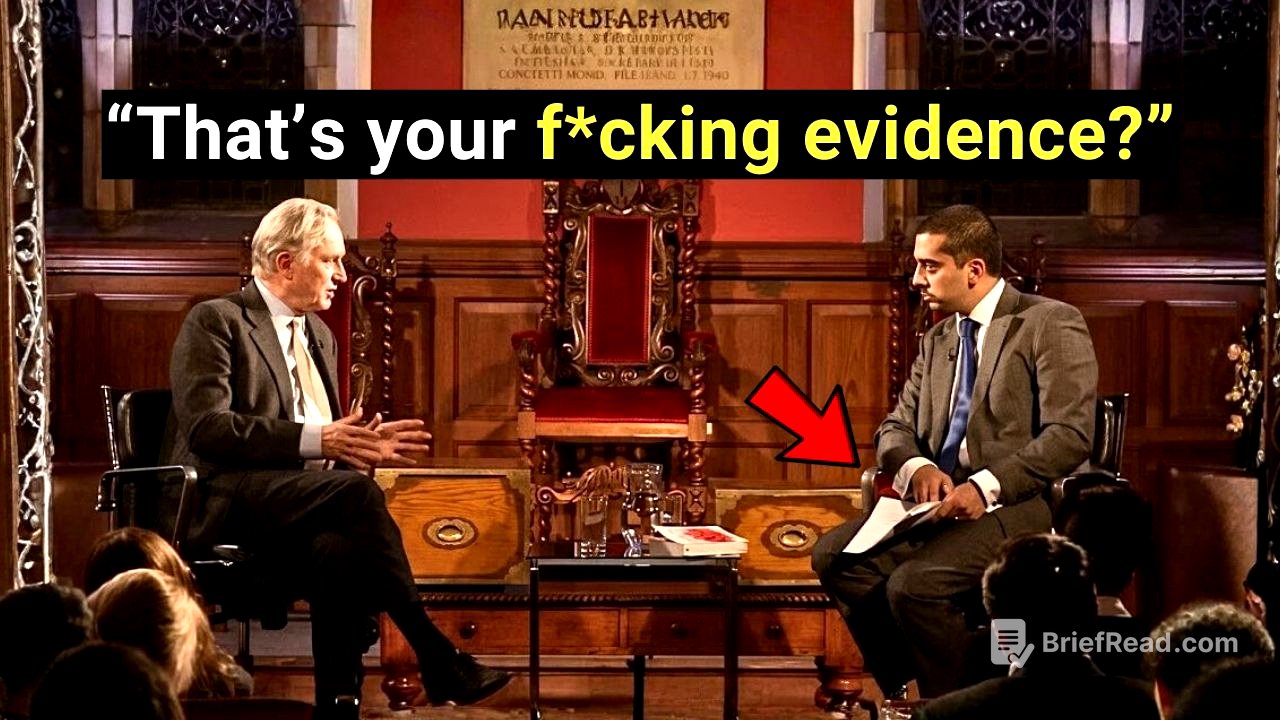
In this debate, Richard Dawkins argues that the world would be better off without religion, suggesting that moral and charitable behaviors stem from civilization rather than religion. He discusses the implications of scientific theories, such as the multiverse, in contrast to faith-based beliefs. He asserts that morality is independent of religion, citing the historical existence of moral principles across cultures. The exchange highlights the difficulties of reconciling faith with scientific reasoning while addressing the potential dangers of religious extremism in modern society.
- Dawkins believes the world would improve without religion.
- He emphasizes civilization as the primary driver of moral behavior.
Would the World Be Better Without Religion? [0:00]
Dawkins argues that if religion vanished, the world would improve, despite acknowledging some positive aspects of religious institutions. He challenges the notion that religion has been crucial in progressing human morality, stating that civilization and a variety of civilizing processes have led to improvements in kindness and charity.
Debate on Universes and God [1:15]
In response to a question about the beliefs of atheists concerning the universe's origin, Dawkins distinguishes between the multiverse theory and faith in God. He explains that some physicists advocate for the multiverse hypothesis to address the fine-tuning of physical constants and critiques the assumption that belief in God requires less evidence than scientific theories.
Science vs. Religion [2:37]
Dawkins maintains that religion and science are fundamentally incompatible, especially when religion claims to explain reality. He acknowledges that science has contributed to harmful technologies but emphasizes that the responsibility lies not in science itself but in how humans choose to use that knowledge. He argues that many scientists compartmentalize their religious beliefs and do not apply them while conducting their work.
Moral Certainty [4:27]
The discussion shifts to morality and whether it can be derived from religion. Dawkins points out that many moral values found in religious texts predate those religions and can also be explained by moral philosophy and evolutionary biology. He insists religion does not provide a solid foundation for morality, as it often contains contradictory messages.
The Function of Religion in Society [7:36]
When asked if religion fulfills human needs that science cannot, Dawkins acknowledges that while religion may comfort the fearful and grieving, this does not validate its truthfulness. He argues that people have the right to their beliefs, but they should not expect their faith to carry weight solely because it is a religious conviction.
Audience Engagement [9:50]
Audience members pose questions regarding Dawkins’ views on various religions and their interpretations of scripture. Dawkins responds to the implications of contradictions within religious texts and favors reasoned debate over faith-based claims. He argues against accepting one interpretation of scripture as uniformly applicable, promoting an evidence-based approach to beliefs.
Final Thoughts on Religion’s Influence [14:52]
Dawkins discusses the historical persistence of religion and counterpoints the belief that it is inherently ingrained in human nature. He expresses hope that societies can outgrow religious doctrines, citing past pagan religions as examples of beliefs that eventually faded. He also reflects on the idea that although religion once served specific social needs, humanity can find value and meaning outside of religious frameworks.