TLDR;
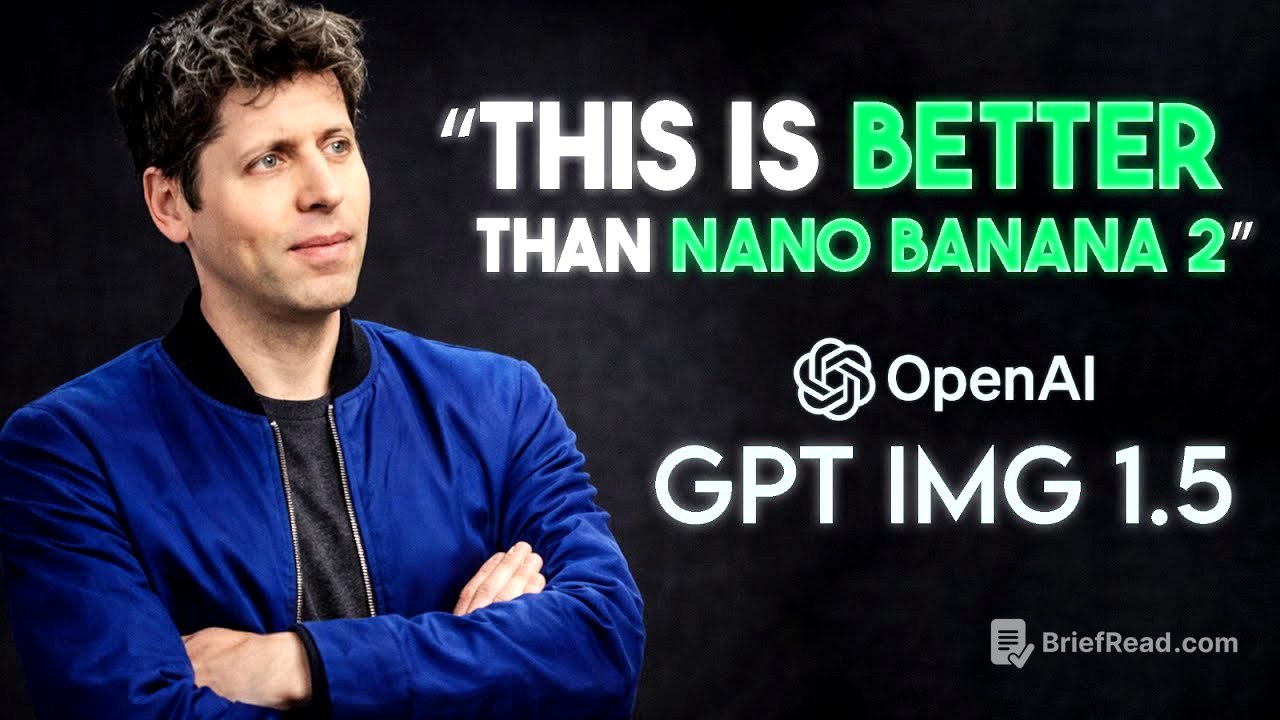
This video discusses OpenAI's release of GPT Image 1.5, highlighting its enhanced precision in image editing, faster generation speeds, and improved text rendering capabilities. It also touches on OpenAI's strategic infrastructure deals with companies like Amazon, NVIDIA, and others to secure necessary computing power for future AI models. The video further explores OpenAI's transparent approach to model limitations through the Frontier Science benchmark and its focus on AI as a tool to augment human capabilities.
- GPT Image 1.5 offers significant improvements in image editing precision and speed.
- OpenAI is making substantial infrastructure investments to support future AI development.
- The company emphasizes transparency regarding the limitations of its AI models.
Introduction to GPT Image 1.5 [0:01]
OpenAI has launched GPT Image 1.5 within ChatGPT, which at first appears to be a standard update with better prompt accuracy and faster image generation. However, a closer examination reveals fundamental changes in how image generation behaves. The most significant improvement is the model's ability to follow instructions with greater precision during image editing.
Enhanced Image Editing Capabilities [0:25]
GPT Image 1.5 excels in editing images by applying specific changes while preserving the original image's lighting, composition, and appearance. This prevents the common issue of images drifting into unrecognizable states after multiple edits, maintaining the identity of people, objects, and the overall scene. This enhancement addresses a major limitation of previous image models, making image generation more reliable for practical applications.
Speed and Workflow Improvements [1:24]
Image generation is now up to four times faster, and users can continue generating and iterating images without waiting for previous ones to finish processing. This improvement promotes a more fluid creative workflow, allowing for rapid experimentation. The new images section in the ChatGPT sidebar, available on both web and mobile, is designed to support visual exploration with a cleaner interface, intuitive editing tools, preset styles, and trending prompts.
Advanced Editing and Creative Transformations [2:17]
The model can add, remove, and blend elements, as well as shift styles without compromising the image's integrity. It can combine multiple inputs into a single scene and selectively restyle individual parts. This capability allows for complex creative transformations, such as merging people and objects into different styles while maintaining consistency in the environment. These advancements position the model as a generative front end for tools like Photoshop, Canva, and Figma.
AI Playbook Promotion [3:28]
The video promotes the "2026 AI Playbook," which includes 1,000 prompts designed to help users leverage AI for personal and professional advantages. It aims to enable users to complete tasks more efficiently and pursue new opportunities by integrating AI into their workflows.
Text Rendering and Model Limitations [4:23]
GPT Image 1.5 shows significant improvements in rendering dense, small, and structured text, making it more reliable for infographics, posters, documentation visuals, UI mock-ups, and marketing assets. While the model still has limitations, the output quality is now high enough for practical use. OpenAI acknowledges that scientific illustrations may still contain inaccuracies, multilingual text can be uneven, and certain styles may break under tight constraints.
API Availability and Commercial Integration [5:19]
GPT Image 1.5 is available to developers with a 20% reduction in image input and output costs, encouraging high-volume commercial use. Creative platforms like Wix, Canva, and Figma are integrating the model, citing its consistency in lighting, composition, and fine detail as reasons for its suitability in real production workflows.
OpenAI's Infrastructure and Partnerships [5:51]
OpenAI has restructured its relationship with Microsoft, allowing it to pursue infrastructure deals with other providers. The company has committed to spending approximately $38 billion over seven years renting servers from Amazon, and Amazon is considering investing over $10 billion directly into OpenAI. These deals aim to secure the massive computing power needed for future AI models like GPT 5.2.
Frontier Science Benchmark and Model Transparency [8:11]
OpenAI is being transparent about the limitations of its models through the release of the Frontier Science benchmark, which evaluates scientific reasoning across various disciplines. While GPT 5.2 performs well on competition-style questions, its performance drops on research-style tasks, highlighting the difference between solving structured problems and conducting real scientific research.
Strategic Direction and Competitive Context [9:38]
OpenAI hired George Osborne to work on AI infrastructure collaboration with governments, indicating long-term planning around national deployment, regulation, and localization. The accelerated launch of GPT Image 1.5 was likely a response to competitive pressure from Google's Gemini 3 and Nano Banana Pro image systems.