TLDR;
This video introduces the number 'e' and the natural logarithm (ln), explaining their properties, how to graph exponential functions with base 'e', and how to solve exponential equations using natural logarithms. It also covers simplifying logarithmic expressions using log laws and applying these concepts to real-world modeling problems, such as population growth and cooling liquids.
- Introduction to the number 'e' and its properties.
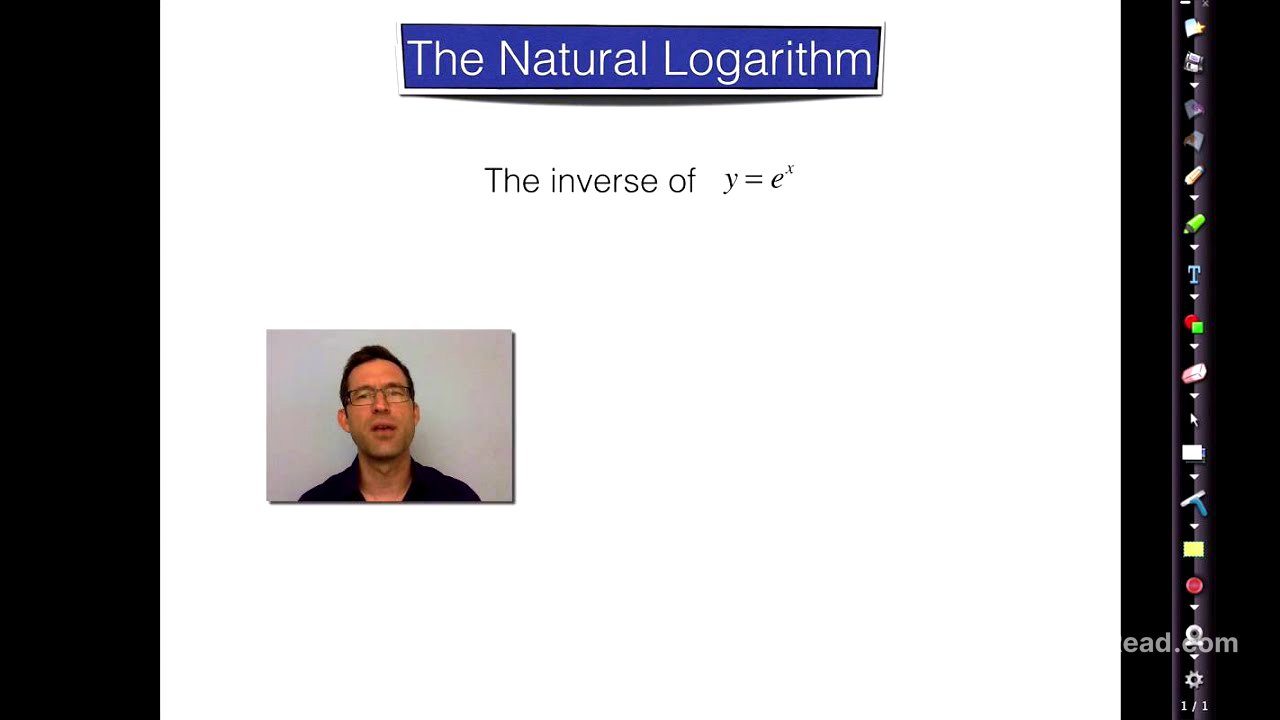
- Explanation of the natural logarithm (ln) as the inverse of e^x.
- Application of 'e' and ln in exponential modeling and problem-solving.
Introduction to the Number e [0:10]
The video introduces the number 'e', which is approximately 2.72, and explains that it is an irrational number, similar to pi, with a non-repeating, non-terminating decimal expansion. The number 'e' is one of the five most important numbers in mathematics along with 0, 1, pi, and another number. It is used extensively in exponential modeling.
Graphing y = e^x [1:35]
The video explains how to graph the exponential function y = e^x. Since e ≈ 2.72, which is greater than 1, the graph of y = e^x is an increasing exponential function. This is because any exponential function of the form y = B^x, where B > 1, is an increasing exponential.
Exponential Modeling with e [3:16]
The video demonstrates exponential modeling using the number 'e' with an example of a llama population on a tropical island, modeled by the equation P = 500 * e^(0.035T). It explains how to find the initial population by setting T = 0 and solving for P. It also demonstrates how to algebraically determine the number of years for the population to reach a certain number by using logarithms to solve the exponential equation.
Introduction to the Natural Logarithm [9:07]
The video introduces the natural logarithm (ln) as the inverse of y = e^x. The natural logarithm is written as ln(x) and is equivalent to log base e of x. The natural logarithm is used because e to the x comes up a lot in nature, especially when describing the rate at which a population grows.
Evaluating Natural Logarithms [10:33]
The video explains how to evaluate natural logarithms without a calculator. It demonstrates that ln(e) = 1, ln(1) = 0, and how to simplify expressions like ln(e^5) and ln(√e) by using the properties of logarithms and exponents.
Logarithm Laws and the Natural Logarithm [12:23]
The video shows that the logarithm laws apply to the natural log just as they do to any other logarithm. It demonstrates how to simplify the natural logarithm of X^3 / e^2 by using the quotient rule and power rule of logarithms.
Modeling with Natural Logarithms [14:17]
The video presents a modeling problem involving a hot liquid cooling in a room, with its temperature modeled by an exponential function. It explains how to find the initial temperature, interpret function notation, and use the natural logarithm to determine when the temperature will reach a specific value. It also demonstrates how to calculate the average rate of change of temperature over a given interval.