TLDR;
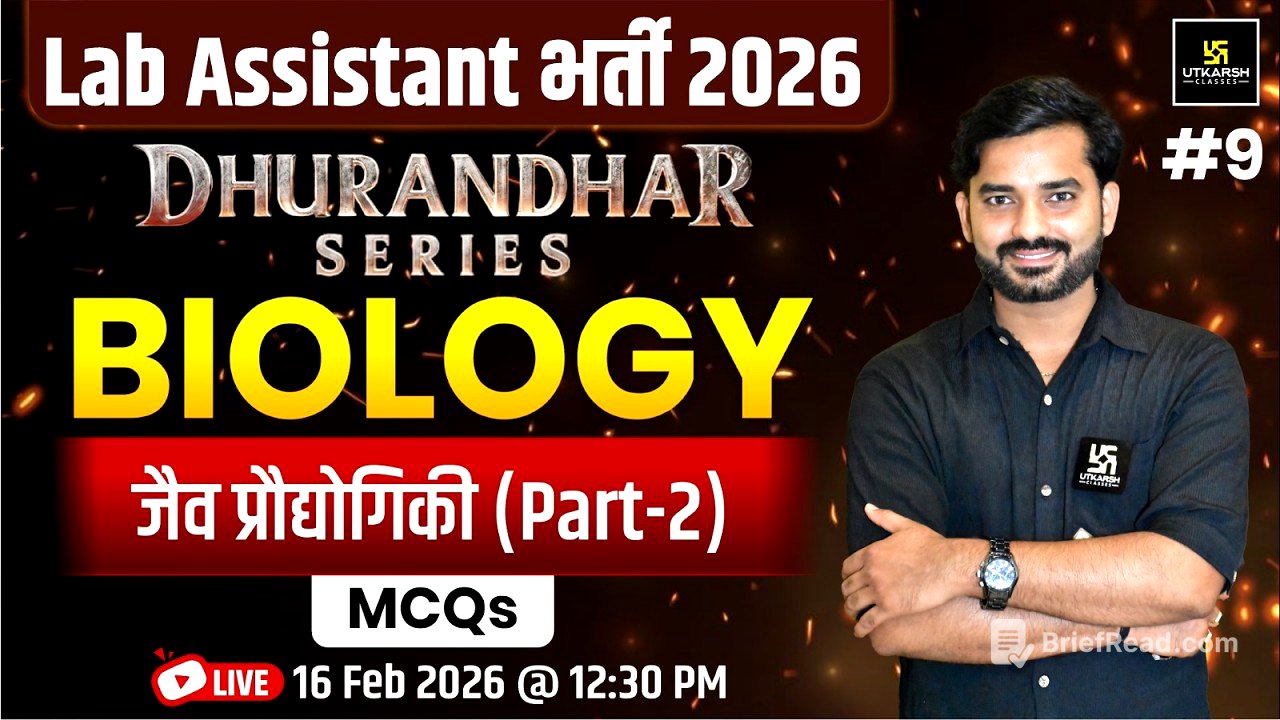
This YouTube video features a biology practice session focused on economic botany, part of the "Dhurandar" series. The session includes multiple-choice questions with a timer and a live poll to help students assess their knowledge and rank. Topics covered include the sources of various plant products, botanical names, and plant family classifications. The video also promotes a महाशिवरात्रि discount on Utkarsh Rajasthan Exams online courses.
- Practice session on economic botany.
- Includes multiple-choice questions with timer and live poll.
- Covers sources of plant products, botanical names, and plant family classifications.
- Promotes महाशिवरात्रि discount on Utkarsh Rajasthan Exams online courses.
Introduction [0:20]
The session starts with a welcome to the viewers and an introduction to the "Dhurandar" series on Utkarsh Rajasthan Exams, focusing on biology. The instructor, Y.K. Mishra, highlights that the series aims to cover all biology topics relevant to the Lab Assistant exam before the exam date. The session is designed as a practice to test the knowledge of the students.
Mahashivratri Offer [1:51]
The host announces a महाशिवरात्रि offer where students can avail a 25% discount on all online courses on the Utkarsh app. To avail the offer, students need to use the coupon code "SHIV25". The offer is valid until February 16.
Question 1: Source of Pure Cellulose from Cotton [2:57]
The first question asks from which part of the cotton plant pure cellulose is obtained. The options are root hair, leaf hair, seed hair, and stem hair. The correct answer is seed hair, as cotton fibers are derived from the hairs surrounding the seeds. 100% of students answered correctly.
Question 2: Botanical Name of Pearl Millet (Bajra) [4:16]
The second question asks for the botanical name of pearl millet (Bajra). The options include Triticum aestivum, Pennisetum typhoides, Zea mays, and Sorghum vulgare. The correct answer is Pennisetum typhoides. The instructor also mentions that Zea mays is the botanical name for maize (corn). 96% of students answered correctly.
Question 3: What is Cauliflower? [6:00]
The third question asks what part of the cauliflower plant is used as a vegetable. The options are terminal bud with immature leaves, fleshy unripe inflorescence, fruit, and swollen stem. The correct answer is fleshy unripe inflorescence. 40% of students answered correctly.
Question 4: Scientific Name of Finger Millet (Ragi) [7:14]
The fourth question asks for the scientific name of finger millet (Ragi). The options are Avena sativa, Sorghum vulgare, Eleusine coracana, and Pennisetum typhoides. The correct answer is Eleusine coracana. 89% of students answered correctly.
Question 5: Plant Family of Pulses and Gram [8:30]
The fifth question asks to which plant family all types of pulses and gram belong. The options are Malvaceae, Liliaceae, Caesalpinioideae, and Papilionaceae. The correct answer is Papilionaceae, which includes most legumes. 70% of students answered correctly.
Question 6: Source of Mustard Oil [10:23]
The sixth question asks from which species of Brassica mustard oil is obtained. The options are Brassica oleracea, Brassica campestris, Brassica juncea, and Brassica indica. The correct answer is Brassica campestris. 92% of students answered correctly.
Question 7: Source of Catechu (Katha) [11:42]
The seventh question asks from which plant catechu (katha), used in paan, is obtained. The options are Acacia arabica, Acacia senegal, Acacia catechu, and Cassia obtucifolia. The correct answer is Acacia catechu. 100% of students answered correctly.
Question 8: Source of Sago (Sabudana) [13:51]
The eighth question asks from which plant sago (sabudana) is obtained. The options are Acacia catechu, Calamus rotang, Phoenix dactylifera, and Metroxylon rumphii. The correct answer is Metroxylon rumphii. 33% of students answered correctly.
Question 9: Richest Source of Carbohydrates [15:30]
The ninth question asks which of the given options is the richest source of carbohydrates. The options are wheat, gram, groundnut, and sorghum. The correct answer is wheat. 63% of students answered correctly.
Question 10: What is Obtained from Cannabis sativa? [18:28]
The tenth question asks what is obtained from Cannabis sativa. The options are coir, wood, hemp, and jute. The correct answer is hemp. 57% of students answered correctly.
Question 11: Plant Yielding Resin, Timber, and Pulp [20:34]
The eleventh question asks which plant yields resin, timber, and pulp. The options are Dalbergia, Quercus, Pinus, and Eucalyptus. The correct answer is Pinus. 96% of students answered correctly.
Question 12: Family of Curcuma longa (Turmeric) [22:11]
The twelfth question asks to which family Curcuma longa (turmeric) belongs. The options include Solanaceae, Cucurbitaceae, Ranunculaceae, Umbelliferae, and Zingiberaceae. The correct answer is Zingiberaceae. 14% of students answered correctly.
Question 13: Source of Morphine [23:50]
The thirteenth question asks from which plant morphine is obtained. The options are Aconitum napellus, Papaver somniferum, Rauwolfia serpentina, and Cinchona officinalis. The correct answer is Papaver somniferum (opium poppy). 90% of students answered correctly.
Question 14: What is Removed During Emasculation? [25:19]
The fourteenth question asks what is removed during emasculation in flowers. The options are style and stigma, sepals and petals, anther, and entire organism. The correct answer is anther. 66% of students answered correctly.
Question 15: Family of Atropa belladonna [27:50]
The fifteenth question asks to which family Atropa belladonna belongs. The options are Solanaceae, Cucurbitaceae, Ranunculaceae, and Umbelliferae. The correct answer is Solanaceae. Only 3% of students answered correctly.
Question 16: Location of Coir Industry [29:54]
The sixteenth question asks where the coir industry is concentrated. The options are Andhra Pradesh, Kerala, Rajasthan, and Gujarat. The correct answer is Kerala. 53% of students answered correctly.
Question 17: Source of Nagkesar Flowers [31:20]
The seventeenth question asks from which flowers Nagkesar is obtained. The options are Crocus sativus, Mesua ferrea, Centella asiatica, and Viola odorata. The correct answer is Mesua ferrea. 81% of students answered correctly.
Question 18: Number of Cultivated Cotton Species [32:49]
The eighteenth question asks how many species of cotton are cultivated. The options are one, two, three, and four. The correct answer is four.
Question 19: What is Margarine Made From? [35:24]
The nineteenth question asks from what margarine is prepared. The options are coconut, almond, groundnut, and cashew. The correct answer is groundnut. 71% of students answered correctly.
Question 20: Plant Family of Top Five Crops by Tonnage [36:45]
The twentieth question asks about the plant family of the world's top five crops by tonnage. The options relate to Poaceae, Solanaceae, and Leguminosae families. The correct answer is that four are from the Poaceae family and one from the Solanaceae family. 57% of students answered correctly.
Question 21: What Part of Vanilla is Used? [38:39]
The twenty-first question asks from which part of the vanilla plant vanilla is obtained. The options are fruit, flower, root, and stem. The correct answer is fruit. 88% of students answered correctly.
Question 22: Source of Bhojpatra [40:38]
The twenty-second question asks from which plant Bhojpatra is obtained. The options are Piper betle leaves, Betula utilis bark, Cinchona leaves, and Cinchona bark. The correct answer is Betula utilis bark. 78% of students answered correctly.
Question 23: Substance Used as Emulsifying Agent and Demulcent in Medicine [42:47]
The twenty-third question asks which substance is used as an emulsifying agent and demulcent in medicine. The options are resin, gum arabic, amber, and gum. The correct answer is gum arabic.
Question 24: Milk-like Preparation from Seeds [44:14]
The twenty-fourth question asks from which seeds a milk-like preparation can be made. The options are gram, grapes, soybean, and barley. The correct answer is soybean. 100% of students answered correctly.
Question 25: Plant Used to Extract Blue Dye [45:04]
The twenty-fifth question asks which plant is used to extract blue dye. The options are Trifolium, Indigofera, and Lupinus. The correct answer is Indigofera. 93% of students answered correctly.
Conclusion and Results [46:25]
The session concludes with the announcement of the top-ranking students. The instructor mentions that the first rank was secured by Sky Queen, followed by PK Chauhan and Suresh Bhati. The instructor also announces that the next session will focus on the cell topic.