TLDR;
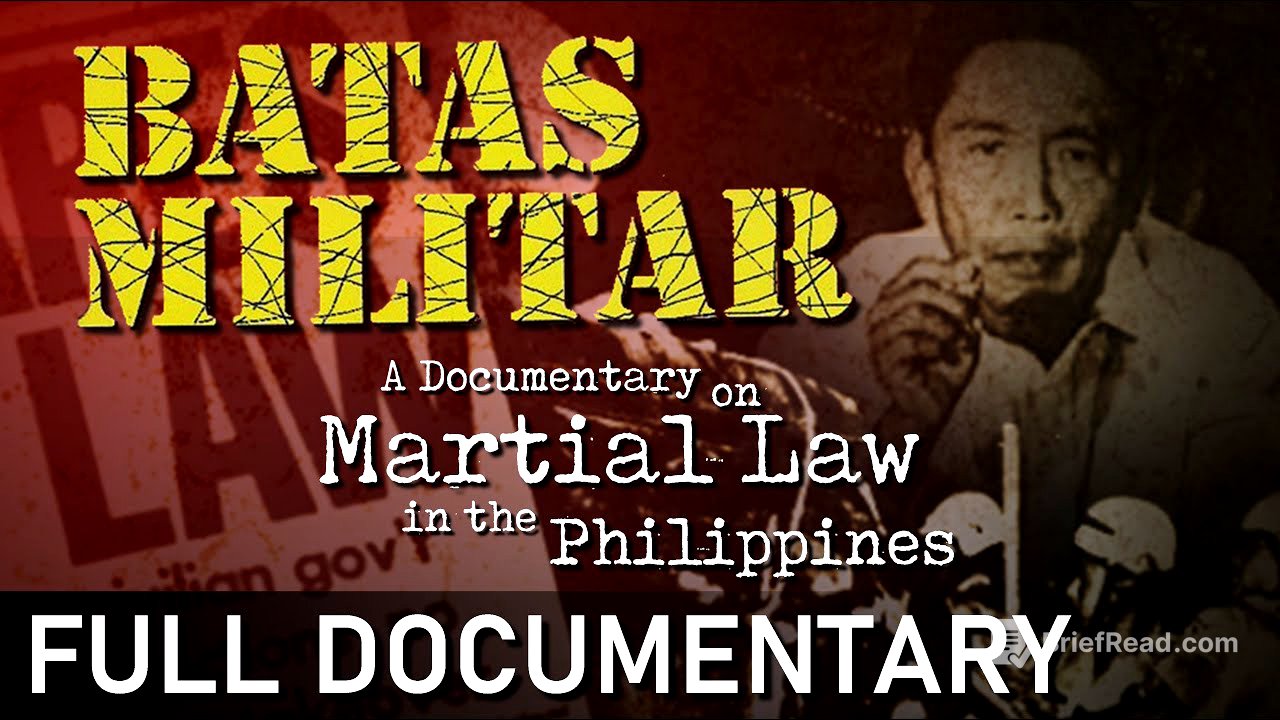
This video provides a comprehensive overview of the events leading up to and during the martial law period in the Philippines under President Ferdinand Marcos. It covers Marcos's initial rise to power, the political and economic turmoil of the 1970s, the declaration of martial law, and the subsequent human rights abuses and corruption that characterized his regime. The video also explores the growing opposition to Marcos, culminating in the People Power Revolution that ousted him from power.
- Marcos's rise to power and consolidation of authority.
- The political and economic climate leading to martial law.
- Human rights abuses and corruption during martial law.
- The emergence of opposition and the People Power Revolution.
Marcos's Ambitions and the Rising Unrest (1970-1971) [2:23]
In the early 1970s, rumors circulated about President Ferdinand Marcos's plans to stay in power beyond his constitutional two-term limit. His strategies included shifting to a parliamentary system or declaring martial law. Senator Benigno Aquino warned that Marcos's rule would turn the Philippines into a "Garrison State" controlled by the military. Protests against the government intensified, addressing issues such as rising prices, the presence of US military bases, foreign control of the economy, government corruption, and the widening gap between the rich and poor. Military force was used to suppress these protests, but this only strengthened the opposition.
Plaza Miranda Bombing and Suspension of Habeas Corpus [5:42]
On August 21, 1971, a bombing at Plaza Miranda during a Liberal Party rally injured many, including Senator Jovito Salonga. Senator Benigno Aquino was absent, leading to suspicions of his involvement. The bombing remains a mystery, with strong suspicions that Marcos orchestrated it to create chaos and justify martial law. Following the bombing, Marcos suspended the writ of habeas corpus, allowing arrests without court appearances, but was later forced to reinstate it due to public outcry.
Escalating Violence and the Rise of Armed Groups [9:19]
In 1972, a series of bombings occurred, seemingly aimed at instilling fear rather than causing fatalities. The New People's Army (NPA), the armed wing of the Communist Party of the Philippines (CPP), was founded in 1968 and led by Jose Maria Sison. The NPA included former members of the Hukbong Mapagpalaya ng Pilipinas (Huk). Marcos blamed the CPP and NPA for the Plaza Miranda bombing.
The Constitutional Convention and Oplan Sagittarius [11:11]
The Constitutional Convention (CONCON) was convened to replace the 1935 Constitution. Delegates manipulated by Marcos focused on shifting the government to a parliamentary system. Delegate Napoleon Rama proposed a resolution to ban Marcos from running for a third term, which gained majority support. Delegate Eduardo Quintero revealed that Imelda Marcos had bribed delegates. Senator Aquino exposed Oplan Sagittarius, a detailed program to place the country under military control. General Romeo Espino claimed Oplan Sagittarius was merely an emergency plan for Mindanao and Luzon.
The Rolex 12 and Martial Law Planning [15:37]
Juan Ponce Enrile was the most powerful official after Marcos and was appointed martial law administrator. He was part of the "Rolex 12," a group of officials who secretly planned martial law. The Rolex 12 included key military figures such as General Fabian Ver, General Fidel Ramos, and others. Ruben Canoy revealed that Marcos and Enrile handled the legal aspects of martial law, while military officials managed its implementation. General Manuel Llano and General Rafael Ileto opposed martial law and were removed from their positions.
The Enrile Ambush and Proclamation 1081 [21:03]
On September 22, 1972, the alleged ambush of Juan Ponce Enrile's car was cited as a reason for declaring martial law, but Enrile later admitted it was staged. Journalist Primitivo Mijares revealed that Marcos ordered Enrile to "make it look good." On September 23, 1972, Marcos announced the proclamation of martial law through Proclamation 1081, officially dated September 21.
Marcos's Background and Rise to Power [24:35]
Ferdinand Marcos was known as one of the most intelligent Filipinos of his generation. As a law student, he was implicated in the murder of Julio Nalundasan, who defeated his father in a congressional election. Marcos was convicted but later acquitted by the Supreme Court. During World War II, Marcos claimed to have led a guerrilla group called Ang Maharlika and received numerous medals for his heroism, though many were later revealed to be fake. He served three terms as a congressman and later became a senator and Senate President.
Political Marriage and Early Presidency [28:11]
Marcos married Imelda Romualdez, a political move that strengthened his base. In January 1966, he was inaugurated as the sixth president of the Philippines. His first term was marked by infrastructure achievements. In 1967, all but one senatorial candidate from Marcos's Nacionalista Party won. Benigno Aquino Jr. of the Liberal Party was the only opposition candidate to win.
Scandals and the 1969 Election [31:06]
In 1969, the Dovey Beams Affair, involving Marcos and a Hollywood starlet, caused a scandal. The 1969 election was marred by corruption and heavy spending, leading to economic issues. Public trust declined further after the Plaza Miranda bombing. In the 1971 elections, Marcos's candidates lost, and Liberal Party candidates who were injured in the Plaza Miranda bombing were elected.
The New Society and Constitutional Authoritarianism [35:14]
On September 23, 1972, Marcos's political opponents were arrested, and media outlets were shut down. Marcos initiated the "New Society," aiming to reform the country. He ordered the dismantling of private armies, the surrender of unlicensed firearms, and the dismissal of corrupt government employees. He had Lim Seng executed for drug trafficking to demonstrate the New Society's seriousness. Marcos's philosophy of "constitutional authoritarianism" sought to legitimize his dictatorship. He reconvened the Constitutional Convention and held a plebiscite to ratify the new constitution, which was replaced by Citizens Assemblies.
American Support and Military Empowerment [42:10]
Marcos consulted with US President Richard Nixon before declaring martial law and secured American support by protecting US military bases and business interests in the Philippines. The Armed Forces of the Philippines (AFP) became more powerful under martial law, with military officers assuming civilian positions and the AFP's budget increasing. The police were centralized under military control. Marcos purged the military to ensure loyalty, favoring fellow Ilocanos like General Fabian Ver, who became one of the most powerful figures in the regime.
Human Rights Abuses and Torture [46:20]
Under Marcos's regime, the military and police were brutal. Amnesty International reported approximately 70,000 arrests, 34,000 cases of torture, and 3,240 killings. Victims like Nena Fajardo and her husband experienced detention and violence. Military officials admitted that martial law harmed the nation but denied personal wrongdoing, claiming they followed orders. The Marcos family denied widespread abuse, but a court in Hawaii recognized human rights violations and ordered compensation for victims.
Propaganda and the Conjugal Dictatorship [52:47]
The Marcos regime promoted a "Compassionate Society" and "Smiling Martial Law," but this contrasted with the reality of repression. Journalist Primitivo Mijares, once a key propagandist, defected and published "The Conjugal Dictatorship," exposing the regime's corruption and Marcos's affairs. Mijares disappeared and was believed to have been murdered by Marcos's agents. His son, Boyette, was also brutally tortured and killed. The regime tightly controlled the media, and newspapers and broadcast stations were owned by Marcos's family and cronies.
Imelda Marcos: The Iron Butterfly [56:42]
Imelda Romualdez Marcos was known as Marcos's "secret weapon" and the "Iron Butterfly." She became the governor of Metro Manila and Minister of Human Settlements, wielding significant power. Imelda was known for her extravagant spending, edifice complex, and construction of numerous buildings, including the Cultural Center and Film Center. The Manila Film Center project was rushed, leading to a collapse that killed an estimated 200 workers.
Land Reform and Crony Capitalism [1:02:44]
Marcos declared the entire Philippines a land reform area, but only a small percentage of tenant farmers became landowners. His agrarian reform targeted the lands of his enemies, such as the Lopez family, whose businesses were seized. Marcos replaced the old oligarchy with a new group of relatives and cronies, leading to "crony capitalism." His family and cronies monopolized key industries, and Marcos issued presidential decrees and letters of instruction favoring their businesses.
Economic Decline and Growing Opposition [1:08:12]
Initially, the economy seemed to improve under Marcos, with technocrats brought into the government and increased corporate profits. However, the oil crisis led to economic decline, increased government debt, and austerity measures imposed by the International Monetary Fund (IMF). The Communist Party of the Philippines (CPP) and New People's Army (NPA) gained strength, and the Moro National Liberation Front (MNLF) and Moro Islamic Liberation Front (MILF) emerged in Mindanao. Protests against the Chico Dam project in the Cordillera also arose.
Political Maneuvering and the 1978 Election [1:14:46]
In 1978, under pressure from the Carter administration, Marcos held elections for the Interim Batasang Pambansa. Ninoy Aquino, from prison, launched his candidacy but was not allowed to campaign. The opposition formed an alliance called Lakas ng Bayan (LABAN). The election was marred by fraud, and the Kilusang Bagong Lipunan (KBL) won all seats. This led to the radicalization of politicians and activists, with groups like the Light of Fire Movement and April 6 Movement emerging.
The Lifting of Martial Law and Ninoy's Return [1:20:07]
In 1981, Marcos formally lifted martial law and held a presidential election, which the opposition boycotted. Despite the lifting of martial law, Marcos retained his powers. Ninoy Aquino, living in the United States, decided to return to the Philippines to challenge Marcos. He obtained a fake passport under the name Marcial Bonifacio and traveled through different countries to mislead those tracking him.
Ninoy's Assassination and the Agrava Commission [1:34:44]
On August 21, 1983, Ninoy Aquino was assassinated upon his arrival at Manila International Airport. The assassination triggered widespread outrage and protests. Marcos ordered an investigation, forming the Agrava Commission, led by Judge Corazon Agrava. General Fabian Ver was implicated in the crime and forced to take a leave of absence. The Sandiganbayan acquitted Ver, and Marcos reinstated him, further fueling public anger.
The Rise of People Power and the Snap Election [1:37:28]
Disgust spread within the military, leading to the formation of the Reform the Armed Forces Movement (RAM). The United States became concerned about the growing influence of the CPP-NPA-NDF. In 1985, Marcos announced a snap election to communicate with the American people. The opposition nominated Corazon "Cory" Aquino and Salvador Laurel.
The People Power Revolution and Marcos's Fall [1:43:22]
The snap election was marked by violence and fraud. The Batasang Pambansa declared Marcos the winner, but the Reform the Armed Forces Movement (RAM) saw an opportunity to act against Marcos. When their plan to attack Malacañang was discovered, they were forced to stand their ground in military camps. The people supported the rebels, leading to the People Power Revolution. Marcos, his family, and close associates fled to Hawaii with the help of the United States.
Aftermath and Lingering Legacy [1:47:53]
Ferdinand Marcos died in Hawaii in 1989. His body was allowed to be returned to the Philippines but has not been buried. The legacy of martial law continues to haunt the Philippines.