TLDR;
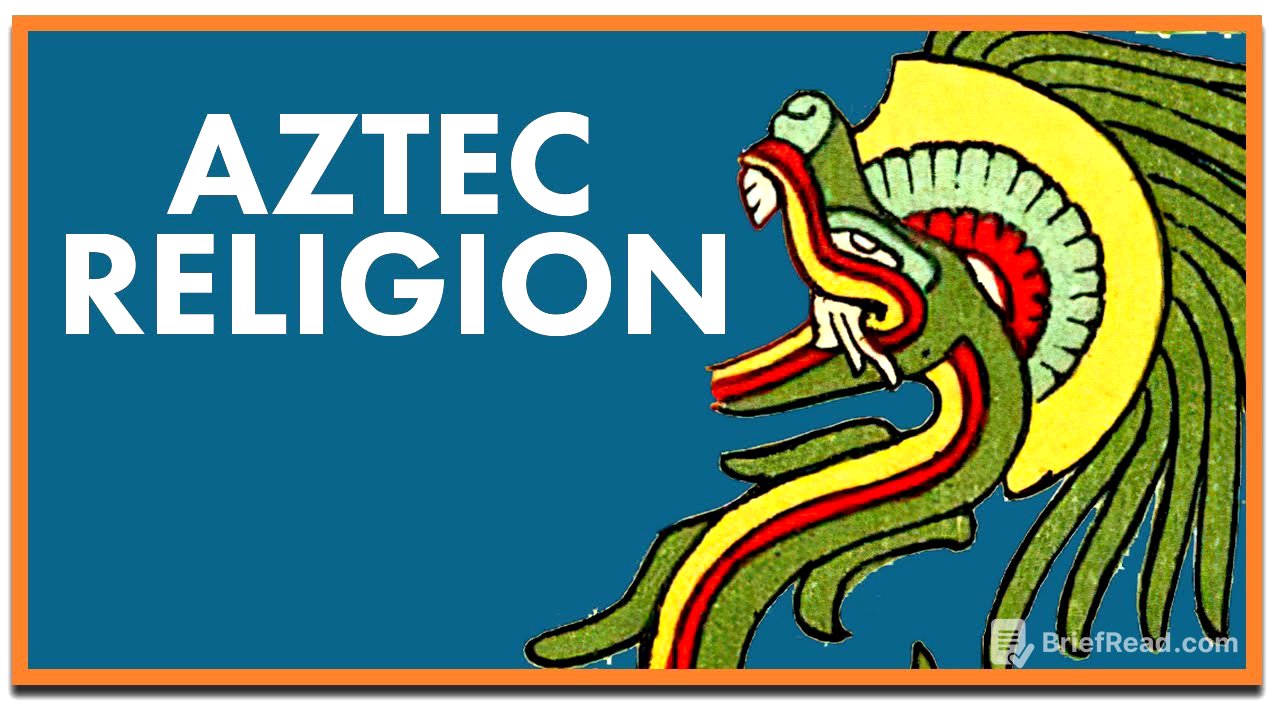
This video explores Aztec religion, moving beyond the common focus on human sacrifice to examine its complex cosmology, pantheon, and views on the human body. It emphasizes the importance of understanding Aztec religion within its historical and cultural context, acknowledging the biases in Spanish sources and the distinction between state and folk religious practices. The video also touches on how scholars approach the study of controversial religious practices like human sacrifice, advocating for understanding over condemnation.
- Aztec religion was polytheistic with a complex pantheon of gods categorized into celestial creativity, rain and agricultural fertility, and war/sacrifice/nourishment.
- The Aztecs viewed the human body as a sacred reservoir of divine forces (Tonali and Teayolia) and practiced human sacrifice as a way to nourish the gods and maintain cosmic balance.
- Scholars interpret Aztec human sacrifice through various lenses, including political control, propaganda, and civic religion.
Introduction: Aztec Religion Beyond Human Sacrifice [0:00]
The video aims to provide a comprehensive understanding of Aztec religion, moving past the common association with human sacrifice. It highlights that while human sacrifice was a significant part of Aztec religious practice, it does not define the entirety of their belief system. The video sets out to explore what is known about Aztec religion and the reasons behind their practice of human sacrifice.
Historical Context and Sources [0:36]
The term "Aztec" refers to an alliance of three indigenous groups in the central Mexican highlands from 1300 to the 1500s, with the Mashika being the dominant group residing in the capital city, Tonoshichelon. Modern historians coined the name "Aztec" in the 1800s based on their mythical homeland, Atlan. These groups spoke the Nawat language, leading scholars to use the term "Nawas" to describe them collectively. Much of our knowledge about Aztec religion comes from 16th-century Spanish sources, such as the Florentine Codex by Bernardino de Salun, which, despite its value, is filtered through a European and Christian lens. The video primarily focuses on the state religion of the Mashika, particularly the mystical military religion of the warrior class, while acknowledging the limited information available about Aztec domestic or folk religion.
The Aztec Pantheon [3:28]
Aztec religion was polytheistic, featuring a vast pantheon with as many as 200 gods. These gods can be loosely categorized into three clusters: celestial creativity/divine paternalism, rain and agricultural fertility (including the rain god Talak), and war/sacrifice/nourishment of the sun and earth (including Ketzel Coat and Wheatzil Pochi). The Aztecs believed in a cyclical universe that had passed through four ages, each ending in cosmic collapse and recreation, with the current fifth age needing to be maintained through rituals and sacrifices. They followed a 365-day solar cycle and a 260-day ritual cycle, aligning every 52 years in a New Fire Ceremony to renew the cosmos.
Understanding Aztec Gods: Forces, Powers, and Impersonations [6:12]
The identities, functions, and attributes of Aztec gods were fluid, with the NWA word "teot" translating to both "god" and "sacred power." Some scholars argue that these gods should be viewed as forces or powers moving through the cosmos rather than discrete personalities. For example, Talak is associated with rain and storms but also represents the force manifested in moisture, fertility, and destruction. Aztec gods had multiple aspects that blended into each other, defying clear identification, and could take human form through deity impersonation in rituals, where humans were believed to actually become the god. The Aztec pantheon was adaptive, incorporating new gods from conquered villages and adapting Catholicism to their cultural frame of reference after the Spanish conquest.
The Templomayor and Aztec Mythology [8:34]
Aztec state-sponsored rituals revolved around Wheatzilla Pochi and Talak, enshrined in temples atop the Templomayor in Tonoshi Talon. The Templomayor symbolizes the myth of Wheatzilla Pochi, who defended his mother by killing and dismembering his sister Coyle Shai. Archaeological discoveries at the Templomayor, including a monolithic stone depicting the dismembered Coyle Shai, symbolically transform the temple staircase into Serpent Mountain, reflecting this myth. The temple served as an axis mundi, the center of the Aztec world and mythology.
The Sacrality of the Human Body: Tonali and Teayolia [11:09]
A pervasive notion in Aztec religion is the sacrality of the human body and its potential to return energy to the cosmos. The Aztecs believed the human body was a reservoir of divine forces called Tonali and Teayolia. Tonali, residing in the head and hair, was associated with warmth, solar heat, strength, and health. Teayolia, residing in the heart, was tied to human reasoning, perception, and understanding, described as a divine fire or spark. These powers permeated reality, residing not only in the human body but also in nature, temples, animals, plants, and objects.
Human Sacrifice: Energy Recycling and Ritual Context [13:07]
Human sacrifice, viewed as a form of energy recycling, was a way to nourish the gods with energy from the human body. It was widely practiced in Mesoamerica and increased in popularity among the Aztecs between the 12th and 16th centuries. These sacrifices were not random but practiced every month, with scholars estimating around 20,000 people sacrificed per year. There were various ceremonies involving human sacrifice, including the famous festival of Toshkot, where a young captured warrior was chosen to impersonate a god for a year before being sacrificed. The priest would cut out his heart and display his skull on a rack.
Interpretations of Aztec Human Sacrifice [15:35]
Scholars have offered various interpretations of Aztec human sacrifice, often viewing it through a political lens as an institution upheld by the elites to exert power. Some tie the practice to expansionist imperial ideology, serving as a warning to conquered neighbors or to intimidate rivals. Others view it as a form of propaganda by terror, intended to terrify the people and warn them against social unrest. Still others see it as a form of civic religion, promoting social cohesion in urban centers through common participation in the ritual.
Approaching Controversial Religious Practices: Lessons from Jonestown [16:39]
The video draws a parallel between studying Aztec human sacrifice and the Jonestown Massacre, referencing Jonathan Z. Smith's call to understand heinous events in religious history rather than simply condemning them. Smith argued for banishing the idea that such events are too exotic to understand and instead recognizing them as instances of something known or seen before. The video aims to make the unfamiliar familiar by placing Aztec human sacrifice in the context of world renewal ceremonies and political/military control.
David Carrasco's Perspective: Aztec Moments and Cultural Identity [18:45]
David Carrasco, a Mexican-American scholar, shares his personal "Aztec moments," reflecting on his connection to his indigenous roots and the importance of studying Aztec civilization. He emphasizes that the Aztecs, like the Egyptians and Romans, had artists, philosophers, kings, and architects who produced complex calendars, monumental architecture, artwork, and literature that deserves recognition. Despite the history of conquest and sacrifice, Carrasco sees a positive reinterpretation of pre-Colombian indigenous culture in the 21st century, particularly in festivals like Dia de los Muertos.