TLDR;
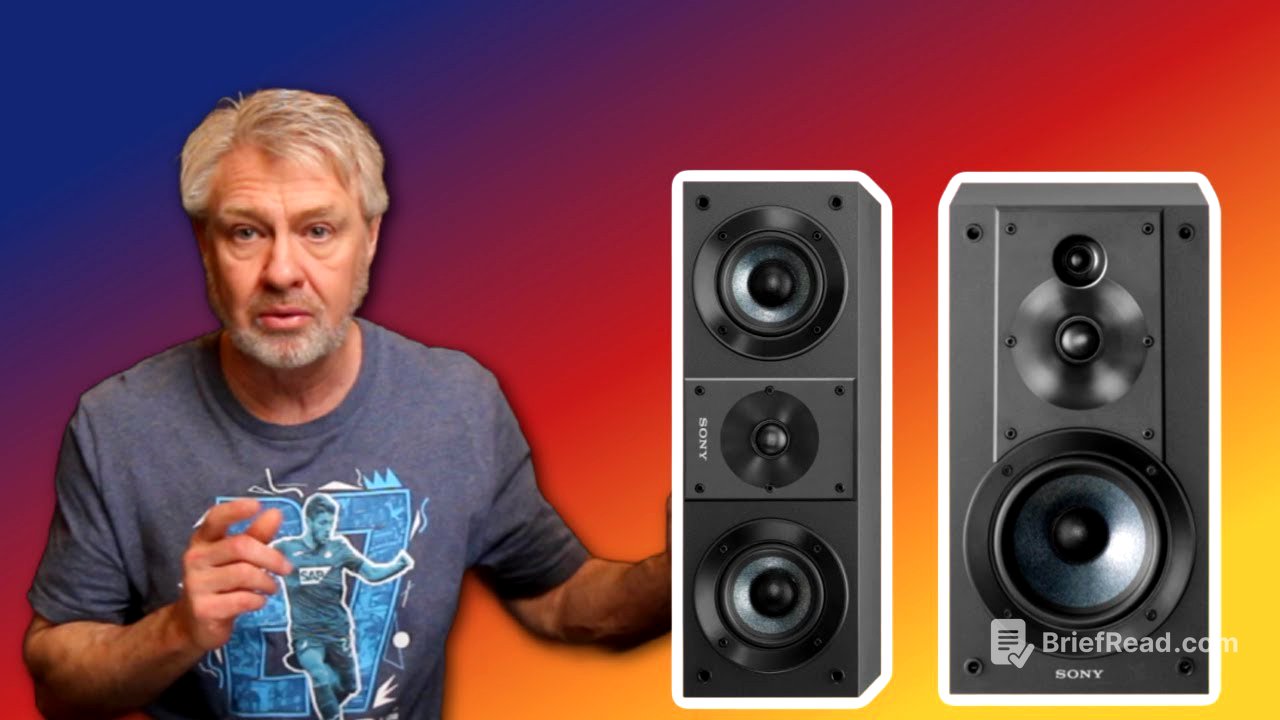
This video is about upgrading the Sony CS8 center channel speaker. The speaker has a lightweight and cheaply made box, but the drivers sound pretty good. The upgrade aims to improve the signal transfer, balance the sound, and use better quality parts. Two different filters were designed, one for center channel use and another for vertical orientation as left or right mains. The upgrades are designed to be budget-friendly, offering significant improvements for a low total cost.
- The speaker box is lightweight and cheaply made, lacking bracing.
- The crossover point is relatively high, leading to comb filtering issues.
- Upgrades include improved signal transfer, better quality parts, and optional Sonic cap.
- Two filter designs: one for center channel use and one for vertical orientation as L/R mains.
- The upgrades are designed to be budget-friendly, offering significant improvements for a low total cost.
Introduction to the Sony CS8 Upgrade [0:00]
The video introduces an upgrade project for the Sony CS8 center channel speaker. The speaker, like previous Sony models, has potential despite its inexpensive construction. The goal is to identify the speaker's shortcomings and determine if it can be improved cost-effectively. The presenter plans to discuss the design aspects, highlighting both pros and cons, and explore whether the speaker can be transformed into a high-value product through targeted upgrades.
Initial Impressions and Design Flaws [1:09]
The initial assessment of the Sony CS8 reveals a lightweight and cheaply made box without any bracing. The speaker's construction includes using leftover cutout pieces glued to the box for added mass, which is unusual. The crossover consists of four basic components: polycaps, an air core inductor for the tweeter, and an iron core inductor for the woofer. While the binding posts are reasonable, the woofers are stamped-frame and use a paper cone, and the tweeter is a simple fabric dome in a waveguide. The speaker's response is weak at the top end, and the sensitivity is low, but it is adequately matched to the woofer.
Value of Upgrades and Budget Considerations [2:37]
The presenter addresses the common concern that upgrade costs can equal the original speaker's price. He argues that a relatively inexpensive speaker, like the Sony CS8, can become a good-sounding speaker with a similarly priced upgrade, resulting in a worthwhile investment. He plans to offer a budget-friendly upgrade option and a higher-end option with a Sonic cap for the tweeter circuit and the addition of two connectors on the back.
On-Axis and Off-Axis Response Analysis [3:45]
The speaker's design has a high crossover point, which, combined with the spacing between the drivers, causes significant comb filtering, especially in the horizontal off-axis response. Directly on-axis, the average response is fairly accurate, but the tweeter level is low, affecting spaciousness and detail. The impedance drops to 4.8 ohms, which should be considered when pairing with a receiver. The spectral decay shows some minor issues around 1kHz, which can be improved with additional insulation.
Impact of the Grill and Off-Axis Performance [5:56]
The speaker's grill negatively impacts the response, making it worse. At 5 degrees off-axis, the response flattens out and becomes more balanced, but beyond that, the horizontal off-axis measurements show significant degradation. At 20 degrees off-axis, the sound quality is severely compromised, and at 30-40 degrees, it becomes almost unlistenable. This makes the speaker highly directional, requiring listeners to be positioned within a narrow angle for optimal performance.
Room Interaction and Upgrade Goals [8:01]
The speaker's narrow dispersion can be advantageous in small, untreated rooms by minimizing sidewall reflections. However, in larger setups, listeners must be positioned directly in front of the speaker. The upgrade aims to balance the sound, improve signal transfer with better quality parts and wiring, and reduce ringing in the box. Two different filters were designed: one for center channel use and another for vertical orientation as left or right mains.
Center Channel Filter Design and Measurements [9:31]
A low-order filter was designed for center channel use, crossing the tweeter as low as possible at 2300 Hz. The crossover response was optimized at 5 degrees off-axis to widen the coverage range. The on-axis response was slightly lifted between 2000 Hz and 4000 Hz. The speaker maintains a usable range within 10 degrees off-axis, and the vertical off-axis response remains flat. The impedance remains at 4.8 ohms, and the spectral decay is slightly improved with added insulation. The horizontal off-axis response is improved but still limited, requiring listeners to stay within 10 degrees for optimal sound.
Vertical Orientation Filter Design and Measurements [13:06]
A different crossover was designed for vertical orientation, voicing it flat on-axis. The woofer and tweeter responses were pulled down slightly to achieve a flatter sum. The horizontal off-axis response drops off smoothly to 40 degrees, and the vertical off-axis response remains good. The impedance remains at 4.8 ohms, and the spectral decay is improved with added insulation to address internal reflections.
Conclusion and Final Thoughts [14:50]
The presenter concludes that the Sony CS8 upgrade is a worthwhile project, especially considering the low cost of the speaker. He emphasizes that the total money spent, rather than the upgrade cost relative to the speaker's price, should be the deciding factor. The upgrades offer significant improvements, making it a fun and rewarding project. The upgraded speakers can provide good sound quality for a minimal investment. The upgrade kits will be available on the GR-Research website.