TLDR;
This video appears to be a classroom lesson focused on language arts, specifically figurative language and character analysis. The teacher guides students through identifying figurative language in sentences, understanding its impact, and analyzing characters' motives in a story. Key activities include finding examples of figurative language, differentiating it from descriptive language, and making inferences about characters based on textual evidence.
- Identifying and understanding figurative language.
- Differentiating between figurative and descriptive language.
- Analyzing characters' motives in a story.
- Making inferences based on textual evidence.
Introduction [0:01]
The teacher begins by introducing an activity involving short and long laughs, using a yellow lighter. The students are asked to identify items and concepts, possibly as a warm-up for the lesson.
Figurative vs Descriptive Language [7:55]
The teacher reviews figurative language, emphasizing that it compares two things to create a different meaning. She uses the example of "The sun winked at me through the clouds" to illustrate how figurative language is more interesting than simply saying the sun moved in and out of the clouds. Students are instructed to identify and mark examples of figurative language in their work, distinguishing them from descriptive language, which merely describes. For example, "Your hair is a beautiful brown and yellow mix" is descriptive.
Examples of Figurative Language [11:14]
The teacher presents several examples of figurative language and asks students to explain what the author is trying to convey. Examples include "The river swallowed the earth," "The fire ran wild," and "The moon winked at me." The students discuss how these phrases imply meanings beyond their literal interpretations, such as the river drenched the earth, the fire spread quickly, and the moon looked friendly. The teacher then instructs the students to revise their work, focusing on incorporating more figurative language.
Character Analysis [13:27]
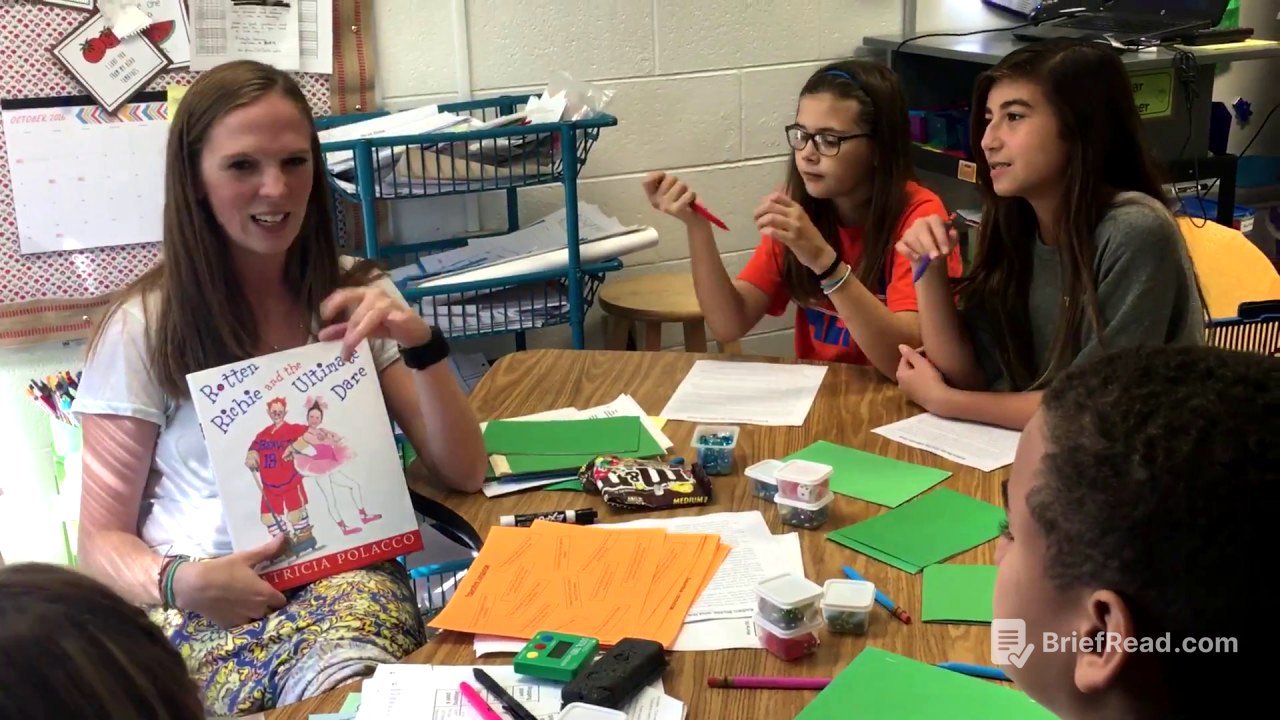
The teacher introduces a story, possibly from a book by Patricia Polacco, focusing on the characters Richie and Tricia. She explains that they will be analyzing the characters' motives. Students are instructed to read a portion of the story and annotate it, looking for words or lines that reveal the characters' feelings.
Inferences About Characters [17:18]
The class discusses what they know about the characters, Richie and Tricia, based on the text. They infer that Richie is a prankster and that Tricia finds his behavior unpleasant. The teacher guides the students to identify specific lines and words that support these inferences, such as Tricia having "to endure" Richie's teasing.