TLDR;
This video discusses the role of religion and everyday life in the American colonies before the Revolution, focusing on the Anglican Church and the Congregational Church (Puritan Church), their structures, and beliefs. It also delves into the Puritan community's strict lifestyle, including the Puritan Church's governance, the Half-Way Covenant, and a significant event in Puritan history: the Salem witch trials. Additionally, the rise of various religious movements like Deism and the Great Awakening highlights the changing dynamics of religion in the colonies.
- The Anglican Church was the largest denomination in the southern colonies, while the Congregational Church was the largest in the north.
- The Salem witch trials exemplify the societal tensions and the Puritan community's response to perceived moral decline.
- The Great Awakening marked a resurgence of religious fervor across various Protestant denominations.
Anglican Church and its Role in the South [0:00]
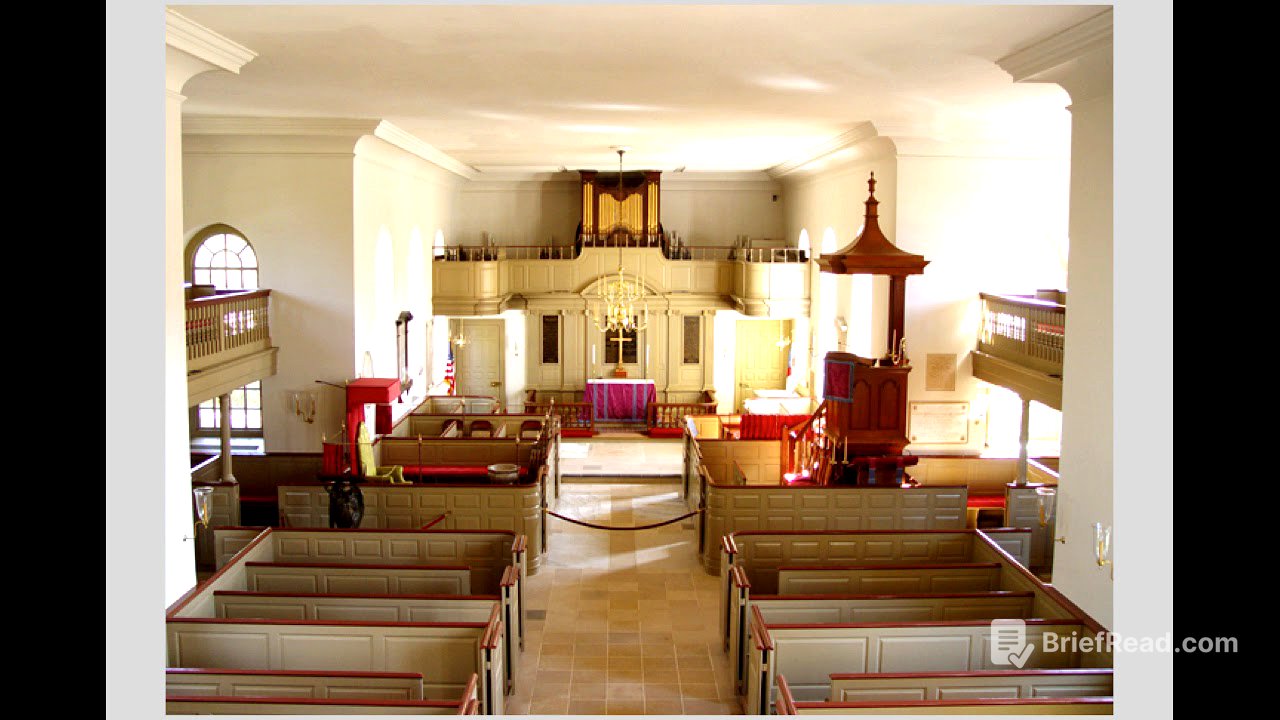
The Anglican Church, known today as the Episcopal Church, was the second-largest denomination in the colonies before the American Revolution. It was established as the official church in several southern colonies, including Virginia and Maryland, where it received tax support for the salaries of its clergy. Rituals included a hierarchical structure led by bishops, although American ministers often faced challenges in gaining ordination and support. The Anglican Church was characterized by a formal liturgy and a relatively low number of churches, leading to sparse clergy coverage for large populations.
Congregational Church: The Puritan Influence in the North [14:08]
The Congregational Church, rooted in Puritan thought, became the largest denomination in the north with around 600,000 members. This church rejected the hierarchical structure of the Anglican Church, emphasizing local governance by the congregation. Worship was simpler, and membership was limited to those deemed "elect" based on evidence of their conversion experiences. The Cambridge Platform codified the independence of individual congregations, while elaborate church services characterized by extended sermons and strict Sabbath observance defined the Puritan worship experience.
The Half-Way Covenant and Declining Religious Fervor [20:35]
The Half-Way Covenant was an adaptation acknowledging that many from the second generation of Puritans were unable to meet strict membership standards. Instituted in 1662, this covenant allowed those who had not publicly testified to conversion to participate in church activities without full rights. This change came amidst concerns over the declining religious commitment and increasing sinfulness among community members, leading to increased calls for moral reforms from Puritan ministers.
The Salem Witch Trials: A Crisis in Puritan Society [29:23]
The Salem witch trials of 1692 arose from a mix of social tensions and religious fervor in the community. The accusations were driven by longstanding disputes between Salem Town, a wealthier community, and Salem Village, which faced socio-economic hardships. Reverend Samuel Parris's position led to an environment of hysteria as young girls began exhibiting strange symptoms, resulting in accusations of witchcraft against local women, including prominent members of the community.
Witchcraft: Accusations and Social Dynamics [31:07]
The witch trials reflected deeper conflicts in Salem society, with accusers often aligned with Reverend Parris and aiming to remove those who opposed his authority. The trials saw a broad spectrum of accused individuals, from marginalized women to respected church members. As paranoia escalated, the trials became a method of addressing social grievances, property disputes, and personal conflicts within the community.
Psychological Factors Behind Witchcraft Hysteria [49:38]
The psychological landscape of the time contributed significantly to the hysteria. The trauma of warfare, personal grievances, and societal pressures created a fertile ground for accusations. Individuals like Mercy Short may have expressed their suffering through accusations and claims of affliction, reflecting the historical trauma endured by many in the community.
Anti-Witchcraft Sentiments and Their Decline [1:01:13]
As the witch hunts continued, increasing skepticism arose regarding the validity of spectral evidence, especially after influential figures like Cotton Mather called for an end to such practices. By 1693, the fervor diminished significantly when the governor intervened after even prominent individuals were accused. The decline of the trials ultimately marked a shift towards rationality and skepticism in matters of witchcraft.
Religious Diversity in the Mid-Atlantic Colonies [1:10:51]
The mid-Atlantic colonies were marked by religious diversity, with the Presbyterian Church emerging as a significant denomination. Presbyterians emphasized governance by councils rather than individual congregations. Other smaller groups, like Baptists and the Dutch Reformed Church, also thrived but faced persecution due to differing beliefs and the push for denominational independence.
The Great Awakening: Revitalization of Religion [1:17:21]
The Great Awakening of the 18th century emerged as a response to declining religious fervor among the colonists. This evangelical movement sought to reinvigorate faith through emotional and experiential preaching, prominent figures such as Jonathan Edwards and George Whitefield played pivotal roles. The movement led to the rise of numerous new denominations and emphasized personal connection with God while also fostering divisions between traditional and reformed churches, reflecting a significant shift towards greater religious freedom and expression in colonial America.