TLDR;
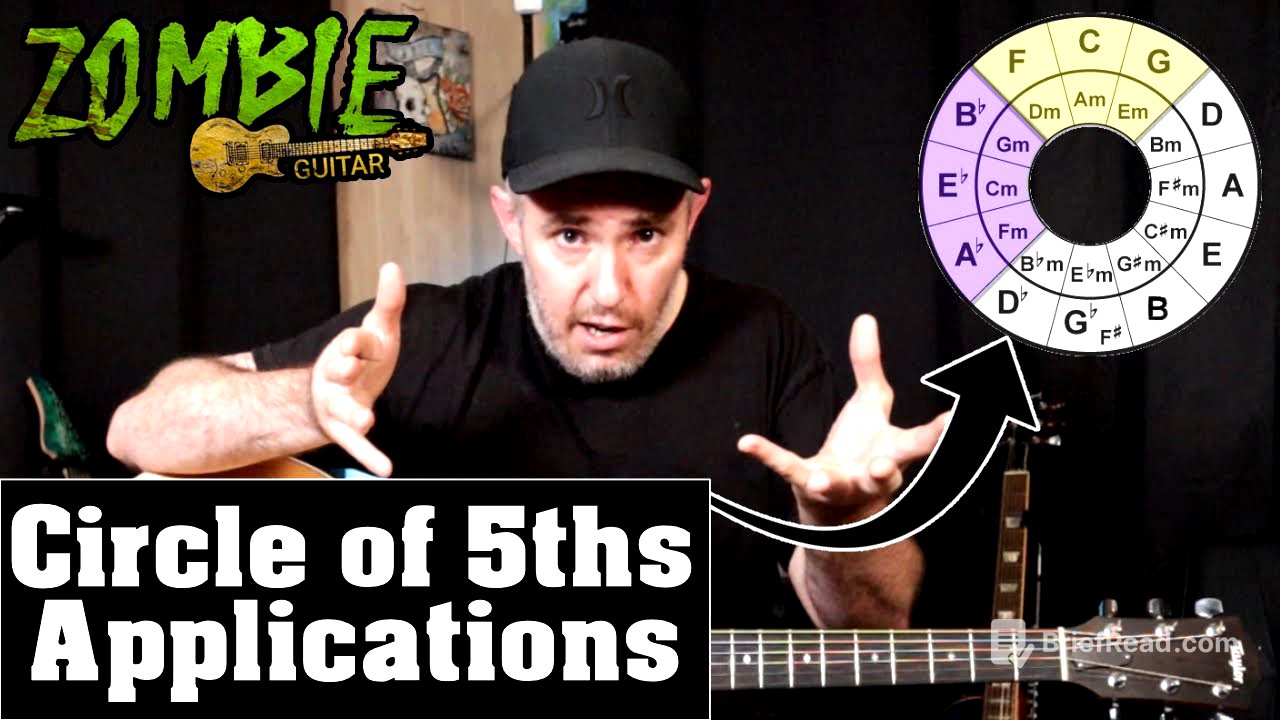
This video by Brian Kelly provides 16 practical applications of the circle of fifths, a crucial tool in music theory. It covers various concepts, such as relative major and minor keys, chords within those keys, the distinction between sharp and flat keys, the diminished chord, pentatonic notes, triads, dominant chords, numbering chord progressions, modes, borrowed chords, intervals, and reciprocal intervals.
- The circle of fifths simplifies understanding major and minor keys.
- It identifies relationships between chords and their tonal centers.
- The video explains how to use the circle to find notes, chords, and understand musical structures.
Lesson Intro [0:00]
Brian Kelly introduces the video by emphasizing the significance of the circle of fifths in music theory. He mentions that this is his 285th upload and that he will highlight 16 practical applications of the circle, which he has used extensively throughout his channel.
Relative Major/Minor [0:38]
The major and minor versions of keys share the same notes and chords. For example, C major and A minor contain the same notes and chords, allowing composers to create music with different emotional tones. By using the circle of fifths, one can determine the chords within any key easily. The speaker demonstrates this by writing a song in A major, showcasing how the same chords can evoke different feelings based on the tonal center selected.
Chords in a Key [2:18]
A key consists of seven notes used to create music. The circle of fifths helps identify these notes. For example, the A major key includes A, B, C#, D, E, F#, and G#. Both major and minor keys arise from this system, allowing musicians to understand their chord structures easily.
Notes in a Key [4:12]
To determine the seven notes in a given key using the circle of fifths, you start with the key note, proceed counterclockwise, and then clockwise until you have a total of seven notes. The speaker exemplifies this using A major and its relative minor, F# minor, demonstrating the process and the concept of enharmonic equivalence.
"Sharp Keys" vs. "Flat Keys" [5:58]
The circle of fifths shows that keys on the right side contain sharps while those on the left have flats. For example, A major and F# minor use sharps, whereas B♭ major and G minor use flats. Specifically, G♭ and F♯ represent the same pitch, differing only in their notation based on sharps or flats.
The Diminished Chord [6:58]
In any key, there is a diminished chord, found by identifying the last note in the clockwise position of the seven notes in the circle. This method allows musicians to easily determine diminished chords, such as B diminished in C major or A minor.
The Pentatonic Notes [7:48]
The pentatonic scale consists of five notes from the seven-note scale of a key. To find the pentatonic notes in a specific key, one can use the circle of fifths. The speaker shares two methods, including crossing out specific notes to identify the remaining five notes that form the pentatonic scale.
Triads [9:25]
Triads consist of three notes forming major and minor chords. The circle of fifths can identify the notes of each triad effectively. The speaker provides examples using C major and G minor, illustrating how the same principle applies across all 12 major and minor triads.
How Many Sharps or Flats [10:39]
The video explains how to determine the number of sharps or flats in a key using the circle of fifths. The process begins with C major (has no sharps or flats) and adds sharps when moving clockwise, while adding flats when moving counterclockwise. The speaker demonstrates this through various keys.
Which Notes are Sharp/Flat? [12:06]
The speaker details how to identify which notes are sharp or flat in a key by referencing the position on the circle of fifths. For example, in D major, F# and C# are the notes made sharp, providing a template for all keys to determine their respective sharps or flats.
Dominant Chords [14:13]
Dominant chords, or seventh chords, introduce tension in music and often resolve into the chord adjacent to them on the circle of fifths. For instance, a G7 chord seeks resolution to C major. The video illustrates this with examples, showing how this tension and release work in both major and minor contexts.
Numbering Chord Progressions [16:42]
Chord progressions can be numbered based on their position in the circle of fifths, allowing for easy transposition between keys. The speaker explains the numbering system (1, 2, 3, etc.) and demonstrates creating a chord progression in different keys while maintaining the same relative relationships.
Modes [18:29]
Modes provide different perspectives on key signatures. The speaker outlines how to shift the tonal center to create various modes using the same set of notes. For instance, using A minor instead of C major as the tonal center gives a sadder sound, known as the Aeolian mode, versus the brighter Ionian mode based on the major key.
Modes Bright to Dark [20:31]
The speaker organizes modes from brightest to darkest and explains that different modes derive their unique sounds from the same set of notes, placing emphasis on how they evoke different emotional tones in music. The ranking includes modes such as Ionian (major) being brighter and Locrian being the darkest.
Borrowed Chords [21:35]
Borrowed chords introduce interest by allowing musicians to utilize chords from parallel keys. The speaker illustrates this by alternating between C major and C minor, borrowing chords to create richer harmonic textures and variety in compositions.
Intervals [24:20]
Intervals, such as perfect fifths or major thirds, are derived using the circle of fifths. By starting at any note, the speaker shows how to find various intervals, explaining that relationships remain consistent regardless of starting point.
Reciprocal Intervals [26:38]
Reciprocal intervals operate on symmetry where an interval above a note has a corresponding interval below it. The speaker demonstrates this with specific examples using the circle of fifths and highlights how various intervals relate to one another consistently, providing a comprehensive understanding of harmony in music.