TLDR;
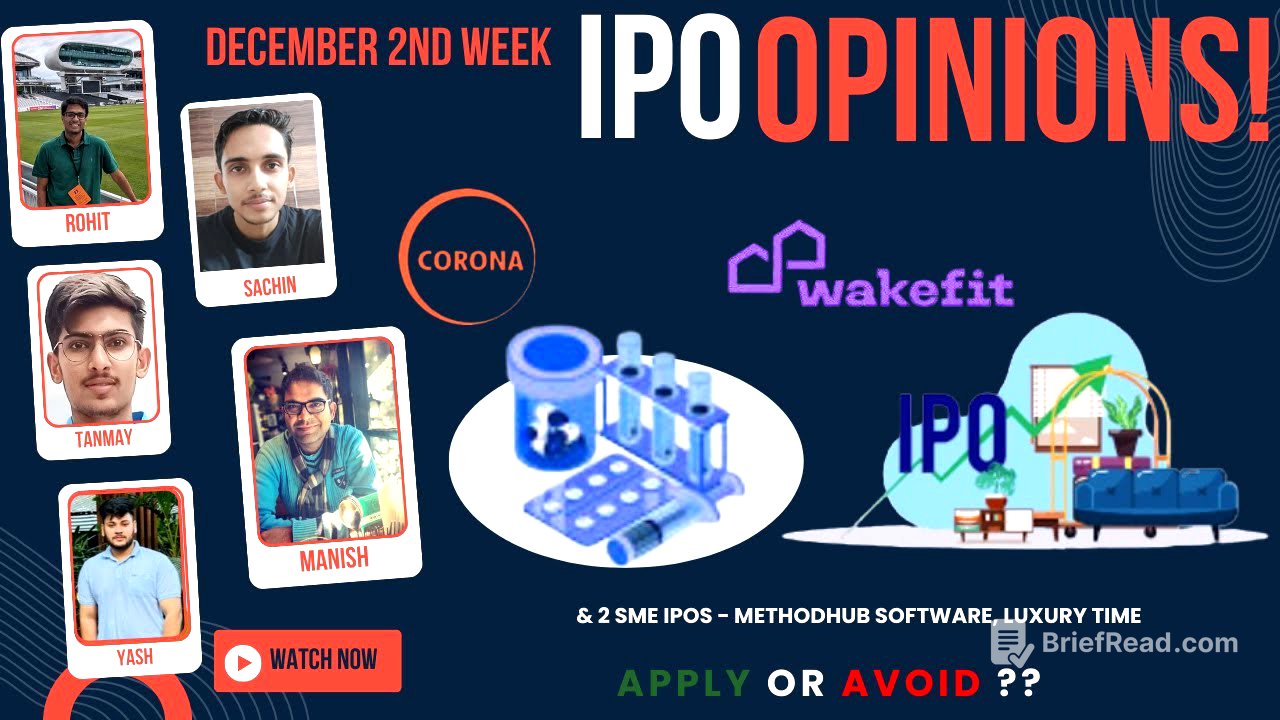
Alright, so this is a summary of Sunday Investing's IPO reviews for the second week of December. They're covering four companies: two SMEs (Methodhub Software and Luxury Time) and two mainboard IPOs (Corona Remedies and Wakefit). They talk about the business, financials, and give their opinion on whether to apply or not. Remember, this is not financial advice, do your own research!
- Methodhub Software: IT services, Sachin is bullish due to projected growth and anchor investors.
- Luxury Time: Luxury watch distributor, small IPO, short-term gains possible but long-term growth is a question mark.
- Corona Remedies: Pharma company, Tanmay feels growth is a concern, so valuations seem high.
- Wakefit: D2C home and sleep solutions, Rohit is neutral, not very exciting compared to peers.
Opening Remarks [0:00]
The host welcomes everyone to the Primary Market Chatter by Sunday Investing, focusing on IPOs for the second week of December. They mention some travel disruptions due to Indigo, hoping everyone is safe. They'll be discussing four companies: two SMEs and two mainboard IPOs. They remind everyone that they are not SEBI registered analysts, so do your own due diligence. They also encourage viewers to subscribe to their YouTube channel and watch promoter interviews for unfiltered insights. They won't be covering KB Toys due to a conflict of interest.
Methodhub Software (SME) [2:58]
Methodhub Software, incorporated in 2016, is an IT service provider offering next-gen business solutions for digital transformation. It's a ₹103 crore IPO with ₹88 crore fresh issue and ₹15 crore OFS. The market cap is ₹366 crores. FY25 revenue is ₹136 crores and PAT is ₹11.5 crores, suggesting a PE of around 30-32. Sachin reviews the company, mentioning they offer offshore IT services to foreign MNCs, including cloud work, AI automation, and cyber security. They have offices in multiple locations including Bangalore, Chennai, Hyderabad, Atlanta, and Canada.
Sachin notes that 40-45% of revenue comes from banking and finance, 30-35% from telecom, and the rest from healthcare and oil & gas. FY23 revenues were ₹36 crores, jumping to ₹58 crores in FY24 with a 10% EBITDA margin. FY25 saw ₹136 crores revenue with 12.5-13% EBITDA. They've signed LOIs for acquisitions in California and Dallas, expected to add 30-40% revenue in the second half of the year. IPO proceeds will be used for these acquisitions, costing around ₹65-70 crores. The breakup of IPO fund usage isn't very detailed to avoid hampering negotiations with acquisition targets. Promoter holding is low, around 27-28% post-IPO. Sachin believes the IPO price is projected well and expects some listing pop, so he would personally apply.
Luxury Time (SME) [16:22]
Luxury Time Limited, incorporated in 2008, is involved in distribution, marketing, retailing, and after-sales service of Swiss luxury watches, along with watch-related tools. It's a small ₹17 crore IPO, with ₹14 crore fresh issue and ₹3 crore OFS. Market cap is ₹68 crores. FY25 revenue is ₹61 crores and PAT is ₹4.3 crores, putting it at 15-16 times FY25 earnings. The lead manager is GYR Capital. They are exclusive distributors for Tag Heuer and other brands.
The company has 70+ points of sale nationwide and two service centers in Delhi and Bombay. They operate monobrand boutiques in Mumbai and Bangalore in JV with Ethos. 70% of their business, which is around ₹40 crores, comes from Tag Heuer watches, with Ethos being a major client. They plan to expand into tier 2 and tier 3 cities with 4 new stores, using IPO money for CapEx and working capital. FY24 topline was ₹50 CR with ₹2 CR bottom line. FY25 topline was ₹60 CR. The business is seasonal, with H2 being stronger.
The speaker notes that Luxury Time is trading at 15 times earnings, while Ethos is at 84 times. He believes there's a possibility of it being cornered and going to the moon. He's reluctant to hold it long-term due to growth concerns, but sees short-term gains due to the valuation gap with Ethos. He would apply, hoping for allotment, but it's expected to be difficult due to the small IPO size.
Corona Remedies (Mainboard) [31:29]
Corona Remedies, incorporated in 2004, is a pharma company involved in developing, manufacturing, and marketing products in women's health, cardiology, pain management, and urology. They have 71 brands. It's a ₹655 crore IPO, entirely OFS. Market cap is ₹6500 crore. FY25 topline is ₹1209 crore and PAT is ₹150 crore, making it 45 times FY25 earnings. The lead managers are JM Financial, IIFL, and Kotak.
Tanmay reviews the company, noting that women's health contributes 28% of revenue, cardio-diabetes 23%, pain management 12%, and urology 4.5%. They acquire family of brands from large MNCs, like Admiral from Sanofi. They have facilities in Gujarat and Himachal Pradesh, running at 95% and 75-80% utilization, respectively. 30% of products are manufactured by third parties. FY23 topline was ₹884 crore, FY24 was ₹1015 crore, and FY25 was ₹1196 crore.
Tanmay feels growth is a concern, as capacity utilization is high and growth is expected to be around 14-15% for FY26. He also mentions that Chris Capital will eventually offload its stake, creating an overhang. He believes value creation will be limited in the short to medium term. He suggests applying for small listing gains if you can take the risk, but he's not convinced with the company.
Wakefit (Mainboard) [47:24]
Wakefit Innovation, incorporated in 2016, is an Indian D2C home and sleep solutions company, known for mattresses, furniture, and home decor. They sell across 700 districts. It's a ₹1289 crore IPO, with ₹375 crore fresh issue and ₹900 crore OFS. Market cap is ₹6300 crore. FY25 topline is ₹1205 crore and PAT is negative ₹35 crore.
Rohit reviews the company, mentioning they started as a mattress company copying the Casper model. They've expanded into other furniture categories. Mattresses are now 60% of their business. They've evolved into an omni-channel presence with their own stores and multi-brand outlets. They own the full stack, with five factories handling manufacturing and logistics. They are mass premium segment.
Rohit notes that mattress segment growth is slowing, and most growth is coming from new categories and offline stores. They have 125 stores and plan to double the count with IPO proceeds. 40% of their business comes from offline. Furniture has high gross margins (55-60%), but is asset-heavy and operationally intensive. He estimates they'll do about ₹4.2 times this year's sales. He's neutral on the company, not very exciting compared to peers. He feels the Diwali bump in H1 won't be there in H2.
Closing Remarks [1:03:24]
The host summarizes that they've covered the four companies. They won't be covering KB Toys. They plan to do another space towards the end of the week to discuss companies closing on the 12th. They thank everyone for joining and encourage them to follow the Sunday Investing Twitter account for updates and IPO reviews. They wish everyone happy IPOing.