TLDR;
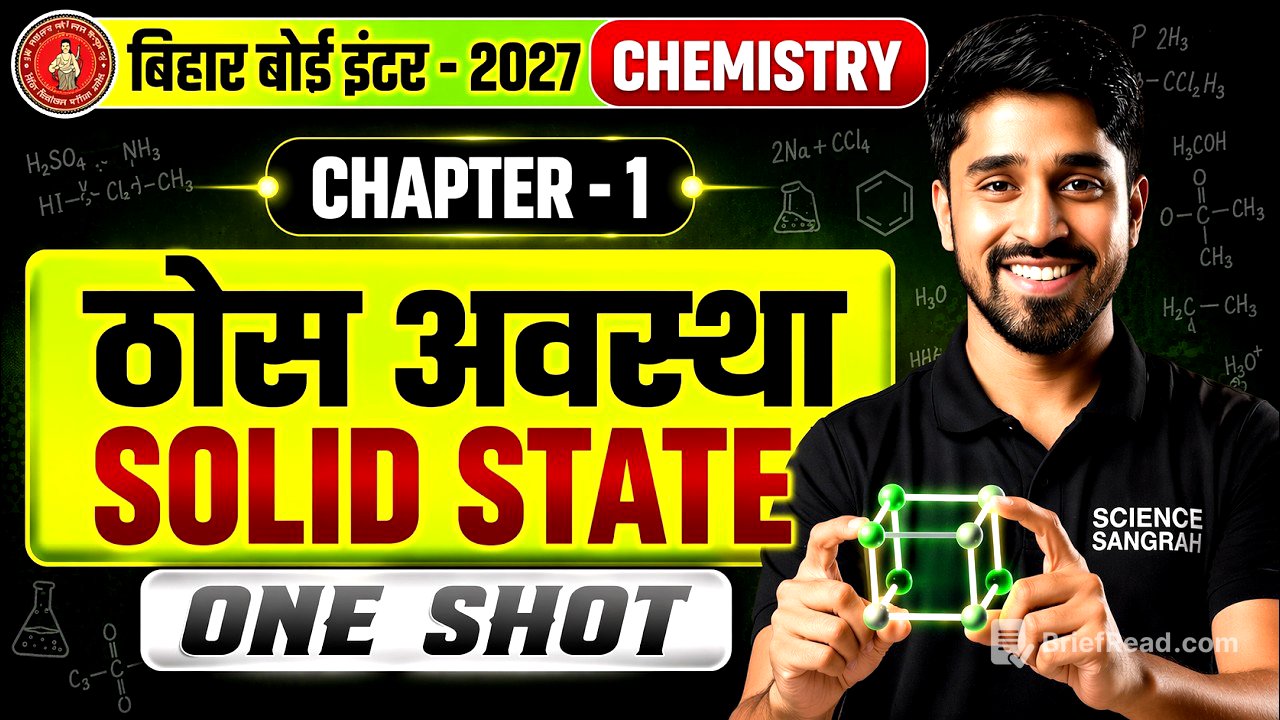
In this video, the presenter, Anu Sir, covers the first chapter of Class 12 Chemistry, focusing on the solid state of matter. He explains various important concepts regarding the properties, structures, and classifications of solids which are crucial for board exams.
- Solid states include unique atomic arrangements leading to distinct properties.
- Classifications of solids include crystalline and amorphous based on their arrangement of particles.
Introduction and Overview [0:00]
Anu Sir welcomes students and introduces the key topic: the solid state of matter from Class 12 Chemistry, emphasizing its importance for board exams. He expresses confidence in covering the chapter comprehensively and encourages students to actively participate.
Concept of Matter and Its States [1:40]
The discussion begins with the definition of matter, explaining its existence in three states: solid, liquid, and gas. The classification of substances is based on physical and chemical properties, further explaining pure substances and mixtures.
Solid State Characteristics [5:00]
Explaining the solid state, Anu Sir discusses how particles are closely packed with minimal empty space and move with limited freedom. He highlights that solids have a definite shape and volume due to the strong interatomic forces.
Types of Solids [10:00]
The chapter reviews different types of solids – crystalline and amorphous. Crystalline solids have a regular arrangement of particles, resulting in specific geometric shapes, while amorphous solids lack a defined structure.
Lattice Structure and Unit Cells [15:00]
Anu Sir introduces the concept of the unit cell as the smallest repeating structure in a crystal. He explains types of unit cells: simple cubic, body-centered cubic (BCC), and face-centered cubic (FCC), detailing their arrangements and coordination numbers.
Coordination Numbers and Density [20:00]
The coordination number, which describes the number of nearest neighboring atoms or ions surrounding a particular atom, is discussed in detail. He explains how density is calculated for different unit cells and the implications of different packing efficiencies.
Defects in Crystals [30:00]
The video explains defects in crystals, including point and line defects. Anu Sir refers to Schottky defects where equal numbers of cations and anions are missing and Frenkel defects where an ion leaves its position, creating a vacancy.
Magnetic Properties of Solids [40:00]
Anu Sir elaborates on how magnetic properties arise from electron movement and alignment in solids. He categorizes solids into diamagnetic, paramagnetic, ferromagnetic, and anti-ferromagnetic based on their response to a magnetic field.
Concluding Remarks on Solid State [50:00]
The session wraps up with a final overview of all concepts covered, encouraging students to comment and interact for clearer understanding. Anu Sir emphasizes the importance of the solid state chapter for board exams and the upcoming classes.