TLDR;
This video talks about the reality of compound interest and how it's not a magical shortcut to wealth, especially when starting with small amounts. It emphasizes that compound interest is slow in the beginning and only becomes powerful when you have a significant amount of money invested. The key takeaways are to focus on consistently saving and increasing your income, rather than chasing high returns, and to understand that building wealth through compound interest is a long-term game that requires patience and discipline.
- Compound interest is slow initially and requires a substantial principal to show significant returns.
- Consistency and increasing contributions are more important than chasing high returns, especially in the early stages.
- Building wealth is a long-term game that requires patience, discipline, and a focus on steadily increasing your investments.
The Uncomfortable Truth About Compound Interest [0:00]
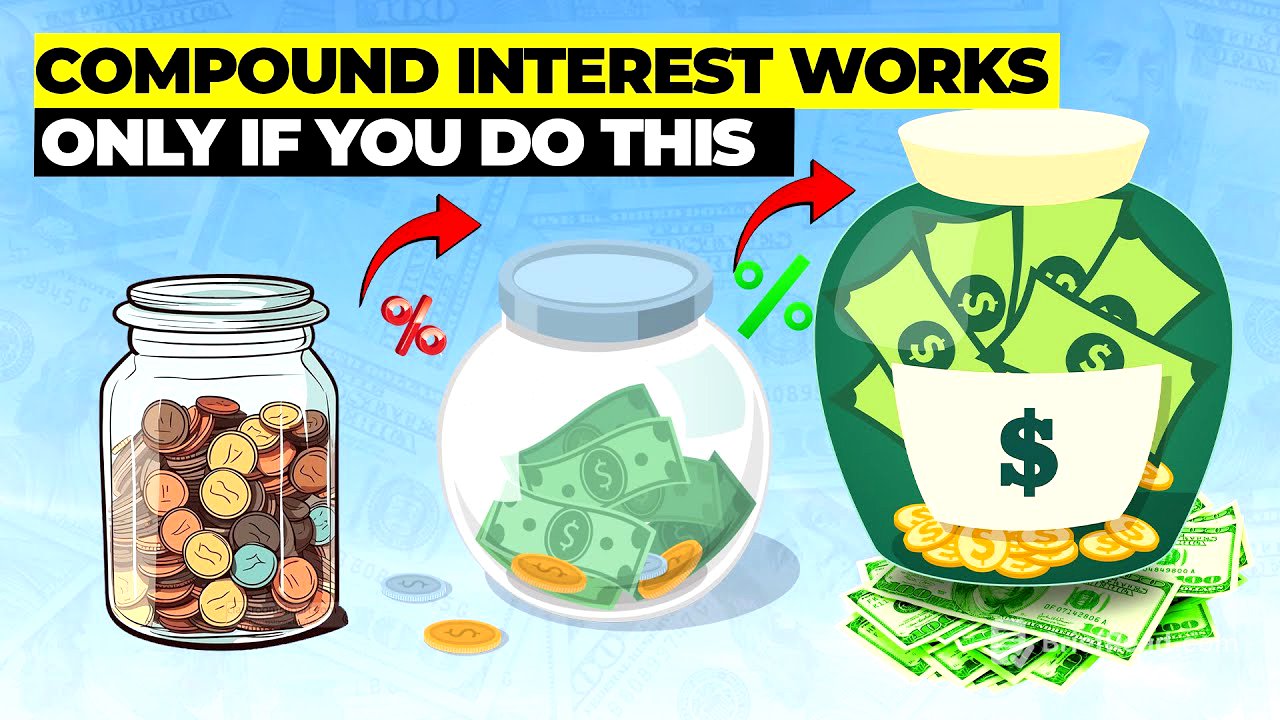
The video starts by saying that compound interest is often portrayed as a magical force that turns small amounts of money into a fortune over time. However, the reality is that compound interest only becomes effective when a decent amount of money is involved, and it doesn't happen overnight. While it sounds great on paper, it's actually one of the slowest ways to build wealth, especially if you're starting with small amounts. The idea is that your money earns interest, and then that interest earns interest, but the compounding effect only becomes powerful when the invested amount is large enough to produce meaningful results.
The Math Behind the Magic [0:00]
To illustrate this point, the video uses an example of investing $100 at a 10% annual return, which yields only $10 after a year. This amount is not life-changing. However, if you apply the same 10% return to $100,000, you get $10,000 in a single year, which makes a significant difference. The video highlights that when you're starting out, the math can be discouraging because the growth feels slow and insignificant. Many people give up at this stage because they don't see immediate results.
The Snowball Effect [0:01]
The video explains that the snowball effect of compound interest doesn't kick in until years later, and only if you keep adding to it. For example, investing $1,000 at an 8% annual return will only yield around $2,158 in 10 years, a gain of just over $1,000. This is not enough to retire on or even cover significant expenses. However, if you invest $100,000 at the same 8%, it grows to over $215,000 in 10 years, a profit of $115,000. The starting amount makes all the difference, which is why compound interest truly works when you're playing with big numbers.
The Rich Get Richer [0:01]
The video points out that one of the reasons the rich get richer is because they already have money, which allows their money to do the heavy lifting. Someone with a $1 million portfolio earning 7% a year makes $70,000 annually without touching the principal, while someone starting with $1,000 earning 7% makes only $70 a year. Compound interest is not a shortcut to riches but a reward for already having money or consistently building towards that point.
Planting Seeds [0:01]
The video suggests approaching compound interest like planting seeds. If you plant one seed, it might take years to grow into something useful. But if you plant dozens, water them regularly, and wait patiently, you'll eventually have a garden full of fruit. In financial terms, this means saving aggressively, increasing your income, keeping your expenses low, and investing consistently. Compound interest works best when paired with consistency because it's a multiplier that needs something to multiply.
The Power of Consistency [0:02]
The video illustrates the power of consistency by showing that investing $200 every month for 30 years at an 8% average return results in around $280,000. Doubling that to $400 a month results in over $560,000. The amount you invest over time is more important than the interest rate, especially in the early stages. Contributions matter more than returns until your account is bigger.
Growing the Pile [0:02]
The video advises that the focus shouldn't just be on earning 1% more or chasing higher returns, but on growing the pile. Getting that base amount high enough for the returns to actually matter. Someone earning 5% on $500,000 makes $25,000 a year, while someone chasing 15% returns on $1,000 might only make $3,000, even if they succeed. The wealthy can afford to be boring with their investments because the math is already working in their favor.
Starting from Zero [0:03]
If you're starting from zero, the video advises starting where you are and making a plan to grow from there. Don't expect miracles from a $50 investment, but understand that every dollar is a brick. Your job is to lay one solid brick at a time. You don't need a high salary to start, just discipline. If you're making $1,000 a month and saving 10%, that's a good start. As your income grows, increase that percentage to 20%, 30%, or even more if you can. The faster you build your principle, the sooner compound interest starts working in your favor.
The Long Game [0:03]
The video concludes by emphasizing that early growth is mostly just you putting money in, and that's okay. The "working for you" part comes later. Eventually, the snowball starts rolling, and it'll feel like it came out of nowhere. If you've been doubting whether it's worth it to invest while you still feel broke, the answer is yes, but not for fast results. You're building a system that rewards your future. Every dollar saved now is buying time later, and that's what true wealth really is: time, peace of mind, and choices. Compound interest gives you more freedom if you let it. The key is to be patient and consistent, rewarding the steady rather than the flashy. Even starting small puts you ahead of most people because most people never start at all. You don't need to get rich overnight, just stay in the game long enough for the math to finally tip in your favor. That's when things start compounding: not just your money, but your confidence, your discipline, and your financial freedom.