
TLDR;
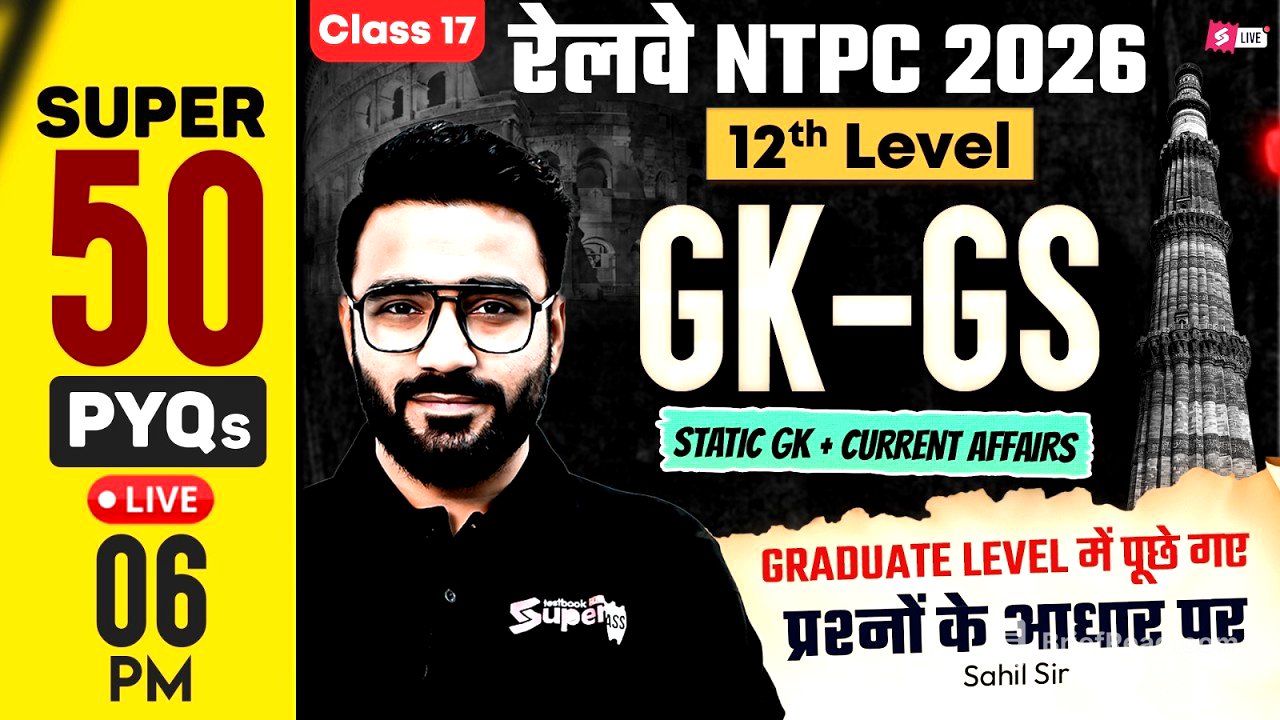
Namaste everyone! This class is for all the students preparing for the NTPC Under Graduate exam. The first 25 questions are from previous NTPC Under Graduate exams, followed by a superfast revision of 2500 important MCQs. The class also includes discussion on important days and themes, current affairs, and static GK. Also, there is information about the Varadan batch, which includes live and recorded classes, topic-wise current affairs, mock tests, practice questions, and study notes.
- Discussion on previous year questions
- Important days and themes
- Information about Varadan batch
Introduction [0:04]
Namaste and welcome to all the students. This class is specially for students preparing for the NTPC Under Graduate exam. The class will continue until your NTPC Under Graduate exam is over, covering exams in May and June. Let's start the class without any delay with the first question.
Rivers Flowing West to East [0:46]
Most of the major peninsular rivers in India flow from west to east, but there's an exception. Which pair of rivers flows from east to west, emptying into the Arabian Sea? The answer is Narmada and Tapi. Other rivers like Godavari, Krishna, and Kaveri flow into the Bay of Bengal.
100% Solar Energy Powered Assembly [2:32]
Which is the only assembly in India that runs on 100% solar energy? The answer is Delhi Assembly. The new CM of Delhi is Miss Rekha Gupta. The Delhi Assembly is also 100% paperless, with all work being done digitally.
World Toilet Day [3:46]
On which day does the United Nations observe World Toilet Day annually? The answer is November 19th. Remember to memorize important days and their themes from January to April of this year and December and November of last year. The theme for World Toilet Day 2025 is "Sanitation in a Changing World."
Asia Power Index 2025 [5:32]
In the 2025 Asia Power Index, which country was at number three? The answer is India. The US was at number one, followed by China at number two. India was previously the fourth-largest economy, but according to a recent IMF report, it has fallen to the sixth position. The top five countries in the Asia Power Index are the US, China, India, Japan, and Russia.
Quantum Diamond Microscope [7:31]
Which group at IIT Bombay developed the Quantum Diamond Microscope in November 2025? The answer is P Quest Group. If you're preparing for NTPC Under Graduate, attend the 1:00 PM current affairs class on the SSC Testbook channel. India has launched a National Quantum Mission to develop quantum computing, and the chosen startup is Q Pi AI. P Quest is a group within IIT Bombay that created the first indigenous Quantum Diamond Microscope, led by Professor Kasturi Shah.
Thousand Pillar Temple [9:35]
Which dynasty is associated with the Thousand Pillar Temple, also known as the Rudreshwara Temple? The answer is the Kakatiya Dynasty. The Kohinoor diamond is historically linked to the Kakatiya Dynasty. Alauddin Khilji acquired the Kohinoor diamond from the Golconda mines after attacking the Kakatiya Dynasty. The diamond was later given to Dalhousie by Dilip Singh in 1849 during the Second Anglo-Sikh War. The Rudreshwara Temple is located near Warangal, Telangana, and was built during the reign of King Rudradeva in 1163.
Self Employment Program for Rural Poor [11:49]
Which of the following programs aims at self-employment for the rural poor? The answer is Deendayal Antyodaya Yojana. This scheme, launched in 2011 under the National Rural Livelihood Mission (NRLM), focuses on providing self-employment opportunities to reduce poverty in rural areas.
Global Economic Expansion in 2027 [13:51]
According to the World Economic Outlook report by the International Monetary Fund (IMF), what is the expected global economic expansion in 2027? The answer is 3.2%. The World Economic Outlook is released by the IMF.
Allocation of Seats in Rajya Sabha [15:04]
Which schedule of the Indian Constitution deals with the allocation of seats in the Rajya Sabha? The answer is the Fourth Schedule. The First Schedule deals with the Union and its territories (Articles 1-4). The Second Schedule deals with salaries and emoluments. The Sixth Schedule deals with other scheduled areas, specifically in the North East states.
Institution Formed by Pandit Birju Maharaj [16:21]
Which institution was formed by Pandit Birju Maharaj? The answer is Kala Ashram. Pandit Birju Maharaj is a well-known figure in Kathak. Other famous names associated with Kathak include Sitara Devi, Shambhu Maharaj, Lachhu Maharaj, and Durga Lal. Kathak is a classical dance form from Uttar Pradesh.
First Indian Woman to Receive Ashok Chakra [17:35]
Who was the first Indian woman to receive the Ashok Chakra? The answer is Neerja Bhanot. The Ashok Chakra is awarded for bravery. It was first introduced in 1952. Recently, Sudhanshu Shukla, an Indian Air Force captain, became the first Indian to visit the International Space Station and was awarded the Ashok Chakra in 2026. This mission is preparation for India's Gaganyaan mission, where three astronauts will be sent into space.
Types of Weathering [19:22]
Which type of weathering is primarily responsible for the karst landscape? The answer is chemical weathering. Karst topography is formed due to chemical weathering, where water containing chemicals erodes the soil, creating underground gaps and cave-like structures.
Pradhan Mantri Fasal Bima Yojana [21:05]
Under the Pradhan Mantri Fasal Bima Yojana, what is the maximum premium rate paid by farmers for annual commercial and horticulture crops? The answer is 5%. For Kharif crops, it is 2%, and for Rabi crops, it is 1.5%. In this scheme, if the government provides any subsidy to the farmers, the center and state share it 50-50 for normal states and 90% by the center and 10% by the state for North East and Himalayan states.
Swaraj is my Birthright [23:44]
Which leader famously declared, "Swaraj is my birthright, and I shall have it"? The answer is Bal Gangadhar Tilak. Remember important slogans like "Karo ya Maro," "Jai Hind," and "Inquilab Zindabad."
Article Related to Maternity Relief [24:26]
Which article of the Indian Constitution deals with humane conditions of work and maternity relief? The answer is Article 42. Articles 36 to 51 cover the Directive Principles of State Policy (DPSP), and there's a high chance of a question from this section in your exam. Article 41 mandates the state to secure the right to work and education. Article 48 talks about protecting wildlife and forests, and Article 44 discusses the Uniform Civil Code.
Difference Between Spreadsheet and Word Processing Software [25:57]
What is the difference between spreadsheet software and word processing software? The answer is that spreadsheet software allows calculations using formulas, while word processing software does not. Both allow changing font and size.
Amendment Related to India and Bangladesh Border [27:37]
Which amendment is related to changing the border between India and Bangladesh? The answer is the 100th Amendment. Memorize amendments from 100 to 106, as a question may appear in the exam. Recently, the 131st Amendment Bill was introduced in the Indian Parliament but was not passed.
Primary Objective of Ultra Mega Power Projects [28:48]
What is the primary objective of Ultra Mega Power Projects? The answer is high-capacity coal-based power plants. The 131st Amendment Bill failed, which included delimitation and women's reservation. Women's reservation is already passed under the 106th Amendment, but delimitation is required for its implementation.
Deen Dayal Upadhyaya Grameen Kaushalya Yojana [30:32]
What is the main objective of the Deen Dayal Upadhyaya Grameen Kaushalya Yojana? The answer is to provide skills to people in villages. "Kaushal" means skills, so the scheme aims to provide skills to help people progress.
Chhau Dance [31:29]
In which state is the Chhau dance found? The answer is Jharkhand. In 2010, Chhau was added to the UNESCO Intangible Cultural List. There are three types of Chhau: Purulia Chhau (West Bengal), Saraikela Chhau (Jharkhand), and Mayur Bhanj Chhau (Odisha).
Global Gender Gap Index 2025 [32:07]
In the 2025 Global Gender Gap Index, what was India's rank? The answer is 131.
Regulating Act 1773 [32:28]
Which act was enacted by the British Parliament to regulate the administration of British East India Company territories in India, especially Bengal? The answer is the Regulating Act of 1773. The post of Governor of Bengal was later changed to Governor-General of Bengal under this act.
Sustainable Development Goals [33:51]
What is the primary purpose of Sustainable Development Goals (SDGs) National Indicator Framework? The answer is to monitor national-level progress of the 17 Sustainable Development Goals. The United Nations, established in 1945 with its headquarters in New York, created these 17 goals.
Right to Information Act 2005 [34:56]
Which of the following statements is incorrect regarding the Right to Information Act 2005? The answer is "The Central Information Commission is a constitutional body." The Right to Information is a fundamental right under Article 19(1)(A). The Central Information Commission is a statutory body, not a constitutional one.
Polaroid Glass in Photographic Cameras [37:14]
Why are Polaroid glasses used in photographic cameras? The answer is to control the intensity of polarization. They help control reflection from water or glass surfaces.
Superfast Revision - Villages in India [38:15]
Approximately how many villages are there in India? The answer is 6,43,000.
India's Rank in Total Area [39:06]
What is India's rank in terms of total area? The answer is seventh.
Land of Five Rivers [39:16]
Which state is known as the "Land of Five Rivers"? The answer is Punjab.
Indian Standard Time Meridian [39:28]
The Indian Standard Time (IST) meridian does not pass through which of the following states? The answer is Maharashtra. It passes through UP, MP, Chhattisgarh, Odisha, and Andhra Pradesh.
Southernmost Point of India [39:51]
The southernmost point of India, Indira Point, is located in which of the following places? The answer is Great Nicobar.
State Sharing Border with Bhutan [40:09]
Which Indian state does not share its border with Bhutan? The answer is Meghalaya. Assam shares a border with Bhutan, but Meghalaya does not.
Geographical Zones of India [40:33]
Into how many geographical regions can India be divided? The answer is six: the Himalayas, the Indo-Gangetic plains, the desert, the Peninsular plateau, the coastal regions, and the islands.
Part of Shivalik Hills [41:01]
The Shivalik hills are part of which of the following? The answer is the Himalayas. The sequence is Karakoram, Ladakh, Zaskar, Kailash range, Greater Himalayas, Pir Panjal, Dhauladhar, and then Shivaliks.
Highest Peak of Peninsular India [41:51]
Which is the highest peak of the Indian Peninsula? The answer is Anaimudi. Kanchenjunga is the highest peak in India.
Western Ghats in Maharashtra and Karnataka [42:14]
The Western Ghats in Maharashtra and Karnataka are known by what name? The answer is Sahyadri.
Objective Resolution [42:48]
When was the Objective Resolution introduced? The answer is December 13, 1946. Jawaharlal Nehru introduced it. Who was the President of the Constituent Assembly at that time?
First Speaker of Constituent Assembly [43:44]
Who was the first Speaker of the Constituent Assembly? The answer is GV Mavalankar, also known as the Father of the Lok Sabha. Dr. Rajendra Prasad was the first elected and permanent chairman of the Constituent Assembly.
Sessions for Making of Indian Constitution [44:38]
How many sessions were conducted for the making of the Indian Constitution? The answer is 11 sessions. It took 2 years, 11 months, and 18 days to complete the task.
Chairman of the Provincial Constitution Committee [45:08]
Who was the chairman of the Provincial Constitution Committee of the Constituent Assembly? The answer is Sardar Vallabhbhai Patel. His statue in Gujarat is the world's tallest statue, standing at 182 meters near the Narmada River and the Sardar Sarovar Dam.
Fundamental Rights in Indian Constitution [45:46]
The idea of fundamental rights in the Indian Constitution was taken from which country? The answer is the USA. The idea of fundamental duties was taken from the USSR.
National Flag Adopted [46:09]
When was the National Flag adopted by the Constituent Assembly? The answer is July 22, 1947.
Federal Feature of Indian Constitution [46:29]
Which of the following is a federal feature of the Indian Constitution? The answer is the division of power. Federalism means the division of power.
Indian Constitution Implemented [47:54]
When was the Constitution of India implemented? The answer is January 26, 1950. Constitution day is celebrated on 26 November 1949.
First Woman President of Indian National Congress [48:24]
Who was the first woman to become the President of the Indian National Congress? The answer is Annie Besant. Sarojini Naidu became the President of Congress in 1925 and was the first Indian woman to hold the position.
Official Languages in Indian Constitution [49:35]
In which schedule of the Indian Constitution are the official languages or 22 languages given? The answer is the Eighth Schedule.
Information About Varadan Batch [50:22]
Information about the Varadan Batch, which includes live and recorded classes, topic-wise current affairs, 2900 mock tests, 10,000 practice questions, and study notes. The batch will cover polity in three classes, history in three classes, geography in two classes, economy in two classes, static GK in three classes, and current affairs in four classes. Use the coupon code AVS to get the batch for ₹149. Classes start on April 20th at 9:00 PM. The batch also includes test series for NTPC Under Graduate, current affairs, GK, and science, as well as notes for reasoning, math, computer, general studies, general science, static GK, and current affairs. The topics will be covered by May 6th, with classes on Saturdays and Sundays. There will be a break for three days, followed by 10 more classes based on the topics appearing in the exam. The batch is useful for NTPC, Group D, and SSC exams.


![Polity Revision for UPSC Prelims | 50 Most Important Topics | How to revise for Polity [ Part -3]](https://wm-img.halpindev.com/p-briefread_c-10_b-10/urlb/aHR0cDovL2ltZy55b3V0dWJlLmNvbS92aS9KR3Fzb3o4UUZHZy9ocWRlZmF1bHQuanBn.jpg)