TLDR;
This training focuses on the inchworm theory of self-improvement, emphasizing performance ranges instead of static levels. Key takeaways include:
- Performance varies from A-Game (best) to C-Game (worst), and improvement requires attention to both ends of this range.
- The approach involves identifying strengths and weaknesses systematically to enhance overall performance.
The Inchworm Theory [0:00]
The nachch:
- Self-improvement involves fluctuating performance rather than a constant level of ability. The inchworm theory, formulated by Jared Tendler, suggests that individuals operate within a performance range defined by their best (A-Game) and worst behaviors (C-Game).
- Understanding this range enables individuals to assess their growth over time by focusing on highs, lows, and averages, rather than just seeking new peaks.
Why Self-Improvement Feels So Inconsistent [0:42]
- People often experience periods of high achievement and drastic lows, leading to confusion about their progress.
- Recognizing the range helps clarify that an exceptional performance is a capability rather than a consistent outcome. Progress can occur even if new highs are not attained, as long as least performances improve.
Your A-Game vs. Your C-Game [1:35]
- The A-Game involves focused, disciplined actions while the C-Game includes setbacks like procrastination and impulsive decisions.
- Awareness of both games can enhance self-regulation and promote development across various areas of life.
Why Your Performance Will Always Fluctuate [4:18]
- Performance consistency is influenced by stress, sleep, emotions, and context, leading to inevitable fluctuations.
- Understanding these influences can help management of lows by ensuring that one's worst performance remains more acceptable over time.
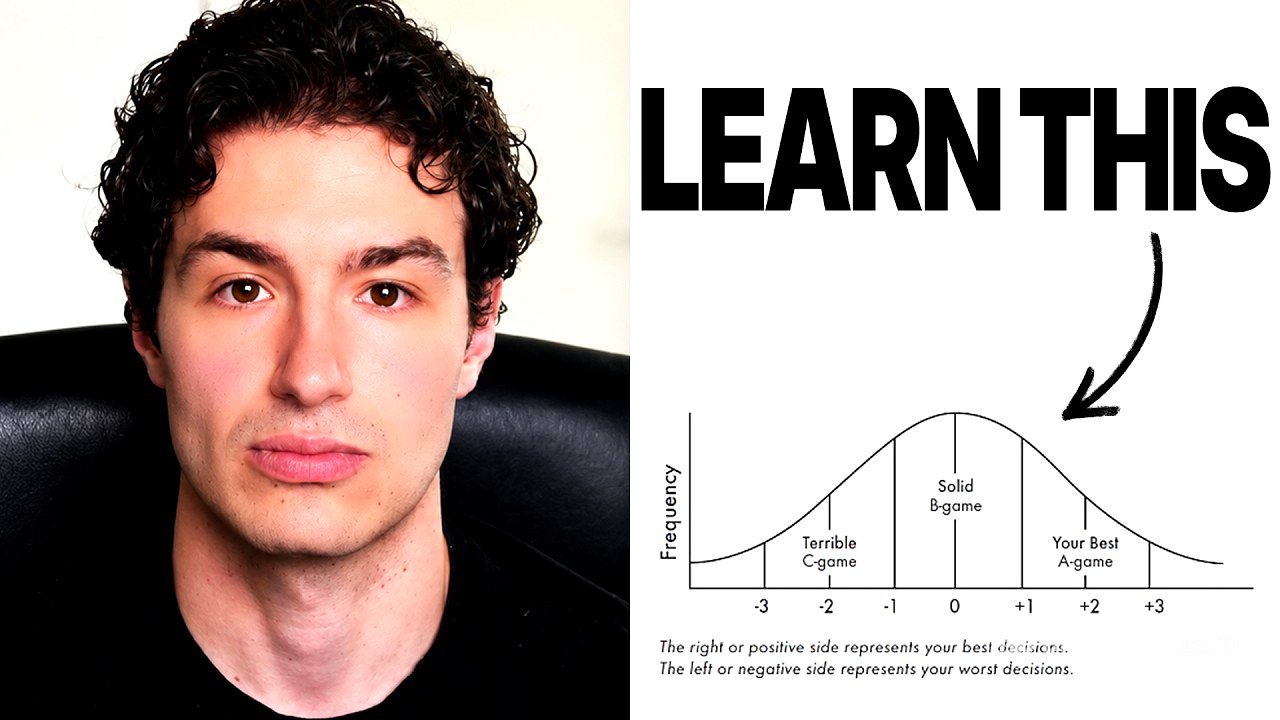
The Performance Bell Curve [5:05]
- Performance typically follows a bell curve where most efforts cluster around the average rather than at extremes.
- This highlights the importance of developing a broader average performance instead of solely chasing exceptional performances.
Why a New Peak Isn't a New Normal [6:54]
- Achieving a peak performance doesn't establish a new baseline; it requires the ability to reproduce that performance consistently.
- The goal is to ensure that improvements are maintainable and not just fleeting breakthroughs.
The Two Jobs of Self-Improvement [8:33]
- Self-improvement involves two tasks: advancing the A-Game by learning and pushing boundaries, and elevating the C-Game by eliminating destructive habits.
- This dual focus leads to sustainable growth and resilience.
Map Your Current Performance Range [11:22]
- Individuals should identify their specific A and C game behaviors with measurable actions rather than vague labels.
- This understanding helps to pinpoint areas of improvement and sets a foundation for further development.
How to Expand Your A-Game [13:42]
- Expansion of one’s A-Game happens through consistent exposure to new challenges, refining skills, and striving to achieve higher standards.
- This can involve stepping outside of comfort zones to identify limitations and potential for growth.
Knowledge Only Matters When Behavior Changes [15:30]
- Gaining knowledge becomes effective only when it translates into behavioral changes.
- Practical application of newly acquired knowledge helps solidify the foundations of self-improvement.
Test Your Performance Under Pressure [17:18]
- It is essential to practice skills in challenging situations to determine whether they hold up under pressure.
- Assessing performance in these scenarios reveals how effectively one can manage stress and obligations.
The Trap of Constantly Chasing New Highs [18:03]
- Continual pursuit of new highs can lead to neglecting the underlying weaknesses that hinder consistent performance.
- It is crucial to balance striving for peaks with focusing on strengthening the foundation of one's capabilities.
How to Raise Your C-Game [21:37]
- Improving the C-Game involves recognizing patterns of negative behaviors and proactively working to mitigate their effects.
- This can include tactics for shortening the time spent in a lower performance state.
Why Recovery Speed Matters [23:34]
- Rapid recovery from poor performances is a sign of progress; the aim is to minimize the intensity and duration of setbacks.
- It is essential to develop habits that facilitate quick rebounds after difficult experiences.
Identify Your Triggers and Warning Signs [24:45]
- Understanding personal triggers for poor performance allows individuals to create actionable responses that prevent a full regression into their C-Game.
- Early recognition can facilitate timely interventions to mitigate negative impacts.
Build Habits That Survive Bad Days [25:32]
- Developing basic routines that remain effective during challenging times is vital for maintaining consistent performance levels.
- These habits should not be dependent on peak mental states to be executed effectively.
The C-Game Flaw Audit [27:57]
- An audit of C-Game behaviors helps individuals identify recurring flaws that hinder growth.
- Pinpointing specific actions that lead to setbacks provides clarity for targeted improvement.
How to Compress Your Performance Range [30:34]
- Compressing the performance range involves shrinking the gap between top performances and low performances.
- This leads to more consistent overall results as both ends improve simultaneously.
Build Your Own Self-Improvement Cycle [34:51]
- Establishing a personalized cycle of self-improvement allows for ongoing growth by continually redefining A-Game and C-Game targets.
- This cycle helps prevent stagnation while ensuring that personal progress is well monitored.
Review + Action Items [36:54]
- The review process synthesizes all training points, leading to concrete action items for ongoing personal development.
- Identifying behaviors from recent successes and failures allows individuals to establish clear, achievable targets for improvement.