TLDR;
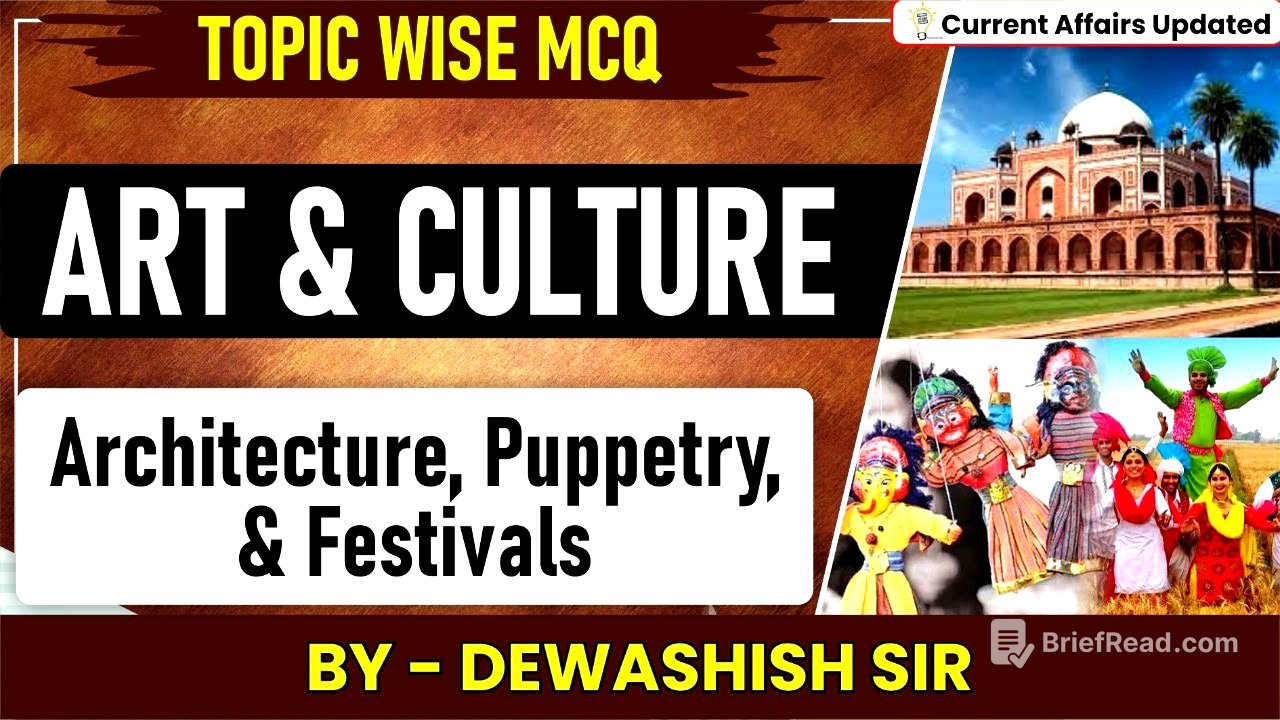
Okay, so this video is basically about discussing some important questions related to Indian art, architecture, and culture for competitive exams. Devaishish Awasthi sir is guiding aspirants on how to approach these questions, especially previous year questions from UPSC. Key takeaways include understanding temple architecture styles, locations of important archaeological sites, and the importance of physical and mental health for aspirants.
- Focus on previous year questions.
- Understand temple architecture and archaeological sites.
- Maintain physical and mental health.
Introduction and Recap [0:00]
The video starts with a quick sound check and a recap of the previous session. Sir mentions that due to a power issue, the last lecture was incomplete, so he'll be finishing it today. He also mentions about the availability of notes and test series for aspirants, which can be accessed through their application.
Discussion on Panchayatana Style and Lingaraj Temple [2:54]
Sir starts discussing previous year questions, beginning with the Panchayatana style of temple architecture. He asks viewers to recall the answer from the previous lecture. Then, he moves on to a question about the Lingaraj Temple in Bhubaneswar, asking which statements about it are correct.
Archaeological Sites and Temple Locations [5:26]
Sir discusses the location of the Tabo Monastery in Himachal Pradesh and its significance. He then asks about the correct matching of historical sites like Ajanta, Mount Abu, and Udayagiri caves with their respective dynasties or locations. He explains that Udayagiri caves are in Madhya Pradesh, correcting a common misconception.
Identifying the Earliest Archaeological Site [10:33]
Sir poses a question about identifying the earliest archaeological site among the given options, which includes Lingaraj Temple, rock-cut elephant at Dhauli, monuments at Mahabalipuram, and the Varaha image at Udayagiri. He emphasizes the importance of knowing the locations of these sites, like Dhauli in Odisha.
Matching Historical Sites with Regions [12:21]
Sir presents a question that involves matching historical sites like Khajuraho and Bodh Gaya with their respective regions such as Bundelkhand and Baghelkhand. He explains how Bodh Gaya is in Bihar, not Baghelkhand, which is in Madhya Pradesh.
Monuments Near the Yamuna River [14:35]
Sir asks which monuments are located near the Yamuna River. He mentions that the Taj Mahal is located on the banks of the Yamuna and discusses other monuments in Agra.
Comparing Ajanta and Mahabalipuram [15:43]
Sir discusses the similarities between Ajanta and Mahabalipuram in terms of art and architecture. He asks viewers to identify the correct statements about these sites, focusing on their religious affiliations and construction periods.
Rock-Cut Caves and Ancient Dynasties [17:53]
Sir presents a question about the rock-cut cave architecture, asking which statements are correct regarding the Barabar caves and Ellora caves. He clarifies that the Barabar caves were originally meant for Ajivikas during the reign of Chandragupta Maurya and later associated with Ashoka.
Identifying Incorrect Temple Locations [20:57]
Sir asks viewers to identify the temple that is incorrectly matched with its location. He discusses the Omkareshwar temple and clarifies that it is a Shiva temple, not a Sun temple.
Temples in Kerala [22:59]
Sir asks which of the given temples are located in Kerala. He mentions the difficulty in remembering all temple locations and suggests using elimination techniques.
Takshashila and its Excavation [24:42]
Sir discusses Takshashila as an important center of learning and asks who excavated it. He mentions Alexander Cunningham and John Marshall, highlighting John Marshall's role in Indian archaeology.
Puppetry and its Forms [26:06]
Sir discusses various forms of puppetry, such as Yamapuri, Kathputli, and Rod Putli, and their respective states. He clarifies that Kathputli is from Rajasthan, not Bihar.
Chausath Yogini Temple [29:31]
Sir discusses the Chausath Yogini Temple in Madhya Pradesh and its resemblance to the Indian Parliament building. He shows an image of the temple and confirms that both statements about its design and location are correct.
Features of South Indian Temples [31:05]
Sir asks which of the given features is not a characteristic of South Indian temples. He clarifies that depictions of Ganga and Yamuna are not typical of South Indian temple architecture.
Matching Architectural Features with Sites [33:14]
Sir presents a match the following question, pairing architectural features like stupas, chaityas, and temples with their respective locations such as Sanchi, Devgarh, and Khajuraho.
Sher Shah Suri's Reforms [34:32]
Sir discusses the reforms introduced by Sher Shah Suri, including the revival of the Dag and Chehra system and the introduction of gold coins. He clarifies that Sher Shah Suri introduced copper coins, not gold coins.
Group of Monuments at Hampi [37:07]
Sir asks about the Group of Monuments at Hampi and which statements are correct regarding their construction and UNESCO World Heritage status.
Architectural Styles and UNESCO World Heritage Sites [39:21]
Sir discusses the Nagara school of architecture and its features. He also asks about the smallest UNESCO World Heritage City in India, clarifying that it is not Orchha but Gwalior.
Classical Languages of India [42:21]
Sir touches upon the classical languages of India, listing Tamil, Telugu, Sanskrit, Kannada, and Malayalam.
Conclusion and Future Plans [43:23]
Sir concludes the session and asks viewers for feedback on whether to start a monthly current affairs series in question format. He emphasizes the importance of staying positive and maintaining physical and mental health during challenging times. He also shares success stories of students from his regular courses. He plans to start the current affairs series from July.