TLDR;
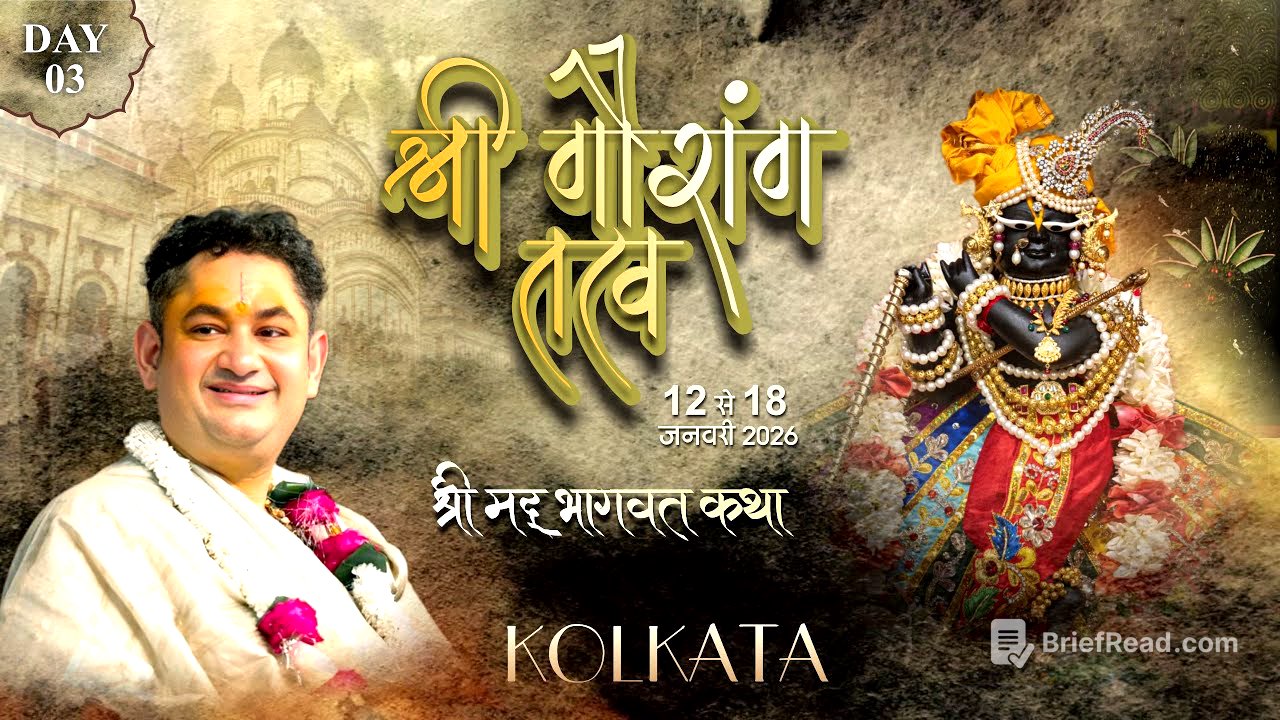
Alright, so Maharaj Sri Pundrik Goswami is giving a katha on Srimad Bhagavatam. He talks about how to listen to the katha, the importance of a guru, and how to make your heart pure. He also shares some stories and bhajans. Key takeaways include:
- Katha should illuminate, not just influence.
- Focus on solutions, not problems.
- Control your senses and mind.
- The importance of a guru who shows you Hari.
- Vrindavan is special, and one should chant "Radhe Radhe" there.
हरि हराय नमः (संकीर्तन) [0:00]
The video starts with a beautiful Hari Kirtan, chanting the names of Krishna, Hari, and the Goswamis. The kirtan emphasizes surrendering to the Goswamis, who can remove obstacles and grant devotion. It also talks about the importance of chanting "Radha Krishna" and taking shelter of Vrindavan.
यजमान जी व सभी श्रोताओं का स्वागत [22:11]
Maharaj welcomes everyone to the katha, praising the organizers and the beautiful decorations. He says the audience is fortunate to be there, regardless of where they are sitting. Those in front are like Dauji, enjoying the katha directly, while those in the back are like Kanha, climbing on Yashoda Maiya's shoulders for a different kind of bliss.
श्रीकृष्ण यशोदा मैया के कंधे पर चढ़ते [26:12]
Maharaj narrates a sweet pastime of Krishna climbing on Yashoda Maiya's shoulders. He explains that just like Krishna, those sitting at the back are also enjoying a special kind of bliss. There is no high or low in the katha; everyone is equal and immersed in divine love.
कथा में पीछे बैठने वाले को रस ज्यादा मिलता है [27:46]
Maharaj jokes that those sitting in the front have to listen, but those in the back can relax and enjoy the essence of the katha even more. The people in front only see the Vyaspeeth, but those in the back see both the speaker and the listeners.
कथा में प्रवेश करने के बाद सब वैष्णव हैं [29:24]
Once you enter the katha, everyone is a Vaishnav, regardless of their background. The listener is even greater than the speaker in terms of Bhagavad Prapti. Hearing is the first step in bhakti.
श्रोता भगवद प्राप्ति में व्यास से बड़ा कैसे? [30:12]
The speaker explains that the listener is greater than the speaker in terms of Bhagavad Prapti. The speaker's work is to help others, and Thakurji will repay that. In bhakti, shravan bhakti (hearing) comes first.
कथा प्रभावित नहीं करती [31:25]
Maharaj explains that katha shouldn't just "influence" you, because influence is temporary and can come from many things like decorations or food. True katha should "illuminate" you. If you are getting influenced, it means you lack something that you see in others.
काला और सफेद रंग क्या दर्शाता है? [35:42]
Maharaj explains the symbolism of black and white. Black represents exclusivity, while white represents availability. That's why lawyers wear black and doctors wear white. Krishna is exclusive, not everyone can understand him, but Radharani is available to all.
राधे तेरे चरणों की (पद) [37:41]
Maharaj sings a beautiful bhajan about Radharani's feet. He says that even a speck of dust from her feet can change your destiny.
महाराजजी के सामने व्यास पीठ पर नरसिंह भगवान क्यों विराजते हैं? [42:13]
Maharaj explains why Narasimha Bhagwan sits on the Vyaspeeth in front of him. He says that Sridhar Swami wrote the first commentary on the Bhagavat, and Narasimha Dev himself dictated it to him.
भागवत कौन कौन जानता है? [43:41]
Maharaj explains that Vyas, Sukhdev, and Sridhar Swami know the Bhagavat. Sridhar Swami's commentary is so important that Chaitanya Charitamrita says that anyone who doesn't accept it shouldn't be accepted.
श्रीरंगपट्टनम नरसिंह भगवान का हाथ ऊपर कैसे हुआ? [44:49]
Maharaj narrates a story about the Narasimha deity in Srirangapatnam, whose hand is raised. It is said that when the Kambha Ramayana was recited in front of the deity, Narasimha Dev raised his hand in approval. Narasimha doesn't appear when a pillar breaks, but when pride breaks.
प्रभाव कैसा होता है? [47:33]
Maharaj explains the difference between being influenced and being truly transformed. Being influenced is like putting gold plating on something; it can wear off. True transformation is like the process of making real gold, which takes years.
एक व्यक्ति ने 3 लाख नाम जप का नियम लिया [51:08]
Maharaj shares a story about a man who was influenced by a katha and decided to chant 3 lakh names every day. However, after a week, he started making compromises and eventually gave up the practice. This shows how influence is temporary.
जप को digitalised मत करो [52:26]
Maharaj advises against using digital counters for japa. He says that Maya comes through machines. Japa should be done with tulsi beads, which represent Vrindavan. If you can't use a mala, you can use kar mala (counting on your fingers).
अग्रिम दिवस का क्रम [54:25]
Maharaj announces the schedule for the next day, including Ganga snan at Dakshineshwar Ghat at 6:30 AM. He jokes about a devotee who thought they would die during Vishnu Sahasranama, as Bhishma Pitamah did.
हास्य [58:32]
Maharaj jokes about how people start making excuses for not chanting properly after being influenced initially. He shares a story about a devotee who started chanting "Ha Krishn" instead of "Hare Krishna" to complete his quota faster.
कथा प्रभावित नहीं प्रकाशित करती है [59:38]
Maharaj reiterates that katha should illuminate, not just influence. If you are getting influenced, it won't last long. He shares a story about a woman who had heard the Bhagavat 118 times but still hadn't changed.
गुरु,प्रभाव देखकर ना बनाएं [1:04:01]
Maharaj says that you shouldn't choose a guru based on influence. Choose someone who shows you Hari. He narrates an incident about Pundarik Vidyanidhi, who appeared to be living luxuriously but was actually a great devotee.
पुंडरीक विद्यानिधि जी का प्रसंग [1:05:38]
Maharaj narrates the story of Pundarik Vidyanidhi. Gadadhar Pandit doubted him because of his opulent lifestyle, but when Pundarik Vidyanidhi showed intense ecstatic symptoms during a kirtan, Gadadhar realized his greatness and later took diksha from him.
साधु सोना बना देता है [1:09:19]
Maharaj says that a true sadhu makes your heart gold, not just gold-plated. Bhagavat purifies the heart. He explains that Hanuman is pleased when Rama is glorified.
Why से निकलकर how पर जाओ [1:12:26]
Maharaj says that there are two types of people: those who get stuck on "why" and those who focus on "how." Parikshit Maharaj didn't get stuck on "why" he was cursed; he focused on "how" to manage it.
Problem में न फंसकर solution ढूंढिए [1:15:57]
Maharaj says that getting stuck on problems doesn't lead to progress. You should focus on solutions. He shares a story about a king who turned a deserted island into a paradise.
स्वर्ग से देवता अमृत लेकर आए [1:17:36]
Maharaj explains that Parikshit didn't ask to avoid death. Even the devtas came with amrit. Long living is not a great thing, happy living is a great thing.
आपके कर्म ही आपका future तय करते [1:19:39]
Maharaj says that your actions determine your future. He shares a story about a kingdom where a person could be king for a year, but after that, they would be left on a deserted island. A sadhu became king and developed the island so that it became a paradise.
षट्तिला एकादशी पर 6 विकारों का त्याग करें [1:25:18]
Maharaj explains the significance of Shattila Ekadashi. He says that you should give up the six vices: kama (lust), krodha (anger), lobha (greed), moha (illusion), mada (pride), and matsarya (envy).
कथा में कैसे बैठें व क्या विचार करें? [1:29:04]
Maharaj gives instructions on how to sit in the katha. He says to find a comfortable position, control your senses, and merge your elements with the elements of Vrindavan.
कथा व्यास कोई साधारण मनुष्य नहीं [1:37:19]
Maharaj explains that the Vyas is not an ordinary person. He becomes one with the universe. He knows what is going on in everyone's mind.
अपात्र रस को भंग कर देता है [1:39:16]
Maharaj says that even one unqualified person can ruin the rasa of the katha. He shares a story about Srivas Thakur's mother-in-law, who was secretly watching the kirtan and ruined the mood.
राधारमण जी मानसी दर्शन [1:41:01]
Maharaj describes the process of having darshan of Radharamanji. He says that you should first have darshan of the Vaishnavas, then Tulsi Maharani, and then Radharaman Lal.
चांद सा सलोना (पद) [1:42:20]
Maharaj sings a beautiful bhajan describing the beauty of Radharamanji.
सबकी अपनी अपनी गंध होती है [1:51:36]
Maharaj explains that everyone has their own unique fragrance, which comes from their thoughts. Those with awakened kundalini have a lotus-like fragrance.
ब्रज में भगवान मिलना बड़ी बात नहीं [1:54:54]
Maharaj says that meeting Bhagavan in Braj is not a big deal. Meeting a sant is a big deal.
तू है सखी बड़भाग (पद) [1:56:18]
Maharaj sings a line from a bhajan, "Tu hai sakhi badbhag, Nandlal tere ghar aavat hai ri."
ब्रज में संत मिलना बड़ी बात [1:57:27]
Maharaj says that in Braj, you should associate with rasik saints. Eat the remnants of the Brajwasis.
उद्धव ब्रज से आए [1:58:58]
Maharaj describes how Uddhav came to Braj and was transformed. He used to be a great scholar, but he became a lover of Krishna.
ब्रज में सिर्फ राधे राधे बोलना चाहिए [2:01:40]
Maharaj says that in Braj, you should only chant "Radhe Radhe." Outside of Braj, you can chant other names, but within Braj, you should only chant "Radhe Radhe."
जपे जा राधे राधे (पद ) [2:03:07]
Maharaj sings a bhajan about chanting "Radhe Radhe."
एक गोपी ठाकुरजी को कूड़ा देती [2:05:17]
Maharaj narrates a story about a Gopi who offered garbage to Thakurji. She said that she had already given him her body, mind, wealth, youth, and life, so what else could she offer?
उद्धव ज्ञानी से प्रेमी बने [2:06:20]
Maharaj explains that Uddhav was a jnani (knowledgeable), but he became a premi (lover) in Vrindavan. Krishna gave him the essence of his lila.
विदुर व उद्धव वृन्दावन को कैसे देखते [2:08:37]
Maharaj explains how Vidur and Uddhav saw Vrindavan. Vidur saw Krishna's pastimes, while Uddhav cried tears of love. If you smile in bhakti, it is Krishna's grace, but if tears flow, it is Kishori ji's grace.
महाप्रभु वृन्दावन आते [2:10:19]
Maharaj says that kirtan can be done anywhere, but katha is done in seclusion. He describes how Chaitanya Mahaprabhu experienced divine love in Vrindavan.
महाप्रभु का पुरी में भाव [2:11:16]
Maharaj describes Mahaprabhu's mood in Puri. He would cry tears of separation from Krishna. His touch could melt stone.
महाराज जी ने एक पद लिखा [2:13:00]
Maharaj shares that he wrote a pad (song) one night about Jagannath. He explains the meaning of the pad, describing the various aspects of the Jagannath temple.
जगन्नाथ चकानैन (पद व्याख्या सहित) [2:16:56]
Maharaj sings the Jagannath Chakanein pad, explaining each line. He emphasizes the importance of surrendering to Jagannath.
महाराजश्री के मन में भाव कैसे आया? [2:42:59]
Maharaj explains how the bhava (feeling) for the Jagannath pad came into his mind. He says that he had a desire to write something, and Thakurji fulfilled it.
विदुर उद्धव संवाद [2:47:32]
Maharaj describes the conversation between Vidur and Uddhav. Uddhav narrated the stories of Braj to Vidur.
विदुर मैत्रेय मिलन [2:49:37]
Maharaj describes the meeting between Vidur and Maitreya. Maitreya recognized Vidur by the mark of Krishna's earring on his thigh.
सब संप्रदाय की अभिव्यक्ति अलग है [2:50:29]
Maharaj explains that all sampradayas (traditions) are good, but their expressions are different. He gives the example of a woman who loves her father, husband, brother, son, and friend, but expresses her love differently to each of them.
वराह अवतार [2:53:25]
Maharaj narrates the story of Varaha Avatar, who rescued the earth from Hiranyaksha.
वृंदावन गोविंददेवजी मंदिर पुनः स्थापित होना चाहिए [2:55:37]
Maharaj says that the Govind Dev Ji temple in Vrindavan should be re-established. It was the first temple to be attacked by the Mughals.
भारतीय समाज का विकास मंदिरों ने किया [2:56:58]
Maharaj explains that temples have played a vital role in the development of Indian society. They are centers of social and economic activity.
कपिल भगवान का आविर्भाव [3:00:58]
Maharaj narrates the story of Kapil Bhagavan, who appeared in the home of Devahuti and Kardam Rishi.
इन वेगों को नियंत्रित करें [3:02:17]
Maharaj says that you should control your senses. The most dangerous sense is the tongue.
सेठ और जिंद की कहानी [3:09:22]
Maharaj shares a story about a Seth (businessman) who bought a jinn. The jinn would do whatever he asked, but if he didn't give him work, the jinn would eat him. The Seth ran out of work, so he asked a saint for help. The saint told him to have the jinn carry a bamboo pole up and down. This is a metaphor for controlling the mind.
महामंत्र कीर्तन [3:14:58]
Maharaj leads a Hare Krishna mahamantra kirtan.
ध्रुव चरित्र [3:21:33]
Maharaj narrates the story of Dhruv, who went to the forest to get a kingdom from God. However, when God appeared, Dhruv asked for bhakti instead.
मृत्यु और निर्वाण में अंतर [3:24:03]
Maharaj explains the difference between death and nirvana. Death is for those who are attached to the world, while nirvana is for those who are detached.
मानवों की species [3:25:06]
Maharaj says that there are 4 lakh species of humans.
विज्ञान में भारतीय धर्म की भूमिका [3:26:42]
Maharaj explains that Indian science is never against dharma, and Indian dharma is never against science.
अपनी सोच बदलिए विचारों को नहीं [3:30:42]
Maharaj says that you should change your thinking, not your character. He explains that the Dashavataras show that you should upgrade your thoughts but not change your character.
अग्रिम प्रसंग [3:36:11]
Maharaj says that he was talking about Manu and his descendants.
कथा विश्राम [3:38:11]
Maharaj concludes the katha and announces that tomorrow there will be Anand at Nand's house.
जगन्नाथ चकानैन (पद) [3:39:52]
Maharaj sings the Jagannath Chakanein pad again.
आरती [3:56:14]
The video concludes with an aarti.