TLDR;
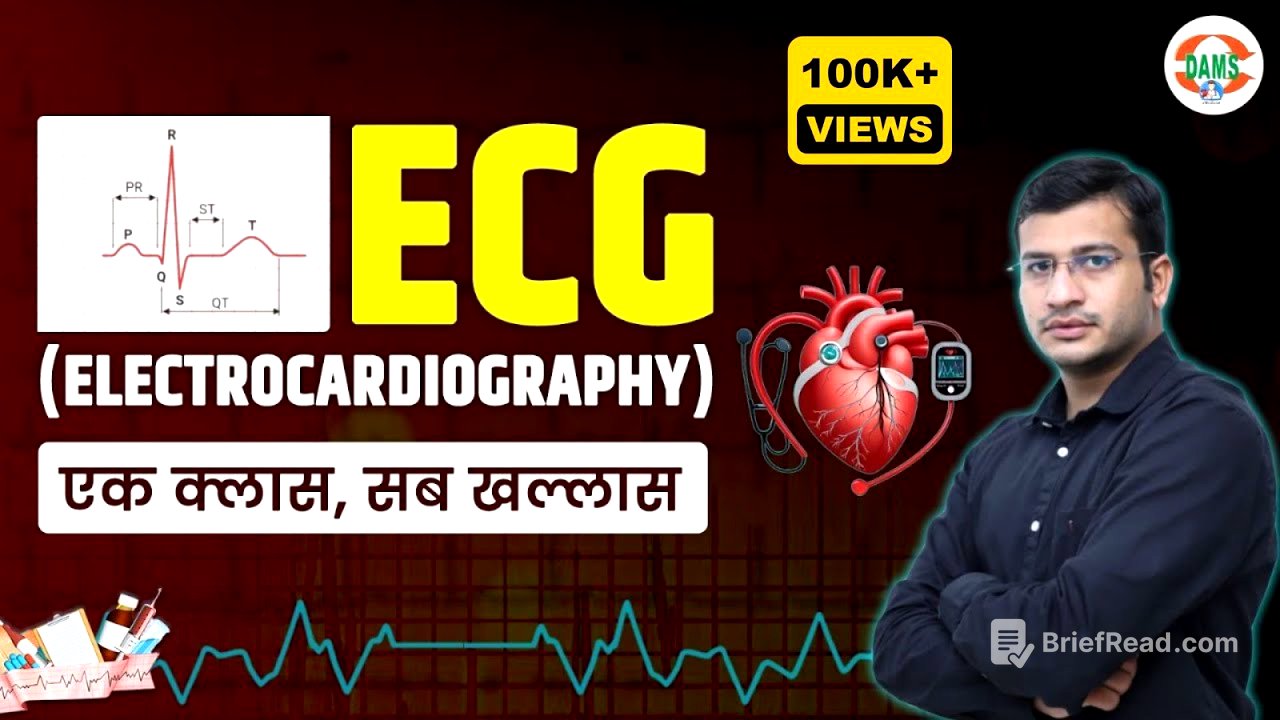
Alright, so this video is basically an ECG crash course, bhai! It starts with the basics - what ECG stands for, what the different parts of the ECG mean, and how to measure heart rate. Then, it jumps into different types of ECG readings like sinus tachycardia, bradycardia, and heart blocks. The instructor explains each condition, how it looks on an ECG, and what treatments might be needed.
- ECG basics and terminology
- Different types of ECG readings
- Treatment options for various heart conditions
Introduction to ECG [0:53]
So, ECG, matlab Electrocardiography. There are three terms used: Electrocardiography (the procedure), Electrocardiograph (the machine), and Electrocardiogram (the report). ECG helps assess abnormal heart rhythms. William Einthoven gave information about it. It works on the principle of a galvanometer.
Understanding ECG Boxes [4:56]
When you look at an ECG report, you'll see small and large boxes. A large box is 0.20 seconds, and a small box is 0.04 seconds. One large box contains five small boxes.
Decoding ECG Waves [7:34]
A normal ECG has P, QRS, and T waves. The P wave indicates atrial contraction or atrial systole/depolarization. The QRS complex indicates ventricular contraction, ventricular systole/depolarization. The T wave indicates ventricular diastole, relaxation/repolarization. The sequence of events in the heart is SA node, AV node, Bundle of His, and Purkinje fibers.
PR and RR Intervals [13:09]
The PR interval shows the time it takes for the impulse to travel from the atria to the ventricles, normally 0.12 to 0.20 seconds. The RR interval is the gap between two R waves, indicating heart rate, and is normally 0.6 to 1.0 seconds.
Calculating Heart Rate [16:16]
To calculate heart rate, if the RR interval is regular, divide 300 by the number of large boxes between two R waves, or 1500 by the number of small boxes. Alternatively, multiply the number of RR boxes by 6 seconds.
Sinus Tachycardia [20:04]
Sinus tachycardia means the heart is beating fast, more than 100 beats per minute, but the rhythm is normal. The RR interval decreases.
Sinus Bradycardia [24:10]
Sinus bradycardia means the heart is beating slowly, less than 60 beats per minute. The RR interval increases. The drug of choice is atropine sulfate.
Inspiratory Sinus Rhythm [26:34]
In inspiratory sinus rhythm, the RR interval decreases during inspiration (tachycardia) and increases during expiration (bradycardia).
Premature Ventricular Contraction (PVC) [29:36]
PVC means there's an extra QRS complex before it's due.
Premature Atrial Contraction (PAC) [33:59]
PAC means there's an extra P wave before it's due.
Atrial Flutter [41:05]
Atrial flutter is when the atria beat very fast, 250 to 400 beats per minute. The P waves have a "sawtooth" appearance. Treatment involves observation.
Atrial Fibrillation [45:11]
Atrial fibrillation is when the atria are quivering instead of contracting properly, with a rate of 350 to 600 beats per minute. The ECG shows irregular fibrillatory waves. This can cause blood clots, so treatment includes anticoagulants and cardioversion.
Ventricular Tachycardia (VT) [49:00]
Ventricular tachycardia is a fast heart rate originating in the ventricles, more than 100 beats per minute. The QRS complexes are wide and bizarre. If there's a pulse, treat with pharmacological cardioversion. If there's no pulse, defibrillate and perform CPR.
Ventricular Fibrillation (VF) [53:06]
Ventricular fibrillation is a life-threatening arrhythmia where the ventricles quiver instead of contracting. The ECG shows chaotic, irregular deflections. The treatment is immediate defibrillation.
Heart Blocks [55:43]
Heart blocks occur when the electrical signals are delayed or blocked as they travel through the heart.
SA Node Block [56:26]
In SA node block, the SA node doesn't fire properly, and the heart rate slows down to 40-60 beats per minute. The PR interval may be abnormal. Treatment involves a pacemaker.
AV Block: First Degree [58:20]
First-degree AV block is when the impulse from the atria to the ventricles is slowed down. The PR interval is prolonged.
AV Block: Second Degree - Mobitz Type I [1:01:57]
Second-degree AV block (Mobitz Type I) is when the PR interval progressively lengthens until a QRS complex is dropped.
AV Block: Second Degree - Mobitz Type II [1:05:16]
Second-degree AV block (Mobitz Type II) is when QRS complexes are dropped without progressive lengthening of the PR interval.
AV Block: Third Degree [1:07:26]
Third-degree AV block (complete heart block) is when there's no communication between the atria and ventricles. The atria and ventricles beat independently.
![If I Wanted to Become a Millionaire In 2024, This is What I'd Do [FULL BLUEPRINT]](https://wm-img.halpindev.com/p-briefread_c-10_b-10/urlb/aHR0cDovL2ltZy55b3V0dWJlLmNvbS92aS9WQm9STEppbVZ6Yy9ocWRlZmF1bHQuanBn.jpg)