TLDR;
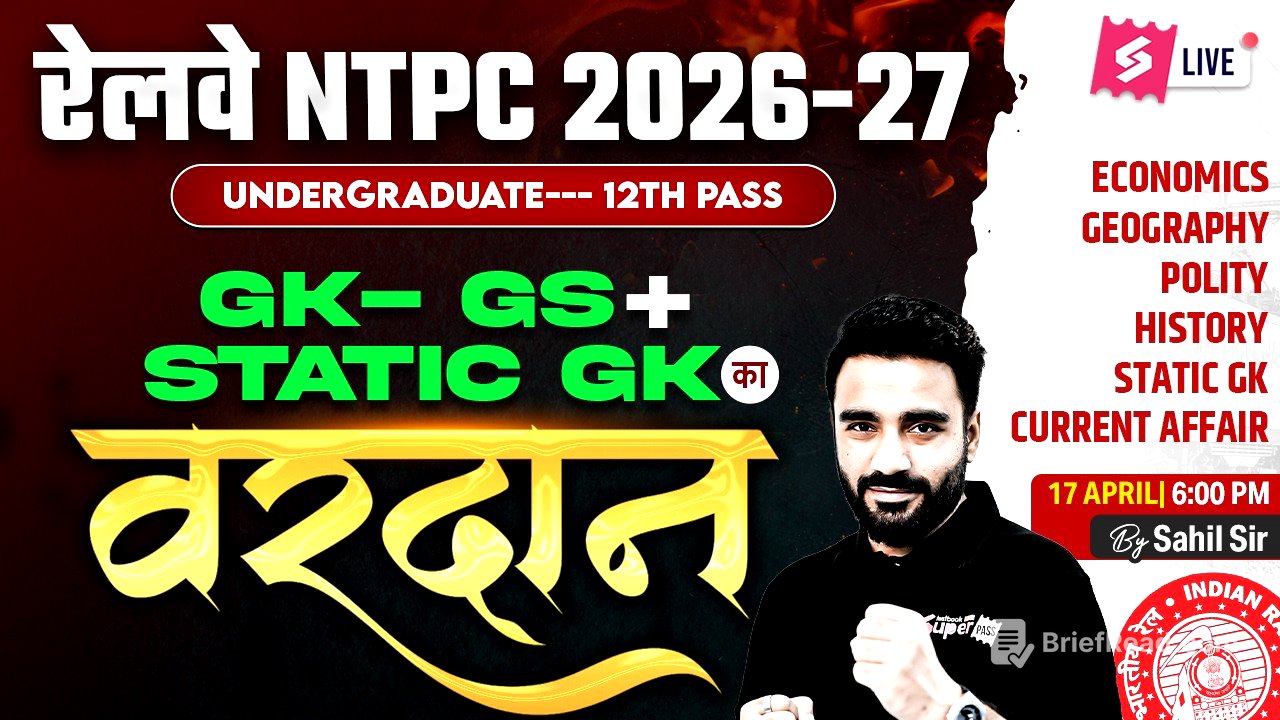
Alright, so this is a special "Vardan Class" for students prepping for NTPC Under Graduate, RRB Group D, RPF, and even SSC exams. The class covers important battles, fairs and festivals, dances, and important articles. After the class, there's a big reveal about what this "Vardan" is all about. Key points include:
- Important battles and wars with year and winner.
- Fairs and festivals of different states.
- Folk dances of different states.
- Important articles of constitution.
Introduction [0:03]
Namaste everyone! This is a special class called "Vardan Class" which is useful for students preparing for NTPC Under Graduate, RRB Group D, RPF, and SSC exams. The class will be around 30-40 minutes of study followed by an explanation of what "Vardan" is. Students are requested to share the class link on Telegram, WhatsApp, and Instagram. The class will cover important battles, fairs and festivals, dance forms (classical and folk), and important articles.
Important Battles [1:58]
The Battle of the Hydaspes between King Porus and Alexander happened in 326 BC, which Alexander won. The second Battle of Tarain happened in 1192, where Muhammad Ghori defeated Prithviraj Chauhan. In 1526, the Mughal Empire started with the first Battle of Panipat between Babur and Ibrahim Lodi, which Babur won. Ashoka won the Kalinga War in 261 BC, with Kalinga being the present-day Odisha and North Andhra Pradesh area. Babur won the Battle of Khanwa in 1527 against Rana Sanga, and the Battle of Chanderi in 1528 against Medini Rai. He also won the Battle of Ghaghra in 1529, but died in 1530. The Battle of Chausa happened in 1539, and the Battle of Kannauj (or Bilgram) in 1540. Sher Shah Suri defeated Humayun in both battles. From 1540 to 1555, the Suri Dynasty ruled. In 1555, Humayun won the Battle of Sirhind against Sikandar Suri, but died in 1556. Akbar, who was 13 years old, then took the throne. The Battle of Haldighati happened in 1576 between Akbar's army and Maharana Pratap's army. The East India Company, led by Robert Clive, won the Battle of Plassey in 1757 against Siraj-ud-Daulah, the Nawab of Bengal. After this, Mir Jafar was made the Nawab of Bengal. In 1194, Muhammad Ghori defeated Jayachand in the Battle of Chandawar. The second Battle of Panipat happened in 1556 between Akbar and Hemu, also known as Raja Hemchandra Vikramaditya. Ahmad Shah Abdali won the third Battle of Panipat in 1761 against the Marathas. The East India Company won the Battle of Buxar in 1764 against the combined forces of the Mughal king, the Nawab of Awadh, and the Nawab of Bengal. Hector Munro led the East India Company, while Mir Qasim led Bengal, Shuja-ud-Daula led Awadh, and Shah Alam II led the Mughal Empire. After this, the Treaty of Allahabad was signed between Shah Alam II and Robert Clive. The first war of Independence took place in 1857. Babur won the Battle of Ghaghra in 1529 against the remaining Lodis and Afghans. The Battle of Talikota happened in 1565. The Battle of Wandiwash, part of the Third Carnatic War, happened in 1760. Nadir Shah won the Battle of Karnal in 1739 against Muhammad Shah. The first Anglo-Sikh War happened in 1845, and the second in 1848.
Fairs and Festivals [13:45]
The Harihar Kshetra Mela is celebrated in Bihar. The Parsi community celebrates the Pateti festival, mainly in Maharashtra and Gujarat. The Kharchi Puja festival is celebrated in Tripura, while the Wangala festival is celebrated in Meghalaya, the Kangching festival in Manipur, and the Bihu festival in Assam. The Bagwal Mela is celebrated in Devidhura. The Ambubachi Festival is associated with the Kamakhya Temple in Guwahati, Assam. The Wangala festival is celebrated in Meghalaya. Yaoshang festival is celebrated in Manipur. Chapchar Kut Mela is celebrated in Mizoram. India's first floating festival was celebrated in Mandsaur, Madhya Pradesh. In 2023, India's biggest shopping festival was celebrated in Delhi. The Palki festival is celebrated in Maharashtra. The Surajkund International Mela is held in Faridabad, Haryana. The Sangai festival is a cultural festival celebrated in Manipur. The Gangasagar Mela is held in West Bengal. The Moatsu festival, along with the Hornbill festival, is celebrated in Nagaland, also known as the "Land of Festivals." The Chhath Puja, dedicated to the Sun God and his wife Usha, is most famous in Bihar but is now celebrated worldwide. The Navchandi Mela is celebrated in Meerut. The Jawa festival is celebrated in Jharkhand, along with Karma, Sarhul, Tusu, Rohini, Bhakta Parv, and Sohrai. The Khajuraho Dance Festival is celebrated in Madhya Pradesh, where the Khajuraho temples are located. The Pushkar Camel Fair is celebrated in Pushkar, Rajasthan.
Dance in India [23:37]
Bhavai folk dance is performed in Gujarat and Rajasthan. Chakkari folk dance is from Rajasthan. Jaat-Jatin folk dance is from Bihar. Lूर folk dance is from Haryana. Koli folk dance is from Maharashtra and Goa. Kolattam folk dance is from Andhra Pradesh. Sattriya classical dance is from Assam. Rouf folk dance is from Jammu and Kashmir. In 2010, Chhau dance was given the UNESCO Heritage Site status. Padayani folk dance is from Kerala. Tarangamel folk dance is from Goa. Matki dance is from Madhya Pradesh. Koya dance is from Odisha. Gormaria dance is from Chhattisgarh.
Important Articles [31:11]
The right to vote is in Article 326. Article 17 talks about abolishing untouchability. Article 23 and 24 talk about the right against exploitation. Article 26 talks about the freedom to manage religious affairs. Article 371G talks about Mizoram. Article 32 is called the "Heart and Soul of Indian Constitution" by B. R. Ambedkar and is part of Part 3. Article 52 says that there shall be a President of India. Article 164 says that the Chief Minister will be appointed by the Governor. Article 315 talks about the establishment of UPSC. Article 316 talks about the appointment of UPSC members by the President for a term of six years. Article 279A talks about the GST Council. Fundamental rights are described in Articles 12 to 35. The ordinance power of the Governor is in Article 213. The right to life is in Article 21. Equal opportunity related to public employment is in Article 16. National emergency is in Article 352. Human trafficking and forced labor are in Article 23. The right to education is in Article 21A. The Attorney General of India is appointed by the President under Article 76.
Vardan Batch [39:51]
The "Vardan Batch" is being introduced to help students crack the NTPC Under Graduate exam. The batch includes live classes, recorded classes, test series (2900 tests), practice questions (10,000), study notes, e-books (Reasoning, GK/GS, Math, Current Affairs), and previous year papers. The batch covers History, Polity, Geography, Economics, Static GK, Current Affairs, and Computer. The live classes will cover GK, GS, Static GK, and Current Affairs. The batch is available on the Railway Testbook app. To access the batch, click the link in the description of the class. The original price of the batch is ₹199, but using the coupon code "AVS," students can get it for ₹149. The batch will cover topics like Articles, Amendments, Parliament, State Legislature, Constituent Assembly, President, Vice-President, Governor, Schedules, Parts of the Indian Constitution, Fundamental Rights, DPSPs, and Fundamental Duties in Polity. History will cover Ancient, Medieval, and Modern History, Indian National Movement, Viceroys, Governors-General, Important Personalities, and Important Movements. Geography will cover the Solar System, Atmosphere, Rivers, Dams, Lakes, Agriculture, Soils, and Indian Monsoon. Economics will cover Census, Economic System, Sectors of Economy, Five-Year Plans, Inflation, Unemployment, National Income, Fiscal Deficit, Monetary Policy, Fiscal Policy, RBI, Banking, and Regulatory Bodies. Static GK will cover National Parks, Wildlife Sanctuaries, Folk Dances, Classical Dances, Fairs and Festivals, Vitamins and Diseases, Important Days, Cities on Rivers, CMs and Governors, Temples, Books and Authors, and Important Slogans. Current Affairs will cover Padma Shri Awards, Government Schemes, National Awards, Oscar Awards, Filmfare Awards, T20 World Cup, Champion Trophy, WPL, IPL, Under-19 World Cup, Women's ODI World Cup, National Games, International Summits, Union Budget, Indexes and Rankings, Books and Authors, Military Exercises, Republic Day, and Appointments. Classes will be held every night at 9:00 PM, including weekends, starting from April 20th. There will be a three-day break after May 7th, and extra classes will be conducted based on the May exams. The batch is for both May and June exam takers. The batch also includes GS 1000 Question PDF, Quant 1000 Question PDF, Reasoning 1000 Question PDF, and Current Affairs 500 Question PDF.