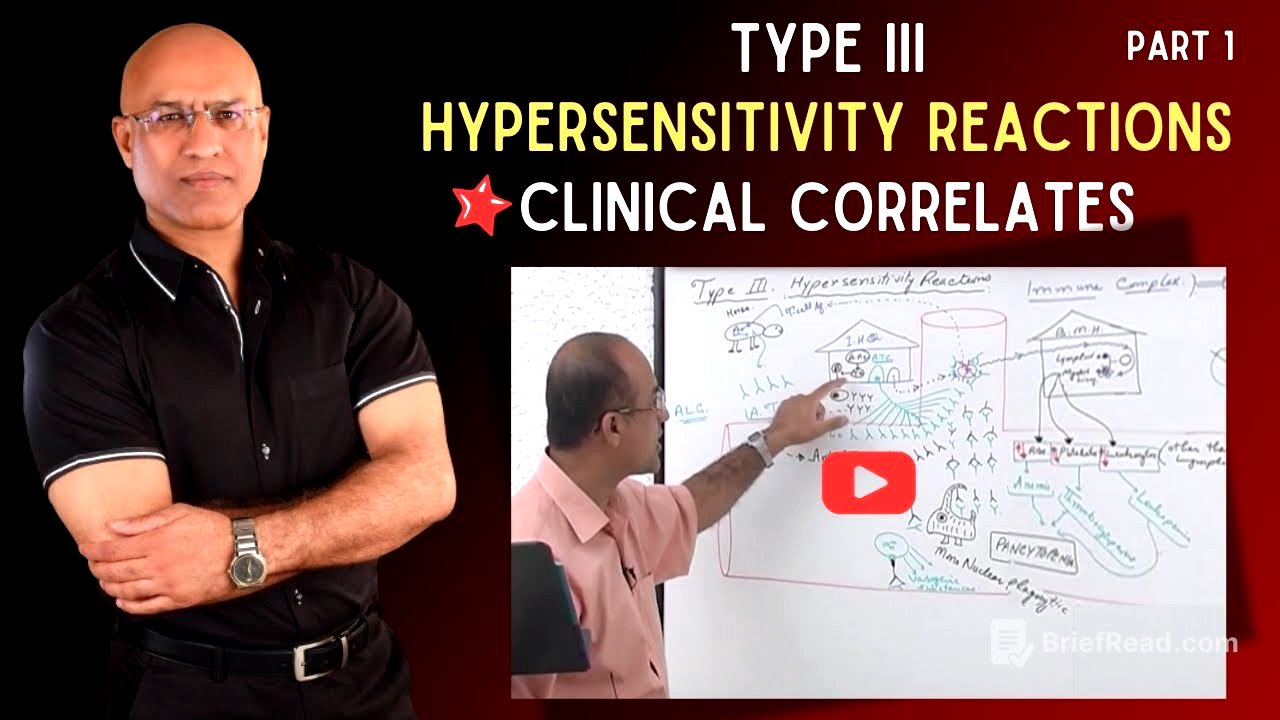
TLDR;
This lecture focuses on Type III hypersensitivity reactions, which are immune-mediated tissue damaging conditions caused by the deposition of immune complexes. Key points include:
- The basic mechanism of Type III hypersensitivity.
- A classification of these reactions, specifically generalized and localized responses.
- The clinical implications and management of Aplastic Anemia, including the use of Antithymocyte Globulin (ATG) therapy and its relation to serum sickness-like reactions.
Basic fundamentals of Type III Hypersensitivity Reactions [0:00]
Type III hypersensitivity reactions are characterized as immune-mediated tissue damaging conditions arising from the formation and deposition of immune complexes. These immune complexes initiate inflammatory responses, which can be harmful. Both free antigens and antibodies are involved in the formation of these complexes, which can deposit in various tissues and lead to inflammation in those areas.
Classification of Type III Hypersensitivity Reactions [4:10]
Type III hypersensitivity reactions are classified into generalized or systemic reactions, also known as serum sickness-like reactions, and localized reactions, referred to as Arthus reactions. Generalized reactions can result from immune complexes circulating throughout the body, while localized reactions occur at the site of the antigen-antibody complex deposition.
Overview of Generalized/Systematic Reactions [5:00]
Generalized or systemic reactions often present as serum sickness. Historically, these reactions were observed more frequently due to the use of horse serum for passive immunization. Currently, such reactions are more commonly caused by modern drugs. A detailed understanding of serum sickness, including its pathophysiology, clinical presentation, and the formation and deposition of immune complexes, is essential for recognizing and managing these reactions.
What are serum sickness-like reactions? [5:29]
Serum sickness-like reactions are characterized by multi-system inflammatory conditions arising from the administration of foreign proteins, such as drugs, rather than horse serum. Symptoms include fever, rash, and arthralgia, similar to classic serum sickness. The pathogenesis involves immune complex formation and deposition in various tissues, leading to inflammation.
Clinical presentation of a patient with Aplastic Anemia [6:46]
Aplastic Anemia is showcased as a condition where the immune system attacks the bone marrow, leading to pancytopenia—characterized by low levels of red blood cells, white blood cells, and platelets. The immune attack results in a hypocellular, or hypoplastic, bone marrow, causing severe anemia, thrombocytopenia, and leukopenia. Patients exhibit symptoms such as fatigue and increased susceptibility to infections.
What are the key considerations in managing patients with aplastic anemia? [17:49]
Management strategies for Aplastic Anemia include administering ATGs (Antithymocyte Globulins), which are animal-derived antibodies targeted against T cells. This treatment aims to reduce the immune response against bone marrow cells, allowing for recovery of hematopoiesis. Successful management can lead to improved blood cell counts and overall patient recovery.
How do Serum Sickness/Type III Hypersensitivity reactions occur? [22:17]
Serum sickness occurs when ATGs are administered, leading to the immune system recognizing these foreign antibodies as antigens. The resultant immune response can produce antibodies against the ATGs, forming immune complexes. If these complexes are not efficiently cleared, they may deposit in various tissues around 7 to 10 days post-administration, causing symptoms indicative of serum sickness.
How do ATGs trigger serum sickness-like reactions or Type III hypersensitivity reactions, and what is the detailed process behind the formation and deposition of immune complexes? [23:53]
ATGs are processed by the immune system, which perceives them as foreign proteins. Subsequent activation of T and B cells leads to the generation of antibodies against the ATGs, creating immune complexes that circulate. If these immune complexes are small or not cleared effectively, they deposit in tissues, causing inflammatory reactions. The inflammation is further exacerbated by immune responses activated by the deposited immune complexes, resulting in various clinical manifestations.