TLDR;
Alright, so this video gives a breakdown of Shakespeare's Julius Caesar for BCA third semester students. It covers the playwright, key characters, act-wise summaries, and important quotes. The play's themes revolve around power, loyalty, fate, and betrayal in the backdrop of historical Rome.
- Shakespeare's life and works are briefly discussed.
- Key characters like Caesar, Brutus, Cassius, and Antony are introduced.
- Each act is summarized, highlighting plot points and character motivations.
- Important quotes are explained in context, revealing the play's central themes.
Introduction: William Shakespeare and Julius Caesar [0:36]
The session will cover William Shakespeare, his play Julius Caesar, key characters, act-wise summary and important quotes. William Shakespeare was born on April 23, 1564, and died on the same day in 1616. He was an English playwright, poet, and actor, known as the Bard of Avon. He wrote 39 plays, 154 sonnets, and two long narrative poems. His works have been translated into every major language and are widely performed. Julius Caesar, written in 1599, is a historical tragedy based on real events in Rome. The central themes are power, loyalty, fate versus free will, and betrayal. Key characters include Julius Caesar, Brutus, Cassius, Mark Antony, Calpurnia, Portia, a soothsayer, and Octavius.
Act 1: Setting the Stage for Conspiracy [3:20]
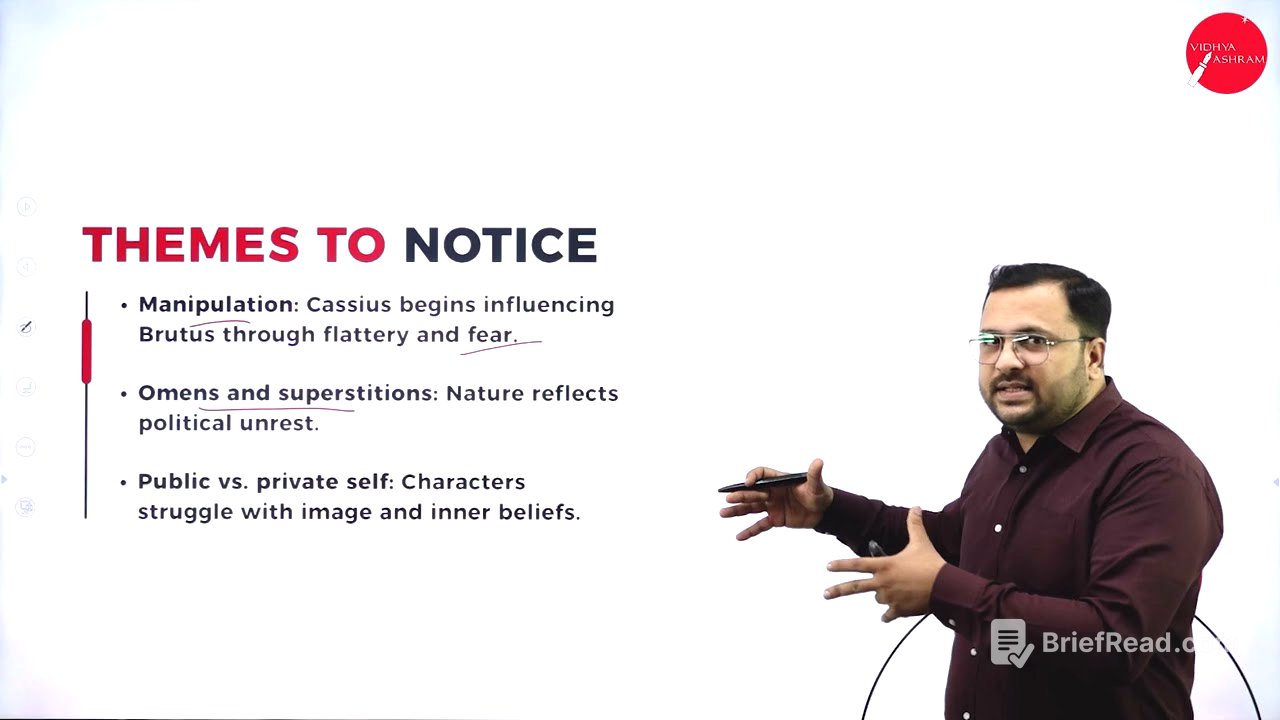
The play begins with tribunes Flavius and Marullus scolding citizens for celebrating Caesar's triumph, reminding them of their loyalty to Pompey. Rome is a democratic state where people elect representatives. Senators Flavius and Marullus are upset that people are celebrating Caesar's victory during the festival of Lupercal. In scene two, a soothsayer warns Caesar to beware the Ides of March, and Cassius begins manipulating Brutus to turn against Caesar, telling him Caesar isn't as strong as people think, recalling an incident where Cassius had to rescue Caesar from drowning in the Tiber River and when Caesar was sick in Spain. Anthony offers Caesar a crown, but Caesar refuses it three times. Caesar notes that Cassius is a silent, observant man who is always hungry-looking and dangerous. In scene three, Cassius and Casca discuss their fear of Caesar's rising power amidst a violent storm and finalize plans for the conspiracy, with Cassius planning to write letters to Brutus to convince him to act against Caesar.
Act 2: The Conspiracy Takes Shape [11:09]
Brutus struggles with his conscience, deciding Caesar must die for Rome's good and officially joins the conspiracy after reading letters planted by Cassius. He values Rome more than his friendship with Caesar. Calpurnia begs Caesar to stay home after troubling dreams of a statue of Caesar bleeding, but Decius interprets the dream positively and persuades Caesar to go to the capital. Calpurnia dreams that Caesar's statue was oozing blood and Romans were washing their hands in it, which she sees as a bad omen. Caesar initially agrees to stay home after a servant reports that a sacrificed animal had no heart. Decius Brutus, however, reinterprets the dream to mean Caesar's blood will give life to Rome. Artimedorus prepares a letter warning Caesar about the conspirators. Portia, anxious about Brutus's behavior, sends a messenger to the capital, and the soothsayer heads there to warn Caesar again.
Act 3: The Assassination and Its Aftermath [18:12]
Caesar arrives at the capital and is stabbed by the conspirators, including Brutus. Anthony appears and cleverly gains permission to speak at the funeral. Caesar rejects a letter from Artemidorus and dismisses the soothsayer's warning. Metellus Cimber petitions Caesar, but Caesar refuses, declaring his steadfastness. The conspirators then stab Caesar, with Brutus being the last, prompting Caesar's famous line, "Et tu, Brute?" Brutus gives a logical explanation for the assassination, but Antony's passionate speech sways the crowd by appealing to emotions and turning them against the conspirators. Antony reveals Caesar's will, which leaves his wealth to the people of Rome, further enraging the crowd. The mob, now out of control, kills the innocent poet Cinna simply for sharing a name with one of the conspirators.
Act 4: Forming Alliances and Growing Tensions [25:45]
Antony, Octavius, and Lepidus form a ruthless alliance and plot the elimination of their enemies, with Antony questioning Lepidus's worth. Brutus and Cassius meet after a long time, and rising tensions hint at cracks in their friendship and leadership. Brutus has understood Cassius's personal motives in killing Julius Caesar. A fierce argument erupts between Brutus and Cassius, but they reconcile emotionally after sharing their personal sorrows, including Portia's death, who committed suicide by swallowing burning coal. Brutus is later haunted by Caesar's ghost.
Act 5: The Final Battle and Tragic Endings [27:55]
Before the battle of Philippi, the leaders exchange sharp words, and Brutus and Cassius emotionally prepare for possible death. Brutus orders a surprise attack hoping to gain an upper hand against Octavius's weakened forces. Cassius, misinformed about the battle's outcome, tragically kills himself, and Titinius follows suit in grief. Lucilius sacrifices himself by pretending to be Brutus, demonstrating loyalty and bravery in battle. Defeated and weary, Brutus takes his own life, and even his enemies acknowledge his nobility and honorable intentions. Antony and Octavius acknowledge Brutus's loyalty to Rome and grant him a proper funeral.
Important Quotes from Julius Caesar [31:07]
Several important quotes from the play are discussed, emphasizing themes of betrayal, fate, power, and rhetoric.
- Act 1:
- Cassius: "The fault, dear Brutus, is not in our stars, but in ourselves, that we are underlings."
- Soothsayer: "Beware the Ides of March."
- Cassius on Caesar: "Why, man, he doth bestride the narrow world like a Colossus."
- Act 2:
- Brutus: "It must be by his death; and for my part, I know no personal cause to spurn at him."
- Calpurnia: "When beggars die, there are no comets seen; the heavens themselves blaze forth the death of princes."
- Julius Caesar: "Cowards die many times before their deaths; the valiant never taste of death but once."
- Act 3:
- Caesar: "Et tu, Brute?"
- Brutus: "Not that I loved Caesar less, but that I loved Rome more."
- Antony: "Friends, Romans, countrymen, lend me your ears."
- Antony: "You all did love him once, not without cause; What cause withholds you then, to mourn for him?"
- Act 4:
- Brutus to Cassius: "There is a tide in the affairs of men which, taken at the flood, leads on to fortune."
- Brutus: "O, Julius Caesar, thou art mighty yet! Thy spirit walks abroad."
- Act 5:
- Cassius: "This tongue had not offended so today, if Cassius might have ruled."
- Brutus: "Caesar, now be still; I killed not thee with half so good a will."
- Antony: "This was the noblest Roman of them all."