TLDR;
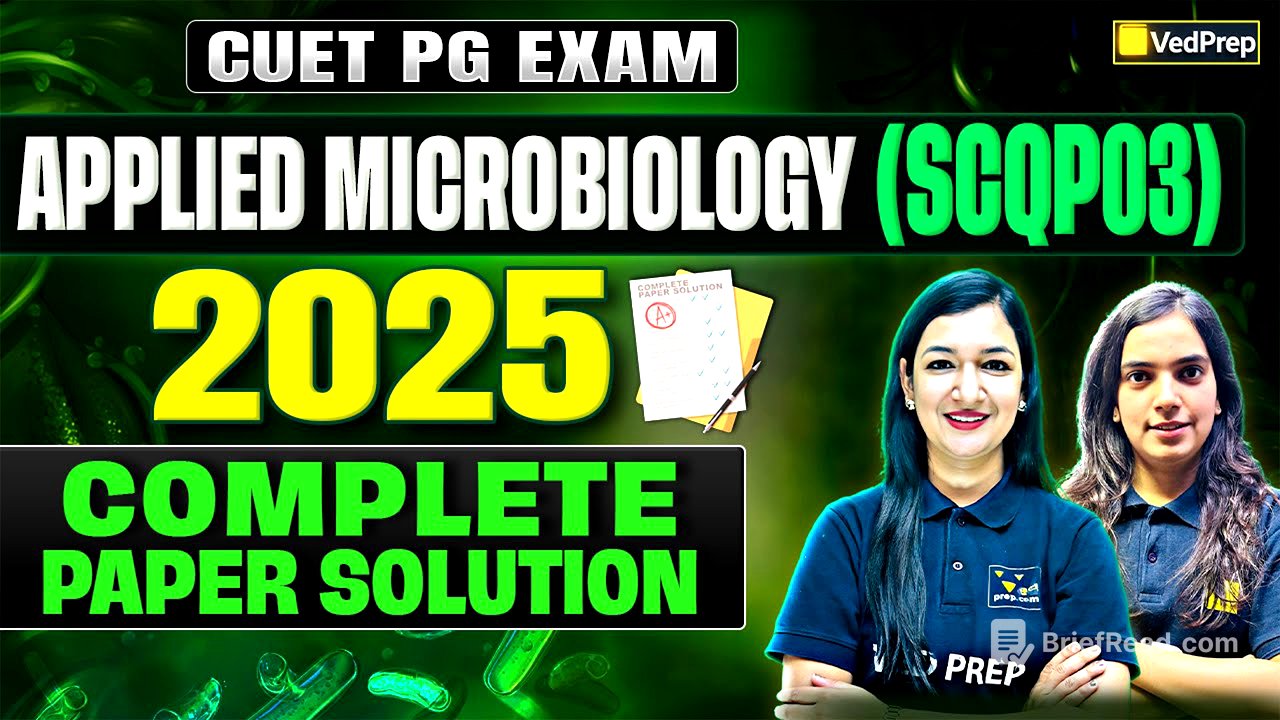
Alright, folks, let's break down this CUET PG 2024 Applied Microbiology paper (ACQP03). The speaker goes through all 75 questions, pointing out a few potential errors by NTA that you might wanna challenge. Plus, there's some gyan on expected cutoffs for DU, BHU, and other unis, along with advice on what to do if your score ain't great. They also solve the paper question by question.
- Expected cutoff for DU/BHU is around 220 for general category.
- If score is below 100, consider dropping or private university.
- A few questions might have errors and can be challenged.
Intro and Paper Overview [0:06]
The speaker starts by saying that they will solve the CUET PG 2024 Applied Microbiology paper, code ACQP03, which has 75 questions. They mention that some students might have marked 25-30% of the answers wrong, but it's likely due to errors on their part, not necessarily NTA's. However, there might be 2-3 questions that can be challenged because the answers aren't properly justified. The speaker urges everyone to share and like the session and fill out the counseling form to get an idea of average scores and cutoffs for microbiology students.
Expected Cutoffs and Options [2:02]
The speaker discusses the expected cutoff for the microbiology paper, suggesting around 220 for the general category if you're aiming for DU or BHU. They acknowledge that many students are scoring in the 230-235 range. For average universities, a score around 150-160 might be enough for the general category. The speaker emphasizes that the micro paper was relatively easy, so a good score is expected. If your score is below 100, you have the option to either drop and prepare again or pursue a master's from a private university.
Question 1: Lac Operon [5:20]
The first question is about the lac operon, asking for the true statement. The correct answer is that the lac operon has three structural genes: Z, Y, and A. The speaker explains why the other options are incorrect, emphasizing that the repressor binds to the operator, not the promoter. The speaker also reminds students to carefully read the options and use the elimination method to arrive at the correct answer.
Question 2: Complement System Activation [7:36]
The next question deals with the complement system activation, asking for the correct order of events. The speaker points out that MAC formation (membrane attacking complex) should be the last step. By eliminating options where MAC formation isn't last, the correct answer is found to be option number 4.
Question 3: Cell Biology and DNA Replication [8:53]
This question is from cell biology, focusing on DNA replication. The speaker highlights that DNA replication occurs during the S phase of interphase. They clarify that even if you're unfamiliar with transcription or the specifics of each phase, knowing that DNA duplication happens in the S phase is key to answering correctly.
Question 4: Matching Scientists with Discoveries [10:29]
The question involves matching scientists with their respective discoveries. The speaker goes through each scientist, such as Beadle and Tatum (one gene-one enzyme hypothesis) and Winogradsky (enrichment culture technique), to arrive at the correct matching. The final answer is option 4, with the specific matches being A-4, B-2, C-1, and D-3.
Question 5: Shuttle Vectors [11:53]
This question asks for the true statement about shuttle vectors. The speaker explains that shuttle vectors can replicate in both prokaryotic and eukaryotic cells. The correct answer is that shuttle vectors have the capability to replicate in two unrelated hosts. The speaker also clarifies that shuttle vectors have different selection markers for prokaryotes and eukaryotes.
Question 6: Antigen Presenting Cells [13:11]
The question asks which of the listed cells is NOT an antigen-presenting cell. The speaker reminds the audience of the "BMW" mnemonic (B cells, Macrophages, Dendritic cells) to remember the major antigen-presenting cells. The correct answer is option number 2.
Question 7: Recessive X-linked Traits [13:43]
This genetics question asks about recessive X-linked traits. The speaker recalls common X-linked disorders like color blindness and hemophilia. By remembering that color blindness is an X-linked recessive trait, the correct answer can be identified.
Question 8: Chain Termination in DNA Sequencing [15:36]
The question is about chain termination methods in DNA sequencing. The speaker explains that Sanger sequencing (dideoxy method) is a chain termination method because the absence of a 3'OH group in dideoxynucleotides prevents further phosphodiester bond formation. Maxam-Gilbert sequencing, on the other hand, uses chemical degradation and doesn't involve chain termination.
Question 9: Petite Mutation in Yeast [16:33]
This question describes a petite mutation in aerobically cultured yeast. When the mutant is crossed with a wild-type strain, all progeny are wild-type. The speaker explains that suppressive mutations and neutral mutations are possibilities. The fact that all progeny are wild-type suggests a neutral mutation.
Question 10: L-Isoleucine Formation [19:07]
The question asks how the formation of L-isoleucine from L-threonine is regulated. The speaker explains that the process is regulated by feedback inhibition, where the product (L-isoleucine) inhibits the enzyme (Threonine deaminase) involved in its synthesis.
Question 11: Agglutination Reaction [21:54]
This question concerns agglutination reactions, particularly in ABO blood grouping. The speaker explains that excess antibody can inhibit agglutination. The correct answer is that excess antibody inhibits the agglutination reaction.
Question 12: Peptide Bond Features [24:15]
The question asks for a feature that is NOT characteristic of a peptide bond. The speaker explains that peptide bonds have partial double bond character, are planar, and are rigid. However, they are not linear.
Question 13: Amino Acid Properties [25:02]
This question involves matching amino acids with their properties. The speaker goes through each amino acid, such as cysteine (polar, sulfur-containing) and aspartate (negatively charged), to arrive at the correct matching.
Question 14: Sugar Derivatives in Bacterial Cell Walls [26:33]
The question asks which sugar derivative is found in bacterial cell walls. The speaker identifies N-acetylmuramic acid (NAM) as a key component of bacterial cell walls.
Question 15: Matching Molecular Biology Enzymes with Functions [27:38]
This question requires matching molecular biology enzymes with their functions. The speaker explains the functions of helicase (unwinding DNA), DNA polymerase (filling gaps), topoisomerase (relieving supercoiling), and ligase (sealing nicks).
Question 16: Mycorrhizae Association [28:45]
The question asks about the association in mycorrhizae. The speaker explains that mycorrhizae is a mutualistic relationship between fungi and plant roots, where both benefit.
Question 17: Denitrification Statements [29:52]
This question asks which statements about denitrification are true. The speaker explains that denitrification converts nitrate to atmospheric nitrogen and is detrimental to agriculture but beneficial for wastewater treatment.
Question 18: Bacterial Chemotaxis [30:59]
This question is about bacterial chemotaxis. The speaker explains the two-component signaling system involved, including CheA and CheW. The correct sequence involves CheA interacting with CheW, followed by adaptation and adjustment of the flagellar motor.
Question 19: Antimicrobial Resistance Mechanisms [33:53]
The question asks which of the listed mechanisms is NOT a mechanism of antimicrobial resistance. The speaker explains that bacteria can alter their target, inactivate the antibiotic, or remove it, but they cannot create a new pathway to bypass the antibiotic's action.
Question 20: Affinity Chromatography for MRNA Purification [36:13]
The question involves affinity chromatography for mRNA purification. The speaker explains that oligo dT sequences bind to the poly-A tail of mRNA, allowing for its purification.
Question 21: Mobile Phase in Gas Chromatography [37:46]
The question asks which gas cannot be used as a mobile phase in gas chromatography. The speaker explains that oxygen cannot be used because it can cause oxidation of the sample.
Question 22: Fermented Food Product
The question asks which of the listed options is NOT a fermented food product. The speaker identifies ragi as a crop that doesn't involve fermentation.
Question 23: Viral Genomes
The question asks which virus has a DNA genome. The speaker identifies smallpox as having a DNA genome, while polio, rabies, and HIV have RNA genomes.
Question 24: Alcohol as a Disinfectant
The question asks about the mechanism of action of alcohol as a disinfectant. The speaker explains that alcohol denatures proteins, disrupting their structure and function.
Question 25: International Recognition for Patents
The question asks which treaty or convention provides international recognition for patents, particularly for microorganisms. The speaker identifies the Budapest Treaty as providing this recognition.
Question 26: Gram Staining Steps
The question asks for the correct order of steps in Gram staining. The speaker outlines the steps: spreading a thin film, applying crystal violet, adding iodine, decolorizing, and applying a counterstain.
Question 27: Chlorosomes
The question asks which features are related to chlorosomes. The speaker explains that chlorosomes are found in green bacteria, contain bacteriochlorophylls, and are involved in light harvesting.
Question 28: Primary Metabolites
The question asks which of the listed options is NOT a primary metabolite. The speaker explains that antibiotics are secondary metabolites, while amino acids, ethanol, and enzymes are primary metabolites.
Question 29: Binary Fission Steps
The question asks to arrange the steps of binary fission in the correct order. The speaker outlines the steps: DNA replication, cell elongation, septum formation, and cell separation.
Question 30: Selective Media for Staphylococcus
The question asks which media is used to select for Staphylococcus. The speaker identifies mannitol salt agar as a selective media for Staphylococcus.
Question 31: Germinal Centers
The question asks about the role of germinal centers. The speaker explains that germinal centers are involved in antigen trapping, somatic hypermutation, and antibody production.
Question 32: DNA Forms with Alternating Purines and Pyrimidines
The question asks which form of DNA is produced with alternating purine and pyrimidine nucleotides. The speaker identifies Z-DNA as the form found in this condition.
Question 33: Peroxisome Functions
The question asks about the functions of peroxisomes. The speaker explains that peroxisomes oxidize substrates, break down hydrogen peroxide using catalase, and are involved in fatty acid oxidation in plants and fungi.
Question 34: Density Gradient Centrifugation
The question asks about density gradient centrifugation. The speaker explains that bands of separated particles appear when the rotor is at rest, the centrifuge tube is filled with a gradient, and sedimentation and separation occur during centrifugation.
Question 35: Recombination Frequency and Map Units
The question involves calculating the distance between genes based on recombination frequency. The speaker explains that 1% recombination frequency is equal to 1 centimorgan (cM) or 1 map unit. Therefore, 20% recombination frequency is equal to 20 cM or 20 map units.
Question 36: Asexual Reproduction in Fungi
The question asks which of the listed options is NOT an asexual method of reproduction in fungi. The speaker identifies gametangial conjugation as a sexual method of reproduction.
Question 37: Group Translocation
The question asks about group translocation. The speaker explains that group translocation involves chemically modifying the molecule during transport and is an example of primary active transport.
Question 38: ATP Production from Glucose Oxidation
The question asks about the number of ATP molecules produced from glucose oxidation via substrate-level phosphorylation. The speaker explains the steps of glycolysis, the link reaction, and the Krebs cycle, calculating the ATP production from substrate-level phosphorylation.
Question 39: Coenzymes and Prosthetic Groups
The question asks about the difference between coenzymes and prosthetic groups. The speaker explains that coenzymes bind loosely to enzymes, while prosthetic groups bind tightly.
Question 40: Vector Selection Markers
The question asks about the function of antibiotic resistance genes in vectors. The speaker explains that these genes serve as selection markers, helping to identify cells that have taken up the vector.
Question 41: First Cells at Inflammation Site
The question asks which cells are the first to arrive at an inflammation site.
Question 42: Organisms in Dry Environments
The question asks which organisms can grow in very dry environments. The speaker identifies xerophytes as organisms adapted to dry conditions.
Question 43: T Cell Receptor Interaction
The question asks about the interaction of a T cell receptor with a cytotoxic T lymphocyte.
Question 44: Bacterial Growth Curve
The question asks about the phase in the bacterial growth curve where there is no net increase or decrease in cell number. The speaker identifies the stationary phase as the phase where birth and death rates are equal.
Question 45: Genome GC Content
The question asks about the inference from organisms with different GC content. The speaker explains that organisms with significantly different GC content are likely unrelated and belong to different taxa.
Question 46: PCR Steps
The question asks for the correct order of steps in PCR.
Question 47: MRNA Synthesis in Prokaryotes
The question asks who is responsible for doing mRNA in prokaryotes. The speaker explains that in prokaryotes, there is a normal RNA, polymase A, which is used to do.
Question 48: Melting Temperature Calculation
The question involves calculating the melting temperature of a primer sequence using the Wallace rule. The speaker explains the formula: 4 x (G + C) + 2 x (A + T).
Question 49: RNA Synthesis Steps
The question asks to arrange the steps in RNA synthesis in the correct order.
Question 50: Cloning Vectors
The question asks to arrange the cloning vectors.
Question 51: Most Abundant Protein
The question asks which is the most abundant protein on earth. The speaker identifies rubisco as the most abundant protein.
Question 52: Ecological Interactions
The question asks to match the ecological interactions.
Question 53: Impellers in Fermenter
The question asks about the function of impellers in a fermenter. The speaker explains that impellers mix nutrients, mix oxygen, and stir the medium.
Question 54: Catabolism
The question asks about catabolism.
Question 55: Citric Acid Cycle
The question asks to arrange the following intermediate on the basis of their synthesis in citric acid cycle.
Question 56: Ozone Depletion
The question asks which deplete the ozone.
Question 57: Human ABO Blood Group
The question asks about human ABO blood group.
Question 58: Google and Research Paper
The question asks about Google and Research Paper.
Question 59: Water Activity
The question asks about water activity.
Question 60: Electrophoresis
The question asks about Electrophoresis.
Question 61: Exotoxin
The question asks about Exotoxin.
Question 62: B-cell Maturation
The question asks about B-cell Maturation.
Question 63: Actinomycities
The question asks about Actinomycities.
Question 64: Vertical Gel
The question asks about Vertical Gel.
Question 65: Stop Codons
The question asks about Stop Codons.
Question 66: Rhizobium
The question asks about Rhizobium.
Question 67: Oligo Nucleotide Probe
The question asks about Oligo Nucleotide Probe.
Question 68: Flow of Genetic Information
The question asks about Flow of Genetic Information.
Question 69: Coding Mode
The question asks about Coding Mode.
Question 70: Batch Culture
The question asks about Batch Culture.
Question 71: Replication Cycle
The question asks about Replication Cycle.
Question 72: Cyanobacterial Biofertilizer
The question asks about Cyanobacterial Biofertilizer.
Question 73: Waste Water Treatment
The question asks about Waste Water Treatment.
Question 74: Proteomics
The question asks about Proteomics.
Closing Remarks
The speaker concludes the session, encouraging students to re-check their answers and prepare for future exams.



![Data Warehouse - The Ultimate Guide [2025] | Master Data Modeling](https://wm-img.halpindev.com/p-briefread_c-10_b-10/urlb/aHR0cDovL2ltZy55b3V0dWJlLmNvbS92aS9IS2NFeUhGMVUwMC9ocWRlZmF1bHQuanBn.jpg)