TLDR;
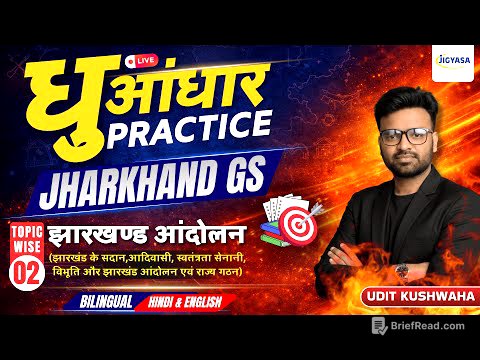
Alright folks, this session is all about cracking the code of Indian awards! We're diving deep into the world of honours, from the prestigious Bharat Ratna to gallantry awards for our bravehearts. The session will cover:
- Types of awards: Civilian and Military
- Highest to lowest order of awards in each category
- Key details like when they started, who were the first recipients, and recent winners.
Introduction to Awards of India [0:42]
The session is an introduction to the Awards of India. The instructor welcomes everyone to the "Aarambh" batch, which will cover important topics of Static GK. The class will be held three days a week: Monday, Wednesday and Friday. The recorded version of the class will be available on YouTube. The instructor also assures that the class will be bilingual, with explanations in Hindi.
Types of Awards in India [5:34]
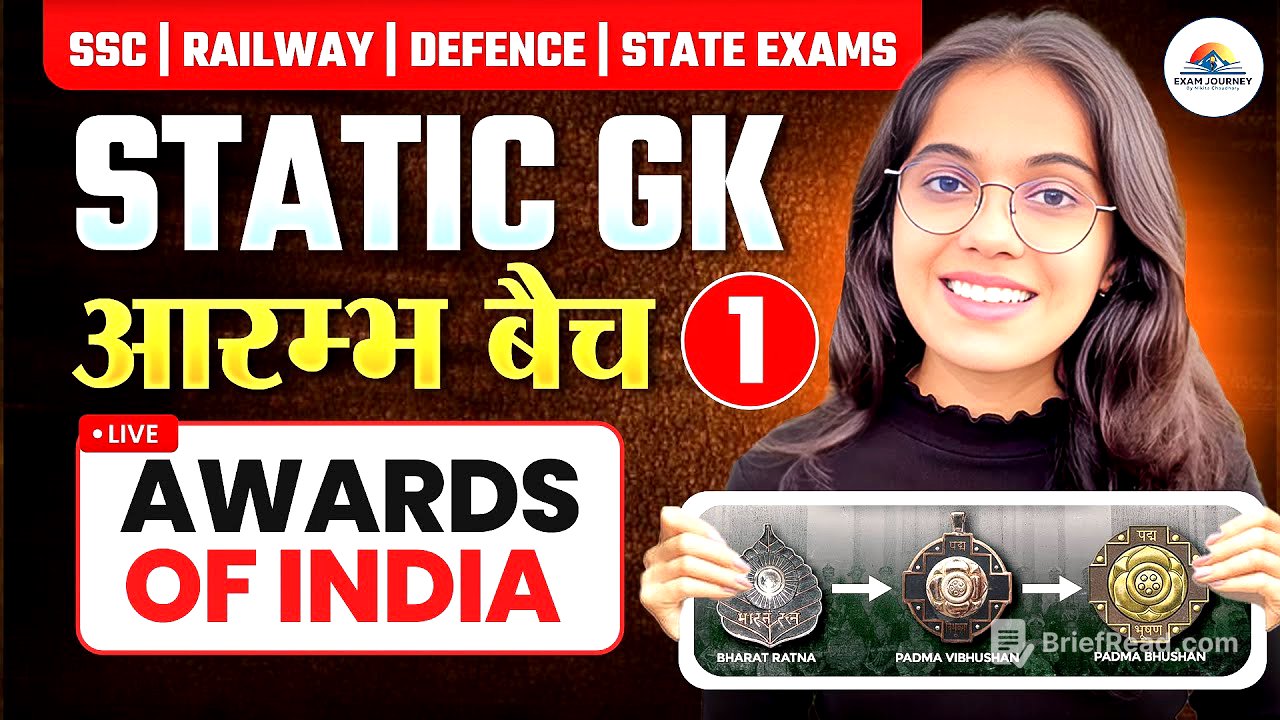
There are mainly two types of awards in India: Civilian Awards and Military Awards. Civilian awards are for any Indian citizen for exceptional work in fields like science, environment, or social service. Military awards are for those serving in the Indian armed forces. There are four civilian awards: Bharat Ratna, Padma Vibhushan, Padma Bhushan, and Padma Shri. Bharat Ratna is the highest civilian award, followed by Padma Vibhushan, Padma Bhushan, and Padma Shri in that order. Military Awards are further classified into Wartime Gallantry Awards and Peacetime Gallantry Awards. Wartime awards are given during war or conflict, while peacetime awards are for acts of bravery in non-war situations. The highest Wartime Gallantry Award is the Param Vir Chakra, followed by Maha Vir Chakra and Vir Chakra. The highest Peacetime Gallantry Award is the Ashok Chakra, then Kirti Chakra, and Shaurya Chakra.
Bharat Ratna: The Jewel of India [13:15]
Bharat Ratna is the highest civilian award in India, started in 1954. The first recipients were C.V. Raman (physicist known for the Raman Effect, and Nobel Prize winner in Physics in 1930), C. Rajagopalachari (also known as Rajaji, the last Governor-General of India), and Dr. Sarvepalli Radhakrishnan (whose birthday is celebrated as Teachers' Day, and was the first Vice President and second President of India). The award is designed on a Peepal leaf, with the sun and "Bharat Ratna" inscribed in Devanagari script on the front. The reverse side has the State Emblem (Ashoka Chakra) and "Satyameva Jayate." There is no prize money associated with this award. A maximum of three people can be awarded the Bharat Ratna in a year. The youngest recipient is Sachin Tendulkar. The award is presented by the President of India. The latest recipients in 2024 were Karpoori Thakur (known as Jan Nayak, former CM of Bihar), M.S. Swaminathan (Father of the Green Revolution), P.V. Narasimha Rao (ninth Prime Minister of India), Lal Krishna Advani (long-time president of BJP), and Chaudhary Charan Singh (fifth Prime Minister of India and former CM of Uttar Pradesh). In 1999, the award was given to four people: Jayaprakash Narayan, Amartya Sen, Gopinath Bordoloi, and Ravi Shankar.
Padma Awards: Vibhushan, Bhushan, and Shri [22:37]
The Padma Awards also started in 1954. Padma Vibhushan is the second highest civilian award, given for exceptional and distinguished service in any field. In 2025, it was awarded to seven people: Nageshwar Reddy (Medicine, Telangana), Jagdish Singh Khehar (Public Affairs, Chhattisgarh), Kumudini Lakhia (Art, Gujarat), Lakshmi Narayanan Subramaniam (Art, Karnataka), M.T. Vasudevan Nair (Literature and Education, Kerala - posthumously), Osamu Suzuki (Trade and Industry, Japan - posthumously), and Sharda Sinha (Art, Bihar). Padma Bhushan is the third highest civilian award, with a lotus-shaped design on the medal. Padma Shri is the fourth highest civilian award. Nominations for Padma Shri are decided by a committee formed by the Prime Minister, and the award is presented by the President.
Military Awards: Bravery in War and Peace [28:22]
Param Vir Chakra is the highest gallantry award, started in 1950. Only 21 people have received it, with many awarded posthumously. The first recipient was Major Somnath Sharma, and the 21st was Captain Vikram Batra. Maha Vir Chakra is the second highest award, and Vir Chakra is the third highest. For Peacetime Gallantry Awards, Ashok Chakra is the highest. Key facts include: the youngest recipient was Sanjog Chhetri, the first woman was Neerja Bhanot, and Wing Commander Rakesh Sharma was the first astronaut to receive it. Kirti Chakra is the second highest, and Shaurya Chakra is the third highest.
Sports and Literature Awards [33:11]
The Major Dhyan Chand Khel Ratna Award is the highest sports award, formerly known as the Rajiv Gandhi Khel Ratna Award (started in 1991-92). It was renamed after hockey legend Major Dhyan Chand. The first recipient was Viswanathan Anand. The award includes ₹25 lakh in prize money and is given by the Ministry of Youth Affairs and Sports. In 2024, it was awarded to Manu Bhaker (shooting), D Gukesh (chess), Harmanpreet Singh (hockey), and Praveen Kumar (para-athlete). Dronacharya Award is given to coaches. Arjun Award is the second highest sports award, given to sportspersons. The lifetime achievement award was given to Murlikant Rajaram Petkar, a Paralympic swimming gold medalist. In literature, the Jnanpith Award is the highest, with ₹11 lakh prize money and a bronze statue of Saraswati. The 59th edition was awarded to Vinod Kumar Shukla. The Saraswati Samman, started in 1991, was awarded to Mahopadhyay Sadu Bradesh for his Sanskrit book "Swami Narayan Siddhant Sudha," and includes ₹15 lakh prize money.
Class Wrap-up and PDF Details [43:45]
The instructor revises all the topics covered in the class. The PDF of the class will be available on the Exam Journey application within one hour.