TLDR;
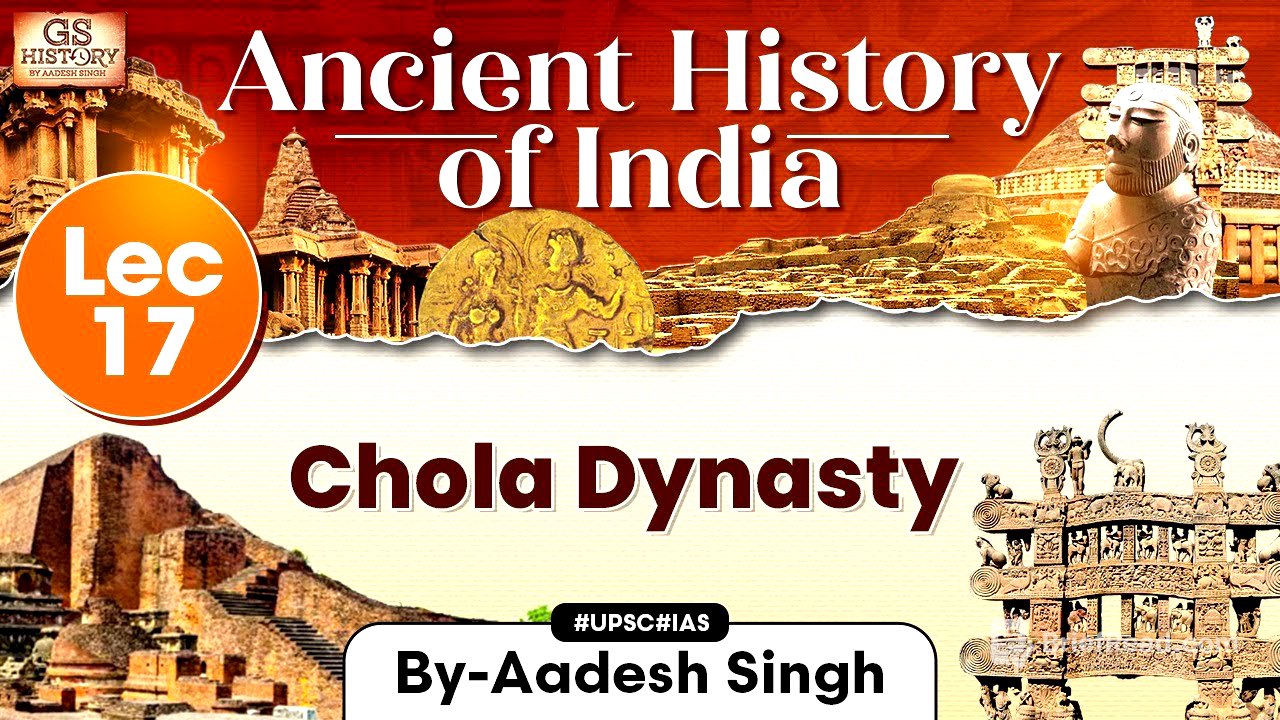
The video talks about the Chola Empire, starting from its origins and rise to power, its expansion across India and Southeast Asia, its achievements in infrastructure, art, and administration, and its eventual decline. It highlights key rulers like Rajaraja I and Rajendra I, naval supremacy, and the empire's lasting legacy in South Indian culture and beyond.
- The Chola Empire rose to prominence in the 9th century, consolidating power in South India and expanding into Southeast Asia.
- Key rulers like Rajaraja I and Rajendra I led military campaigns and oversaw significant cultural and infrastructural developments.
- The Cholas had a powerful navy that allowed them to dominate maritime trade routes and exert influence over distant lands.
- The empire's administration was well-organized, with a sophisticated bureaucracy and local governance structures.
- The Chola period is considered a golden age for art, architecture, and literature, with magnificent temples and bronze sculptures.
The Cholas [0:00]
The video introduces the Chola Empire, highlighting that while empires like the Mauryas, Guptas, and Mughals are well-known, the Cholas, who dominated South India for 450 years, are often overlooked. The Cholas not only stabilised South India but also expanded their influence into Southeast Asia, becoming a regional power in the Indian Ocean. The video aims to explore how the Cholas rose from the Kaveri Delta to become an imperial force.
Origin [1:28]
The Chola kingdom's origins trace back to around 300 BC, mentioned in Ashoka's edicts, known as the Early Cholas, but the video focuses on the Chola Empire or Imperial Cholas, starting around 850 AD. The founder of the Imperial Chola dynasty was Vijayalaya, a feudatory of the Pallavas. During the 6th and 7th centuries, the Kaveri Delta was divided between the Pallavas of Kanchi and the Pandyas of Madurai. Vijayalaya took advantage of the weakness and rivalry between these kingdoms, capturing Thanjavur from the Pandyas and making it his capital. His son, Aditya I, further strengthened the empire by destroying the Pallava dynasty.
Consolidation of Empire in India [3:23]
In 925 AD, Parantaka I defeated the Rashtrakuta ruler Krishna II, expanding Chola influence northward. However, the most powerful Chola kings were Rajaraja Chola I and Rajendra Chola I, credited with consolidating the empire and expanding it beyond the Kaveri Delta. Their control extended from the Krishna-Godavari basin in the north to Sri Lanka and the Maldives in the south, and from Lakshadweep in the west to the Malay Peninsula in the east. Rajendra I succeeded Rajaraja and his biggest achievement in India was the campaign in the Ganga basin, defeating rulers in Odisha and the Pala kingdom. To celebrate this victory, Rajendra built a new capital called Gangaikonda Cholapuram, located in present-day Tamil Nadu, which served as the Chola capital for the next 250 years.
Foreign Conquests [4:50]
The Chola kingdom's foreign conquests are their most significant achievements, earning them the title of Imperial Cholas. Like modern imperial countries, the Cholas controlled foreign territories' economic resources through military power, using these resources for their own prosperity, a system some historians call pseudo-colonialism. Parantaka I's Sri Lanka campaign was an important early conquest, completed by Rajaraja I. Rajaraja's Sri Lankan expedition is compared to Lord Rama's campaign, with descriptions of the Chola army crossing the ocean and burning up the king of Lanka. The Cholas also expanded their control over the Maldives. Rajendra Chola I launched a massive attack on the Sri Vijaya Empire in Southeast Asia, but maintained only indirect control after the victory. The reasons behind this campaign are linked to the economy, local politics, and international relations of the time. The immediate trigger was the conflict between the Cambodian Angkor dynasty and the Sri Vijaya Empire, with Rajendra supporting Angkor. Another theory suggests the cause was the politics of Tamil guilds and the maritime silk route.
The maritime silk route involved the Abbasid Caliphates and Malay ports, which served as transition points for ships. Tamil guilds had a monopoly over this trade, controlling Malay ports. However, improved ship-building techniques allowed ships to travel longer distances, reducing the importance of transition points and causing most ships to stop only at Malay ports, harming Indian Tamil guilds. The Sri Vijaya Empire also began discriminating against Tamil guilds based in Malaya, worsening their condition. It is suggested that lobbying by these guilds led Rajendra to attack Sri Vijaya, fearing they might support enemy kingdoms. Regardless of the reason, Rajendra's unmatched naval supremacy led to significant victories in Southeast Asia. His navy was so strong that a naval training academy was named T.S. Rajendra in 1972 to commemorate his legacy. After this expedition, the Sri Vijaya Empire declined, and smaller kingdoms emerged, accepting Chola suzerainty and military bases. As a result, Tamil guilds dominated South East Asia for the next century, and the Cholas maintained hegemony over the maritime silk route.
The Civilizational Golden Age [9:00]
The Chola rule is considered a civilizational golden age, marked by massive infrastructure, temples, and fine bronze sculptures. Tremendous agrarian expansion led to the construction of massive canals in the Kaveri basin, including the famous Uyyakondan and Rajendran Vaikal, which still exist today. Besides canals, massive water tanks were also built, the most important being the 16-mile-long Chola Gangam of Gangaikonda Cholapuram, also known as the liquid pillar of victory. While earlier kings also built temples, Chola temple architecture reached its peak during Rajaraja's rule, symbolising the empire's prosperity and being about five times larger than older temples. UNESCO has designated the Great Living Chola Temples as World Heritage Sites, including the Brihadeeswarar Temple of Thanjavur, built by Rajaraja I in 1010 AD, the Brihadeeswarar Temple of Gangaikonda Cholapuram, built by his son Rajendra 25 years later, and the Airavatesvara Temple of Darasuram, built by Rajaraja II.
Chola temples are prime examples of the Dravida style, with the Brihadeeswarar Temple of Thanjavur being the most brilliant structure and engineering marvel. Its granite vimana, built without mortar or cement, is 59 meters tall and still stands after 1000 years. Vimanas are pyramid-shaped structures built above the sanctum of Dravidian temples. The top stone of the Brihadeeswarar Temple's vimana weighs 80 tons, and engineers still debate how it was lifted 59 meters without modern machinery. The Chola rulers were Shaivites, and the main deity of Thanjavur is Shiva, with one of the largest Shiva lingams in India located here. The world-famous Nataraja bronze sculpture, symbolising Shiva's cosmic dance of creation and destruction, is also found here. The bronzes of Bhoga Shakti and Subramanya are also considered masterpieces. Chola temples, receiving massive grants, were also centres of economic activities, working for village welfare. The period also saw developments in literature, with the compilation of the popular Vaishnava text Nalayira Divya Prabandham by the 12 Alwar saints.
Chola administration is also a symbol of their legacy, with information about a fully developed secretariat. Using palm leaves, the Cholas created a brilliant record system, including land records and intelligence reports. The Chola Empire was divided into nine provinces called mandalams, governed by governors who maintained standing armies. Provinces were divided into districts called nadus, governed by autonomous assemblies called nattar. While the Chola administration was largely a centralised political system, it also had powerful and autonomous local administration. Villages were governed by assemblies called ur and sabha, which enjoyed huge autonomy. Ur assemblies included people from all castes, while sabha assemblies governed agrahara villages granted to Brahmins by Chola kings. The legacy and influence of this system are seen in Gandhi's idea of village republics and modern India's Panchayati Raj system. The Chola military was notable for its unmatched naval power. According to Venetian traveller Marco Polo, the king's bodyguards would sacrifice themselves on the king's funeral pyre.
Decline [14:04]
The Later Chola dynasty was ruled by capable rulers like Kulothunga, Vikrama Chola, and Kulothunga II, who maintained the integrity of the territory. However, the decline of the Cholas started with Kulothunga III. The first cause was the rise of the Sinhala kingdom in Sri Lanka, which expelled them from the island. The second cause was weak rulers after 1216, such as Rajaraja III and Rajendra III. According to a record, Rajaraja III was taken hostage by one of his feudatories. The third cause of the Chola's decline was the rise of the Pandyas and the divisive politics of the Hoysalas. The Hoysalas used divisive politics to prevent both the Cholas and Pandyas from rising. While the Hoysalas were successful in stopping the Cholas, the Pandyas became a formidable power. The Pandyas first defeated the Hoysalas and then the Cholas in 1279. By the time of Rajendra III, the Pandya Empire was at the peak of its prosperity. 1279 is the last recorded date of Rajendra III's rule, after which the Cholas disappeared from India. However, a rebel branch of the Chola dynasty continued in the Philippines until the 16th century. This dynasty was founded by Cholas who went to establish a base in Cebu or Sugbu in the Philippines. This kingdom ended after the Spanish invasion, and the glorious history of the Chola Empire became history. However, the legacy of the Cholas lives on and continues to flourish in the culture, religion, and temples of South India.