TLDR;
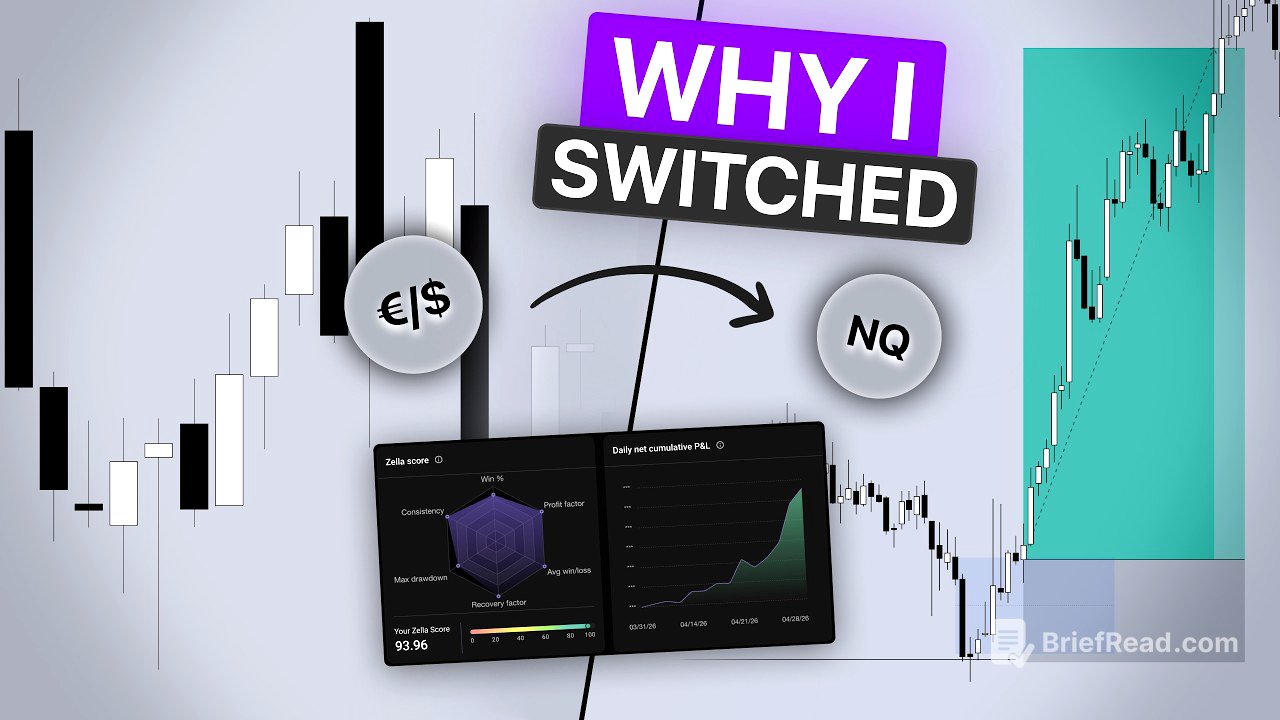
David discusses his shift from trading Forex (FX) to trading futures, outlining the reasons behind this decision and offering advice to traders considering a similar transition. He highlights the changing market conditions in FX, the benefits of futures trading, and the importance of adapting to market changes.
- FX market has been in a consolidation profile, with less expansion profiles on daily timeframe.
- Lower time frames on FX have inconsistent price action, worse trading conditions in terms of spread, slippage, and fees.
- Futures offer more time-based movement and cleaner price action on lower time frames.
- Futures prop firms have simpler rules, faster funding, and are more scalable.
- Adapting to market changes is crucial for maintaining an edge in trading.
Introduction [0:00]
David explains that he will discuss the reasons behind his shift to trading futures in recent months, providing a breakdown of his decision-making process.
Changing Forex Market Conditions [0:15]
The primary reason for trading less FX is the altered market dynamics. David typically trades the H1 timeframe in Forex, focusing on daily and weekly expansions. However, the FX market has been consolidating recently, with fewer daily expansion profiles. This is attributed to rising global uncertainty, which has reduced the market's reaction to economic news. Expansions, when they occur, often happen at unpredictable times, such as during the daily closure or Asian session, making it difficult to participate. The New York session is often in consolidation, and London session moves are frequently retraced, making the FX market a low-probability environment for his strategy.
Limitations of Lower Time Frames in FX [6:14]
David explores the possibility of adapting his system to trade hourly or H4 expansions but questions whether FX is suitable for lower timeframe trading. He believes the FX market is one of the worst for trading the one-minute timeframe, citing inconsistent price action with frequent chop and fakeouts. Additionally, lower time frames in FX have worse trading conditions, including wider spreads, slippage, and higher fees due to the increased lot sizes needed for tighter stops. The realised risk-reward on these trades is often lower than the risk-reward on paper due to these factors.
Advantages of Futures Trading [10:01]
Futures offer more time-based movement, such as the volatility injection at 9:30 AM, providing a predictable time window for trading. David finds the price action on the one-minute timeframe in futures, specifically on the NQ (Nasdaq 100), cleaner than in FX. This, combined with defined trading windows like the London session, 9:30 AM open, 10:00 AM, and the PM session, makes futures a better option for trading lower time frames. He trades the same concepts he used in FX but adjusts for the different market nuances and execution styles required for lower time frames.
Differences Between Indices and Forex [13:13]
Indices are naturally appreciating assets, generally trending upwards over time, which gives an edge to long positions. Forex, on the other hand, is mainly a mean-reverting asset, consolidating over the long term, especially major currencies. This difference influences trading strategies on lower time frames, as Forex tends to be more range-bound.
Prop Firms and Scalability [15:09]
The landscape of CFD prop firms has become less reliable, with stricter rules and payout issues. Many firms create reasons to deny payouts, adding unnecessary stress for traders. Futures prop firms, in contrast, have simpler, more transparent rules, faster funding, and are more scalable. Consistency rules in futures prop firms promote consistent trading, which should not be an issue for profitable traders. The challenges are cheaper, and funding can be achieved quickly, making futures prop firms a better model for extracting payouts.
Adapting to Market Changes [18:24]
David emphasises that he is not abandoning Forex entirely but is adapting to the current market regime. He can switch back to FX if conditions improve. He advises against marrying a specific market and forcing it to work, highlighting that the market environment may not always suit a particular system. Adapting to market changes is crucial for maintaining an edge in trading. Refusing to adapt and lowering standards to force low-quality setups will lead to worse results. Applying existing concepts in a better-fitting environment can significantly improve trading outcomes. Many of his students have found success by transitioning from FX to NQ, demonstrating the impact of trading in a more suitable market.
Conclusion and Call to Action [22:15]
David concludes by encouraging viewers to adapt to market changes and consider exploring futures trading if they are struggling with FX. He offers to create a video on transitioning from Forex to Futures if there is interest. He also promotes his Discord channel, where he posts breakdowns of his NQ trades, and encourages viewers to like and subscribe.