TLDR;
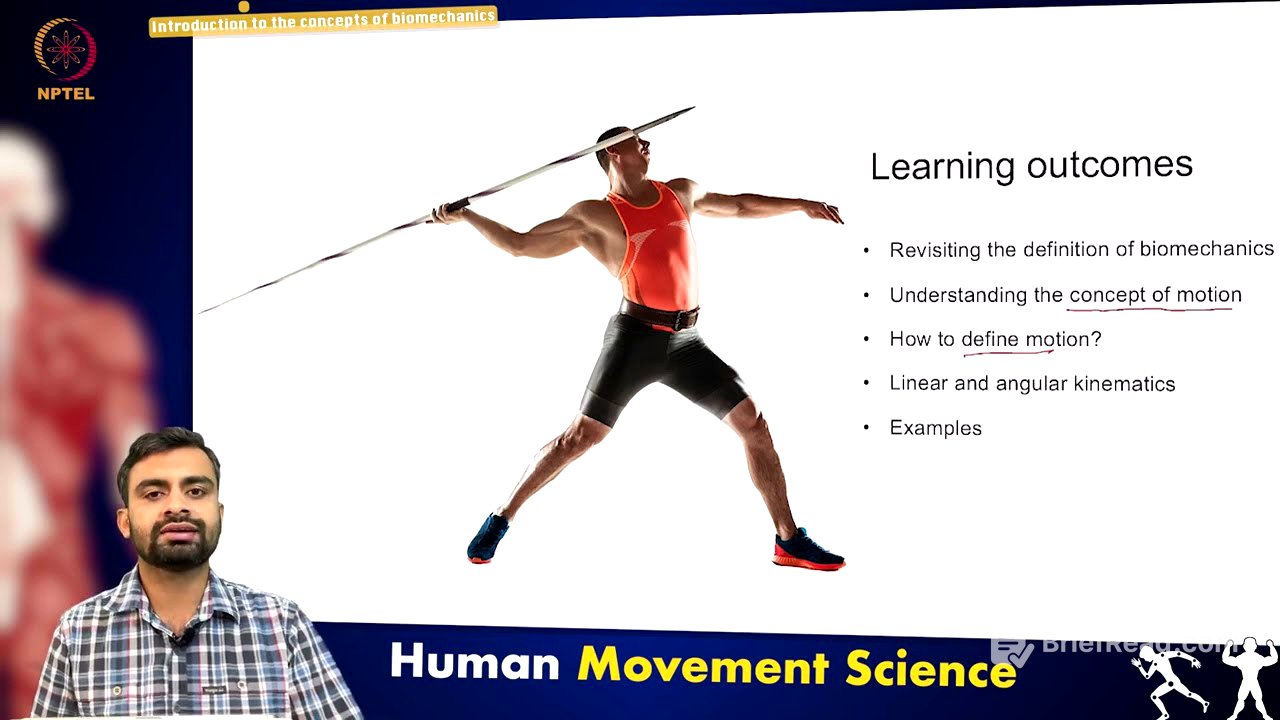
This module introduces the fundamental concepts of biomechanics, starting with its definition as the study of movement in living things using mechanics. It covers sports biomechanics, emphasising its role in improving athletic performance, preventing injuries, and aiding rehabilitation. The importance of reference systems, particularly the Cartesian coordinate system, is highlighted for defining motion. The module also classifies motion into linear, angular, and general types, and reviews essential mathematical concepts like trigonometry, Pythagoras theorem, scalars, vectors, and the central difference method for biomechanical analysis.
- Biomechanics is defined as the study of movement of living things using the science of mechanics.
- Sports biomechanics enhances athletic performance, prevents injuries and aids rehabilitation.
- Motion is classified into linear, angular and general types to simplify analysis.
- Mathematical concepts like trigonometry, Pythagoras theorem, scalars, vectors and central difference method are essential for biomechanical analysis.
Introduction to Biomechanics [0:00]
The module begins by defining biomechanics as the study of the movement of living things, using the principles of physics and mathematics to analyse forces and their effects. It highlights the importance of quantifying movement by examining parameters such as distance, joint angles, and the impact of body weight, ground reaction forces, friction, and air resistance on movement. Herbert Hadze defined biomechanics in 1974 as a study of movement of living things using the science of mechanics.
Sports Biomechanics [2:57]
Sports biomechanics is defined as the mechanics of human movement in sports, aiming to understand and improve athletic performance. By analysing how athletes move, adjustments can be made to their technique, leading to enhanced performance. It also aids coaches in developing more efficient training programmes and identifying potential injury risks, enabling the creation of preventive strategies. Understanding movement mechanics in sports contributes to injury prevention, rehabilitation, and performance enhancement.
Reference Systems and Motion [4:06]
The concept of reference systems is crucial for defining motion, with the Cartesian coordinate system being the most commonly used in biomechanics. This system uses horizontal (x-axis) and vertical (y-axis) planes to define location in 2D, and adds a third axis (z-axis) for 3D analysis. Using a reference system allows for repeatable definitions of positions, aiding in remembering positions and identifying strategies for maximum output.
Kinematics and Kinetics [6:06]
The module introduces kinematics, which describes motion without considering its causes, focusing on parameters like distance and joint angles. Kinetics, on the other hand, references the causes of motion, such as forces and torques generated at joints. An example of a drop vertical jump is used to illustrate these concepts, with analysis focusing on critical points like touchdown, maximum knee flexion, and feet off, analysed in both frontal and sagittal planes.
Classifications of Motion [9:16]
Motion is classified into linear, angular, and general types to simplify complex movement analysis. Linear motion involves movement in a straight or curved line, where all points on a mass move the same distance in the same time. Angular motion involves rotation around an axis, with different points covering different distances in a fixed time. General motion is a combination of both linear and angular motion, commonly seen in everyday activities. Understanding these classifications provides a structured framework for analysing and enhancing athletic performance.
Mathematical Concepts: Trigonometry and Pythagoras Theorem [12:46]
The module reviews essential mathematical concepts, starting with trigonometry, which deals with the measurement of triangle sides and angles. It focuses on right-angle triangles, defining sine, cosine, and tangent. The Pythagoras theorem, applicable to right-angle triangles, states that the square of the hypotenuse equals the sum of the squares of the other two sides, which is a principle useful in biomechanical analysis.
Scalars and Vectors [15:44]
Mathematical quantities used to describe motion are divided into scalars and vectors. Scalars have magnitude only (e.g., distance, speed, mass, temperature, time), while vectors have both magnitude and direction (e.g., displacement, velocity, acceleration, force). Vectors are crucial in biomechanics for detailed analysis of forces, velocities, and accelerations in movements. A vector is represented as an arrow with a point of application, tail, and head, where the length indicates magnitude and the line from head to tail indicates the line of action.
Vector Resolution and Magnitude [18:14]
Vectors can be resolved into horizontal and vertical components using trigonometry. A vector AC can be resolved into components AB (horizontal) and AD (vertical). The horizontal component is calculated as the magnitude of the vector times cosine theta, while the vertical component is the magnitude times sine theta. The magnitude of a vector can be calculated using the Pythagoras theorem, where the square of the hypotenuse (AC) equals the sum of the squares of the other two sides (AB and BC).
Central Difference Method [24:41]
The central difference method is a numerical technique used to calculate the rate of change with respect to time, essential for biomechanical analysis involving movement. The rate of change for a position (xi) is given by the difference between the (i+1)th and (i-1)th values, divided by twice the time interval. This method can be used to find velocity from position data and acceleration from velocity data, providing a way to analyse how parameters change over time given numerical data for position or displacement.


![One Meal a Day (OMAD) and your Health. [Study 18, 144-146 Analysis]](https://wm-img.halpindev.com/p-briefread_c-10_b-10/urlb/aHR0cDovL2ltZy55b3V0dWJlLmNvbS92aS9KS3dDOHNIRUVqWS9ocWRlZmF1bHQuanBn.jpg)