TLDR;
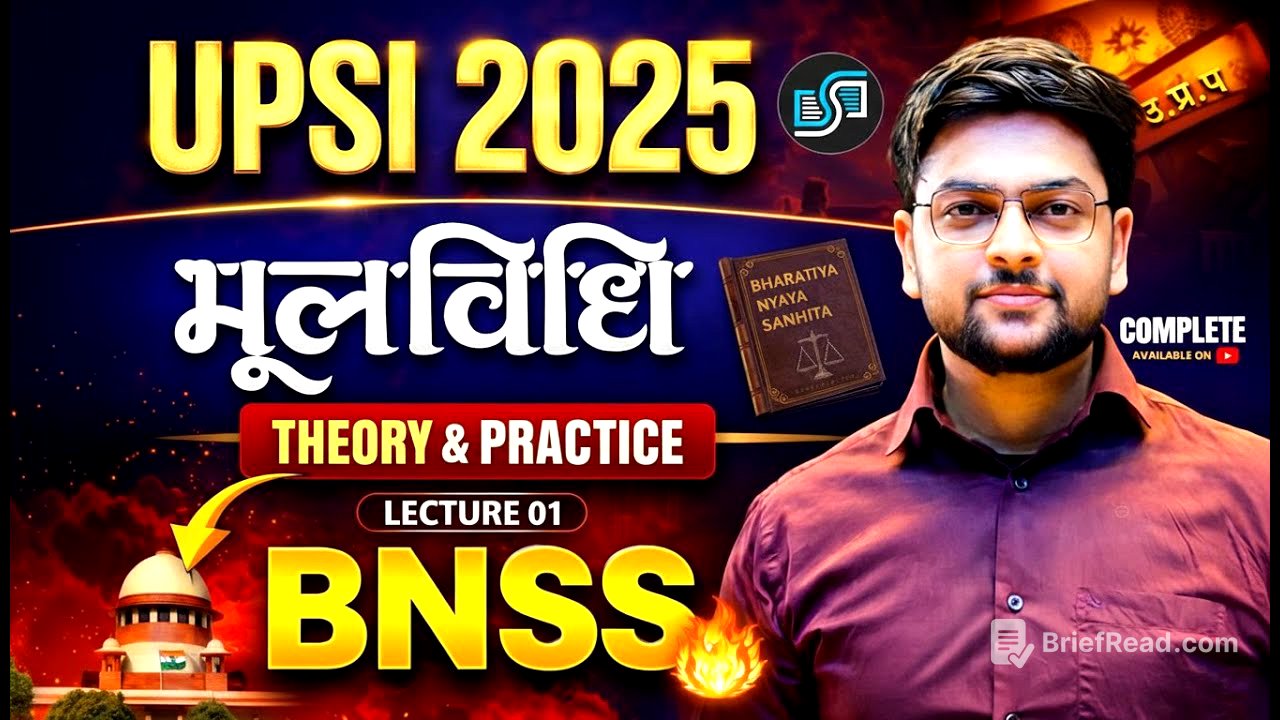
This YouTube video by Jeet Rana GS provides a detailed introduction to the Bharatiya Nagarik Suraksha Sanhita (BASS), a new legal framework in India. The lecture explains the differences between the Bharatiya Nyaya Sanhita (BNS) and BASS, the objectives behind the introduction of BASS, and key definitions within the code.
- BASS replaces the Criminal Procedure Code (CRPC) of 1973.
- It aims to modernise the legal system, improve the FIR process, and incorporate forensic evidence.
- The lecture covers the schedules within BASS, focusing on the classification of offences and related forms.
Introduction [0:16]
The instructor welcomes the students to the class, mentioning a lighthearted anecdote about students eagerly awaiting the class. He highlights previous lectures on the channel, including those on Mool Vidhi (Basic Law) and BNS, and encourages students to show their support for the ongoing BASS series.
Weightage of Mool Vidhi [2:25]
The lecture begins by discussing the weightage of Mool Vidhi in the Uttar Pradesh Sub Inspector (UPSI) exam. Mool Vidhi, or Basic Law, is also known as Substantive Law. It is divided into BASS, BNS, and Minor Acts. The instructor mentions that BNS is already available on the YouTube channel in a bilingual format, and Minor Acts will soon be uploaded.
Difference Between BAS and BASS [4:50]
The instructor explains the difference between BAS (Bharatiya Adhiniyam Sanhita) and BASS. BNS 2023 contains 20 parts and 358 sections, and it replaces the Indian Penal Code (IPC) of 1860. BNS defines what constitutes an offence and its punishment. BASS, on the other hand, deals with the procedure of how punishment is to be administered, covering everything from the commission of an offence to conviction, punishment, and acquittal. BASS 2023 contains 39 parts and 531 sections, and it replaces the CRPC of 1973.
Digital Explanation [13:17]
The instructor initially attempts to use digital slides to explain the judicial journey of a case but finds them inaccurate. He decides to explain the concepts manually, highlighting the differences between the CRPC and BASS.
CRPC 1973 vs BASS 2023 [14:52]
A comparison between the Criminal Procedure Code (CRPC) 1973 and the Bharatiya Nagarik Suraksha Sanhita (BASS) 2023 is presented. The CRPC was passed on 25 January 1973 and implemented on 1 April 1974, comprising 37 parts and 484 clauses. In contrast, BASS was passed on 25 December 2023 and is set to be implemented on 1 July 2024, featuring 39 parts and 531 sections. Both codes contain two schedules.
Objectives to Include BASS [19:21]
The instructor outlines the reasons for including BASS in the legal framework: Modernisation: To update outdated procedures. Changes in FIR Process: Including concepts like e-FIR and Zero FIR. Forensic Investigation Improvement: Making forensic investigations mandatory for offences with a sentence of seven years or more. Vocabulary Changes: Replacing outdated terms like " पागल" (mad) with more appropriate terms. New Punishments: Including community service as a form of punishment. Time Limit: Setting time limits for certain procedures. Digitalisation: Incorporating summary trials and victim rights. E-documents: Introducing the concept of e-documents. Extended Police Custody: Allowing for extended police custody (up to 90 days with judicial permission).
Questions Related to BASS [30:40]
The instructor poses several questions related to BASS to test the students' understanding, including the full form of BASS, the date of its implementation, the law it replaces, and the number of sections it contains.
Schedules of BASS [34:49]
The lecture details the two schedules of BASS: Schedule 1: Deals with the classification of offences, their nature (cognizable or non-cognizable, bailable or non-bailable), and the procedure for punishment. Schedule 2: Contains forms related to offences and their formats.
Part One of BASS [42:19]
Part one of BASS, covering sections 1 to 5, provides preliminary information such as the short title, extent, and commencement of the code. Section 1 states that the code is called BASS 2023, extends to the whole of India, and will come into force on 1 July 2024. Cases registered before this date will be governed by the CRPC. An exception is made for certain scheduled areas in Nagaland, where only parts 9, 11, and 13 will apply, relating to public peace, public order, and police action.
Section 2 of BASS [48:58]
Section 2 of BASS deals with definitions: Audio-Video Records: Evidence available in electronic form. Bail: Releasing an accused or suspect on certain conditions. Bailable Offence: An offence for which bail is granted according to Schedule 1. Bond: A release without monetary deposit. Charge: A claim of offence. Cognizable Offence: An offence for which an arrest warrant is not required. Complaint: A written or verbal complaint to a magistrate, not including a police report. High Court: The highest court of a state. Inquiry: Confirmation of an offence. Investigation: The procedure of investigation, including questioning and collecting evidence, conducted by the police. Non-Cognizable Offence: An offence for which a warrant is required for arrest. Notification: Information issued by the government or a department. Offence: Any act that is illegal and against Indian law. Officer Incharge (of police station): Generally an inspector, or in their absence, any officer above the rank of constable as determined by the state government. Place: Any location, including a house, flat, or land. Police Report: A report submitted by the police to a magistrate. Police Station Public Prosecutor: A government advocate or provider of free legal aid.
Section 4 of BASS [1:16:33]
Section 4 of BASS outlines the procedure for punishments described in the BNS, detailing how the six types of punishments will be administered. The instructor assigns a homework question: In which section of the BNS are the punishments described? He directs students to a previous video on the channel that covers this topic.
Conclusion [1:18:09]
The instructor concludes the class, encouraging students to like the video and other sessions on the channel. He announces upcoming classes on UP GK and expresses his commitment to providing regular classes. He requests students to comment on their place of origin and assures them of his support in their selection process.