TLDR;
This video discusses a recurring financial pattern observed over the past 50 years, characterised by a significant drop in gold prices amidst global crises, followed by a repricing of major asset classes. It highlights the current economic situation, where foreign central banks are reducing their holdings of US treasuries, and the government is spending more on debt payments and entitlements than it collects in taxes. The video outlines a four-wave sequence that occurs across different asset classes (gold/commodities, dollar, hard assets, risk assets) when the Federal Reserve starts printing money, and advises viewers on how to position their portfolios to benefit from this sequence.
- Gold price drops during global crisis signals financial system math is broken.
- Government spending exceeds tax revenue, leading to potential recession.
- Fed's printing money triggers a four-wave sequence across asset classes.
- Portfolio should be positioned to capture value across the entire sequence.
The 50-Year Financial Turning Point [0:00]
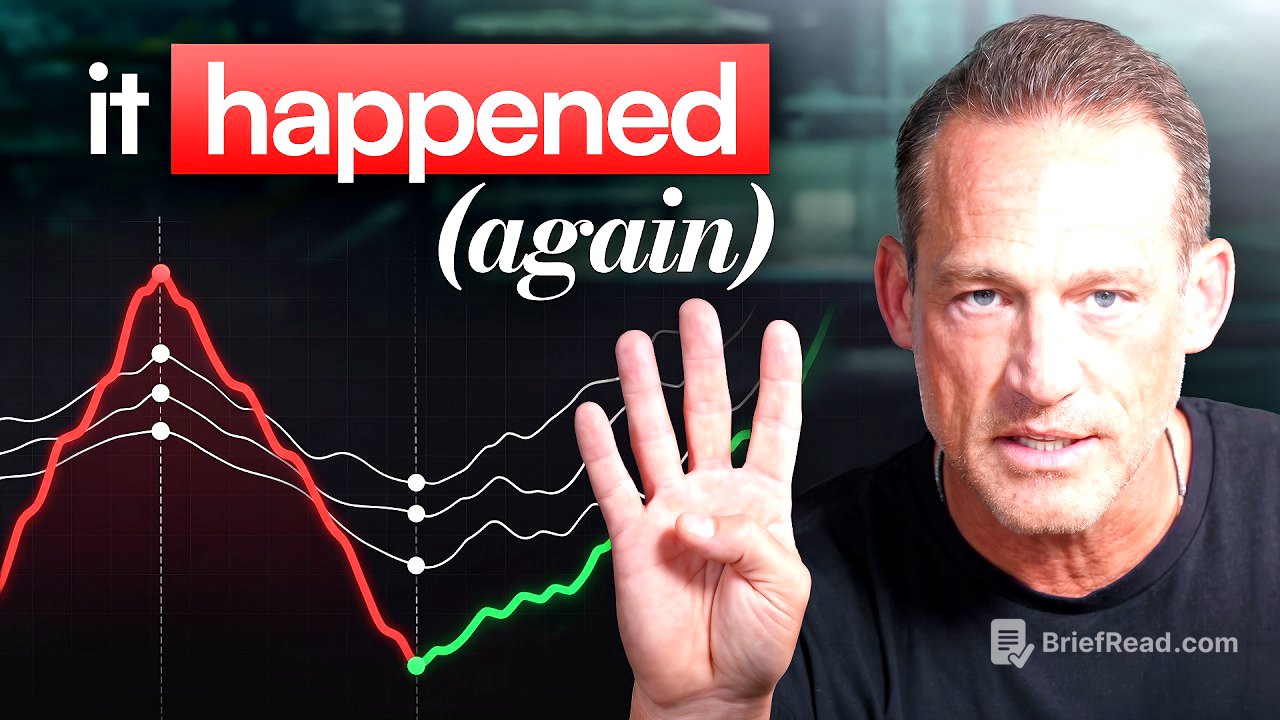
The video introduces a financial pattern that has occurred four times in the last 50 years (1973, 1978, 2008, and currently), each time leading to a complete repricing of major asset classes like stocks, real estate, and commodities. The pattern begins with foreign central banks dumping US treasuries, currently at the lowest level of holdings since 2012. The US government is now spending more on debt payments and entitlements than it collects in taxes, and the emergency tool used in the past to buy time is no longer available. The video aims to explain this pattern, the sequence of events across different asset classes, and how to position oneself ahead of these changes.
The Pattern Behind Gold Price Volatility [0:59]
The pattern begins with gold. In late February, gold was at all-time highs, around $5,600 an ounce. When the Iran war started, analysts expected gold to rally, but instead, it dropped 25% in less than a month, reaching $4,100 on March 23rd, marking the biggest weekly loss since 1983. Sentiment shifted from euphoria to panic, with the daily sentiment index for gold plummeting. However, zooming out reveals that a 25% drop in gold during a major global crisis has only happened four times in the last 50 years. Each time, this was followed by an explosive rally in gold's price. Examples include the 1973 OPEC oil embargo, the 1978 Iranian revolution, and the 2008 global financial crisis. In each case, after the initial drop, gold prices surged significantly. The current situation in 2026, with the Iran war, mirrors this pattern, with gold already starting to bounce back.
Why The Financial System Is Breaking [4:23]
The recovery of gold is not the main story, but rather a signal. Each time this pattern has occurred, a specific sequence plays out across multiple asset classes, including stocks, bonds, real estate, and commodities. This sequence occurs because the math behind the financial system has broken, forcing decision-makers to take actions they would rather avoid. The situation is starting with oil. The closure of the Strait of Hormuz has led to a significant shortfall in the world's oil supply, estimated to be between 7% and 10%. Such a large drop in oil supply has historically led to recessions or required significant intervention from the Federal Reserve. The government's cheat code from 2022, using the Strategic Petroleum Reserve (SPR) to lower oil prices, is no longer available as the SPR is at its lowest level in decades. A critical threshold to watch is when US oil consumption as a percentage of GDP crosses 3%, which historically leads to a recession, and this threshold kicks in around $120 a barrel.
The government is already spending more on essential bills like social security, Medicare, and interest payments on the national debt than it collects in tax revenue. This means that every dollar spent on other areas is borrowed. This situation is occurring before a recession has even started, which is concerning because a recession would further reduce tax revenue while obligations increase. The government has three options, all of which involve putting more dollars into the system. Historically, they have always chosen to print money, which keeps the system running in the short term but worsens the problem in the long term. Once printing starts, a specific sequence of events occurs across major asset classes.
Wave 1 [10:44]
When the Federal Reserve is forced to print money, the money flows through the economy in waves, following the same sequence each time. Wave number one involves gold and commodities moving first. Gold's initial sell-off of 25% is now rebounding, acting as the market's smoke detector for monetary debasement. Smart money, including central banks and institutional allocators, anticipates the printing and starts buying gold before it becomes obvious. Central banks bought over 700 tons of gold last year, with China buying for 15 straight months. Commodities, broadly, also start to move in wave one, including energy, industrial metals, and agricultural commodities, all of which are priced in dollars and have real-world scarcity. The market anticipates inflation and liquidity, moving into assets that cannot be printed.
Wave 2 [12:08]
In wave number two, the dollar weakens. Despite the dollar's current strength, driven by the high price of oil and the need for countries to acquire dollars to pay for energy, this strength is temporary. Foreign central banks are buying dollars out of necessity, not confidence in the US economy. Every dollar raised by selling US treasuries worsens the US debt math, increasing the pressure to print more money, which ultimately weakens the dollar. Historically, the dollar has been strong leading up to the Federal Reserve printing money, but the policy response brings it back down. The Federal Reserve starts easing, and printing begins. When the dollar rolls over, it amplifies everything that happened in wave one, causing commodity prices to rise even faster. The inflation already present from the oil shock is accelerated by the currency losing value.
Wave 3 [13:51]
Wave number three involves hard assets repricing. Commodities beyond gold start to move, including real estate, land, and commodity-producing equities. As inflation rises and the dollar weakens, investors look beyond gold for assets that hold value, have real-world scarcity, and generate income or have productive value. Real estate is a classic example, as seen after 2008 when real estate bottomed out and ran for a decade, not because the economy was great, but because the dollars used to price real estate were worth less every year. Mining stocks, energy producers, and infrastructure plays also start to move aggressively. These businesses own real assets in the ground and sell them at prices rising with inflation, increasing their revenues while their debt stays fixed in the weakening dollar.
Wave 4 [15:16]
Wave number four is the liquidity wave, which hits risk assets and pushes out along the risk curve. This is the final wave and where things become very interesting. Once the Federal Reserve is actively printing and the dollar is weakening, liquidity floods the entire financial system. Equities broadly start to lift, but not equally. The assets that benefit the most are the ones that are the hardest to produce, such as Bitcoin. Bitcoin enters the conversation not as a speculation tool, but as the logical endpoint of the entire sequence. As a fixed supply asset existing natively in the digital financial system, Bitcoin captures the flow of liquidity when the dollar weakens. It acts as a monetary sponge because it is the hardest money available, with only 21 million ever to be produced. In 2008, Bitcoin did not exist, but it was born out of that crisis, with Satoshi launching it in January 2009, months after the Federal Reserve started printing. After the 2020 printing cycle, Bitcoin went from roughly $6,000 to over $60,000, then to $100,000, which is not a coincidence but part of the sequence.
In 2008, gold bottomed in October, the S&P bottomed five months later in March 2009, and real estate bottomed in 2011. Each wave lagged the one before it, with money moving through the system in that order. Currently, we are at wave one, with gold having bottomed and bouncing. The question is not whether the other waves are coming, but whether you are positioned for them before they arrive. The goal is to build a structure that captures value across the entire sequence as it plays out. Most people's money is set up for an environment of slow, steady growth, low inflation, and a stable dollar, which is no longer the current environment. The biggest risk is being positioned for the wrong environment, sitting in an allocation designed for a world that no longer exists. The right structure involves exposure across the sequence, not all at the same time or with equal weight, but intentionally. This includes owning assets that benefit from wave one (gold, commodities), a weakening dollar, hard assets (real estate, commodity producers), income-generating assets, and truly scarce assets like Bitcoin.