TLDR;
Ultra-Orthodox Jewish music blends religious traditions with melodies from popular and foreign songs. The video traces this practice from mystical ideas about sacred melodies to the rise of Orthodox pop, exploring disputes over appropriation, religious authority and musical influence. It also follows the genre into political conflicts, from the fight over a Mormon university in Jerusalem to a campaign-song controversy in Indonesia.
- A nigun is a Jewish melody, often sung with religious verses or repeated without words. Some Jewish mystics believed that adapting secular tunes for worship could restore their divine holiness.
- Orthodox pop grew into a distinct, varied genre, though its foreign influences have caused controversy within some communities.
- Jewish music has crossed cultural and political borders, and music has been used to express religious identity, factional loyalty and political opposition.
Secular Melodies Recast as Sacred Songs [1:30]
Ultra-Orthodox wedding performers sometimes sing religious lyrics to melodies from popular songs, including “Worth It” and “Despacito”. This practice draws on the nigun, a Jewish melody that may carry verses from the Bible or consist of a simple repeated tune. In eighteenth-century Eastern Europe, some Jewish mystics saw communal singing as a way to grow closer to God.
A Kabbalistic idea called the great shattering held that divine sparks exist throughout the world and can be released when ordinary things are used for holy purposes. Some Jews applied this belief to music: adapting a secular melody for worship could redeem it. Legends even credited a rabbi’s newly composed nigun with bringing about the death of Emperor Francis II and the cancellation of anti-Jewish decrees; the melody became known as the “emperor’s nigun”.
Some communities also believed that popular tunes had once belonged to the choirs of the ancient Jewish Temple, but had spread and become corrupted after its destruction. Replacing secular words with religious ones could, in this view, restore a melody’s holiness. Tunes adopted for Jewish use included Napoleon’s marching anthem and the French national anthem, whose melody became a Hasidic nigun.
The video also gives examples of melodies travelling between traditions. The Israeli national anthem, “Hatikva”, was set to a Romanian folk melody, which had appeared in many European musical traditions. Its resemblance to an Indian patriotic song later led to accusations of plagiarism. The practice of adapting tunes is not unique to Jewish music: football fans also rewrite popular songs to support their teams.
Musical Borrowing, Ownership and Controversy [8:28]
Jewish wedding performers often earn little from adapted songs, which are usually performed within isolated communities and rarely released as recordings. That makes the practice seem like a victimless form of borrowing. However, original artists have not necessarily consented to their melodies being used with new messages, so others regard it as artistic theft.
The exchange of musical influence has also worked in the other direction. The Yiddish song “Dos Zekele Koilen” (“The Little Sack of Coal”) supplied parts of the melodies for both the Italian anti-fascist song “Bella Ciao” and the Soviet song “The Red Army Is the Strongest”. A Jewish song also became popular among Nazis, who initially mistook its Yiddish lyrics for a German folk song. After recognising its Jewish origins, they banned it; later, a government-sponsored propaganda group reused its melody for anti-Semitic and anti-Soviet material.
Using secular melodies for religious songs has been controversial within Ultra-Orthodox communities. Some believe holy words redeem a secular tune; others fear that the melody will undermine the sacred lyrics. In 2007, a musician released Rapping Edish, an album of Yiddish songs set to pop melodies, including tunes associated with Michael Jackson, Madonna and 50 Cent. The release drew harassment and calls for a ban. It eventually carried a warning that Ultra-Orthodox Jews were forbidden to listen, which shut it off from its likely audience.
Some Hasidic dynasties keep their distinctive nigunim secret, partly to prevent them being reused for secular words. These groups have their own musical styles and traditions, and their internal power struggles can be intense. The video notes that this world of dynastic politics could itself fill a separate story.
Orthodox Pop and Its Many Styles [14:51]
As well as borrowing existing tunes, Ultra-Orthodox musicians began creating original songs influenced by international pop. The video calls this broad and varied genre Orthodox pop, or OP. Its subgenres include rock, rap, soul and metal; its common musical features often include drums, horns, electric guitar and prominent keyboards.
The narrator judges much of the genre to be weak, particularly music influenced by mid-2010s electronic dance music, but praises a smaller proportion as original and highly catchy. OP includes Orthodox boy choirs, with the Miami Boys Choir singled out as a prominent example. A song by the choir went viral on TikTok, prompting non-Jewish listeners to treat its members like pop idols and discuss their releases.
Some OP songs also attracted attention because they sounded like 1990s Japanese rock used in anime theme music. The video connects this to broader Japanese interest in Jewish music. The Israeli folk song “Mayim” became widely known in Japan from the 1950s onwards, where it was taught in schools and summer camps. Its melody later appeared in advertisements, video-game music and online anime edits.
Another OP song, “Kadai”, about the second-century Jewish mystic Rabbi Shimon bar Yochai, gained a following in Japan because of its resemblance to classic anime-era rock. Jewish melodies have also appeared in Japanese media, including the anime Gintama.
Other OP styles include rap, which the narrator finds generally weak but identifies Nissim Black, a former gangster rapper who converted to Judaism, as a notable artist. American Orthodox communities also make humorous a cappella parodies of popular songs, with the original tunes credited. Orthodox children’s music is a major industry because many families do not allow mainstream children’s television. Uncle Moishy, a Mr Rogers-style character who teaches Jewish values through songs, became especially popular. A religious court ruled that two parties both had rights to the character, leading to two performers each claiming to be the legitimate Uncle Moishy.
Music, Factional Politics and the Jerusalem Mormon Dispute [22:24]
Orthodox pop can signal political allegiance as well as religious identity. During a succession dispute in the Satmar Hasidic dynasty, rival factions supported different brothers as leader. An album released for the wedding of one leader’s grandson used a title meaning “May the house of Aaron be blessed”; the biblical wording also served as a direct expression of support for Aaron’s branch of the dynasty.
A major political conflict over a proposed Brigham Young University campus in Jerusalem also helped shape Orthodox pop. In the 1980s, Israeli leaders, including Jerusalem mayor Teddy Kollek, supported the campus. Some Ultra-Orthodox Jews opposed it, fearing Mormon missionary activity, and found allies among Jerusalem’s Christian denominations, which also regarded Mormonism as heretical.
The campaign against the project included vandalism, threats and protests. Hasidic leader Shimon Alter asked rising Jewish musician Mordechai Ben David, known as MBD, to write a protest anthem. “Jerusalem Is Not for Sale” portrayed the dispute as a defining battle over the holy city and warned the Mormons to leave. More than 10,000 people reportedly marched while singing it.
The Israeli government continued with the project despite the protests and pressure from the Ultra-Orthodox party Agudat Israel, which threatened its own governing coalition. The campus was built, but the Mormons had to sign a legally binding pledge not to conduct missionary work there. The video also notes that Jerusalem’s Muslim community opposed the campus, partly because it viewed the Mormons as too pro-Jewish.
The Ultra-Orthodox leadership later withdrew support from Kollek in the 1993 mayoral election, helping end his long tenure. The protest song, meanwhile, became popular beyond the Mormon dispute and helped establish MBD as a major figure in Jewish music. The video presents its energetic style as one influence on the development of Orthodox pop as a distinct genre. The genre continues to feature in Israeli elections, where Ultra-Orthodox parties release campaign songs urging people to vote for them.
A Jewish Pop Melody in Indonesia’s Jakarta Election [30:32]
The video turns to the 2017 Jakarta gubernatorial election and describes a political climate in Indonesia and Malaysia where anti-Semitic conspiracy theories circulate despite their historically tiny Jewish populations. In Indonesia, political opponents have sometimes been accused of being secret Jews or Mossad agents. The video also mentions Malaysia’s ban on Schindler’s List and political claims about a powerful Jewish lobby.
During the Jakarta election, the campaign song of Muslim candidate Anies Baswedan sounded very similar to “Hashem Melech” (“God Is King”), an Orthodox pop song by Israeli singer Gad Elbaz. The similarity became a major Indonesian political scandal, and a music expert consulted by the Jakarta Post confirmed that the tunes sounded alike. The controversy led some Christian supporters of the incumbent, Basuki Tjahaja Purnama, to accuse Baswedan of secretly being Jewish.
The melody itself was not original to the Israeli song: it had also appeared in “C’est la vie” by Algerian singer Cheb Khaled, and Elbaz had reportedly obtained rights to use it. Baswedan said his campaign song dated from 2014, before the 2016 version of “Hashem Melech”. However, the original Israeli song had been released in 2013; the 2016 track was a later remix featuring Nissim Black. The narrator argues that Baswedan’s explanation was misleading and that the campaign may have copied the Jewish pop version rather than the Algerian source.
Elbaz heard about the dispute from Indonesian social-media users and said he would like to visit and perform in support of Purnama. Baswedan initially received fewer votes than Purnama, but won the run-off election. Purnama was subsequently convicted of blasphemy and imprisoned. The video suggests that the song controversy may have influenced the campaign, while acknowledging that its precise effect on the result cannot be known.
Opposition to Orthodox Pop and Its Boundaries [36:36]
Orthodox pop remains contentious within some Ultra-Orthodox communities, especially when artists bring in conspicuous foreign influences. Lipa Schmeltzer became a major star, but his plans for a large Madison Square Garden concert collapsed after 33 leading rabbis issued a public warning that the event would be a dangerous setting for debauchery. Schmeltzer cancelled, recognising that defying the rabbis could end his career in the community.
One prominent critic of Orthodox pop was Frank Luft, who presented himself as a defender of traditional Jewish music. He founded a Committee for Jewish Music that could certify albums as kosher. His objections included claims that rock music and percussion were religiously dangerous, and his arguments contained racist ideas about Black music. His published rules rejected rock and disco rhythms and discouraged percussion in quiet music.
The video briefly mentions a separate controversy involving digitally altered recordings of deceased singers. Some listeners feared that the album had been made through séances or necromancy, prompting the company to post signs stating that no necromancy had been used. The narrator notes that Ultra-Orthodox music represents only a small part of Orthodox Jewish music, which in turn is only a small part of Jewish music as a whole.
Terminology and Closing Notes [40:14]
The closing section clarifies that terms for different Jewish communities are not interchangeable, although the video often uses “Ultra-Orthodox” as a broad label for the communities discussed. It also explains that Jewish terms can be pronounced according to Hebrew, English or Ashkenazi conventions, and that the video’s pronunciations vary as a result.
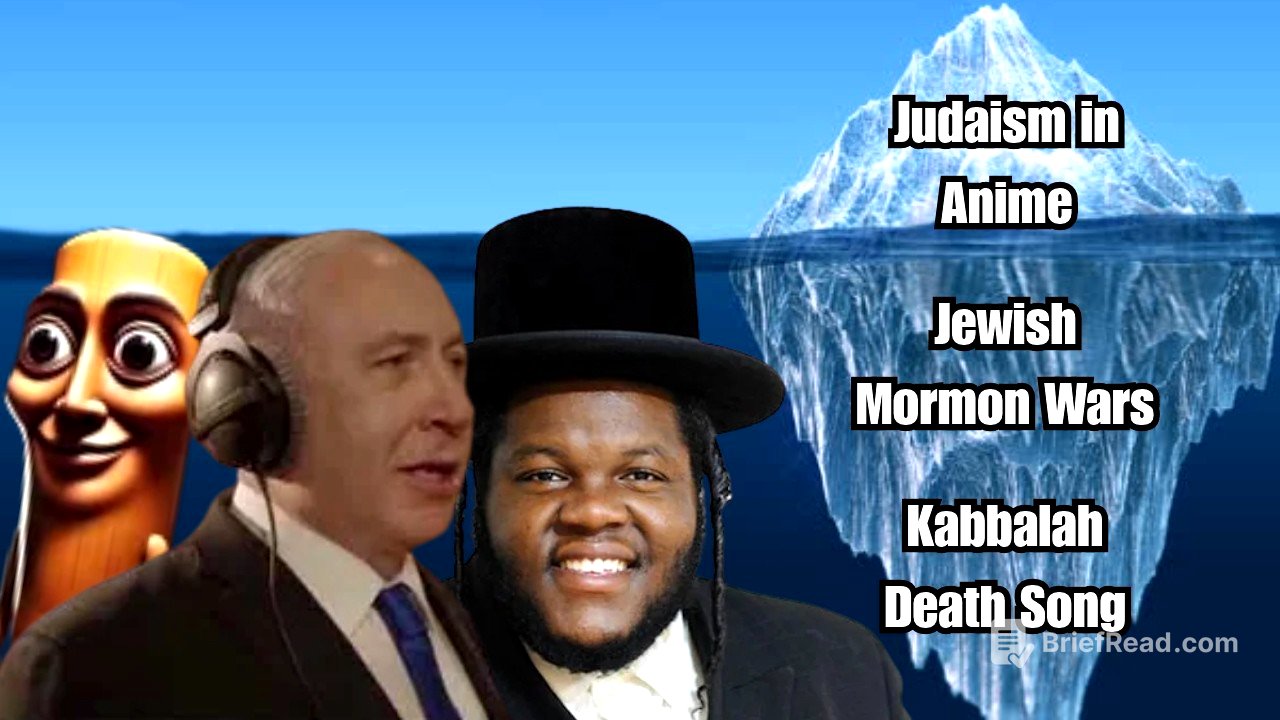
The narrator says the video’s structure reflects an earlier plan to make it an “iceberg” video, which led to some topics being joined together even when they were only loosely related. The video ends with acknowledgements to supporters and a note that its sources are listed in the description.