TLDR;
An oxygen molecule travels from the air into the lungs, passes into the blood and is carried to a working muscle. There, it helps cells release energy from food and is transformed into water; its oxygen atom can then become part of carbon dioxide, which returns to the lungs and leaves the body when you breathe out.
- Oxygen moves from the lungs’ air sacs into the blood and binds to haemoglobin.
- The heart and blood vessels carry it to muscles, where conditions encourage haemoglobin to release it.
- In mitochondria, oxygen accepts electrons and hydrogen ions, forming water and helping cells keep producing energy.
- An oxygen atom can become part of carbon dioxide, which travels back to the lungs and is exhaled.
From Breath to Bloodstream [0:00]
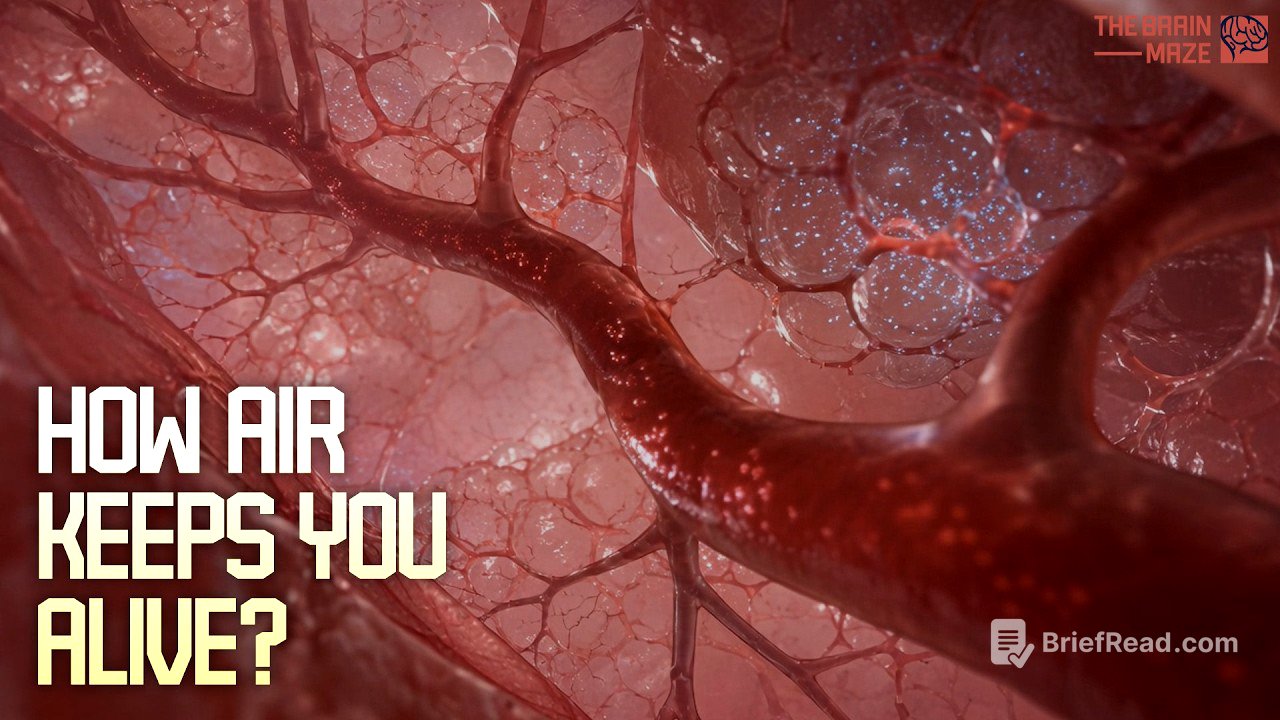
As you breathe in, oxygen enters through the nose, where the air is warmed and moistened, then travels down the windpipe. The airway branches more than 20 times, narrowing until it reaches one of nearly 500 million tiny air sacs in the lungs. A network of small blood vessels surrounds each sac, separated from the air by a wall less than one-thousandth of a millimetre thick. In about a quarter of a second, oxygen crosses this wall and binds to haemoglobin, the protein carried in large numbers inside red blood cells.
Carried to the Muscles [0:49]
The blood carries oxygen to the heart, whose contraction sends it through the aorta. Arteries divide into increasingly smaller vessels, eventually reaching capillaries so narrow that red blood cells must bend to pass through. In a working muscle, oxygen levels are low and the tissue is warmer and more acidic. These conditions make haemoglobin loosen its grip, allowing oxygen to leave the blood and enter a muscle cell.
Oxygen Powers Cells [1:16]
Inside the muscle cell, oxygen reaches a mitochondrion, where electrons taken from food pass along a chain of proteins in the inner membrane. At the end of this chain, oxygen accepts four electrons and binds with four hydrogen ions, forming two water molecules. This final step keeps the electron transport chain running so the cell can produce energy. One of the water molecules then enters the cycle that breaks down food, and its oxygen atom may become part of a new carbon dioxide molecule.
Carbon Dioxide Returns to the Lungs [1:54]
The carbon dioxide leaves the cell and enters a red blood cell, where it is converted into bicarbonate, a form in which much of the body’s carbon dioxide is transported. It travels through the veins back to the heart and then to the lungs. At an air sac, bicarbonate is converted back into carbon dioxide, which crosses into the airways. When you breathe out, it leaves the body as part of a different molecule from the oxygen that entered with the breath.