TLDR;
This video explores the history and evolution of paper, from its ancient origins to its modern industrial production. It covers early writing supports like clay tablets and papyrus, the invention of parchment, and the pivotal development of paper in China. The summary also details the spread of paper production to Europe, the innovations in papermaking, and the eventual shift to using wood pulp, which led to mass production and widespread use of paper.
- Early writing supports included clay tablets and papyrus.
- Paper was invented in China around 105 AD.
- The use of wood pulp in the 19th century enabled mass production of paper.
Cos'è la carta [0:04]
Paper is a material used daily for reading, writing, packaging, and even construction. The term "paper" comes from the Latin word "papyrus," which originally referred to the papyrus sheets used for writing in ancient Egypt. This introduction sets the stage for exploring the history and evolution of paper.
Evoluzione dei supporti per la scrittura [0:27]
Around 7,000 years ago, the Sumerians in Mesopotamia used clay tablets for writing, which were heavy and fragile. The Egyptians, about 5,000 years ago, used papyrus, derived from an aquatic plant. Later, parchment was introduced in Pergamon (present-day Turkey), made from the skins of goats, sheep, or rams. Parchment was more durable and easier to handle than papyrus and was used in Europe until the 14th century.
L'invenzione della carta [1:36]
Paper was developed in China long before its adoption in Europe. According to legend, around 105 AD, a Chinese official noticed that cellulose fibres from worn clothes accumulated in ponds, forming thin layers that, when dried, became suitable for writing. This marked the invention of paper.
Le materie prime antiche [2:02]
The raw materials used to produce paper in ancient China included hemp, bamboo shoots, wheat straw, rice plants, and rags. The highest quality paper was made from rags. These materials were cooked with water and lime for many hours to create a pulp.
La produzione nell'antica Cina [2:15]
In ancient China, the raw materials were cooked with water and lime to create a pulp, which was then washed to further separate the cellulose fibres. The pulp was beaten and diluted in a vat, where a sieve was immersed to retain the fibres and drain the water, forming sheets of paper.
Lo sviluppo delle cartiere [2:58]
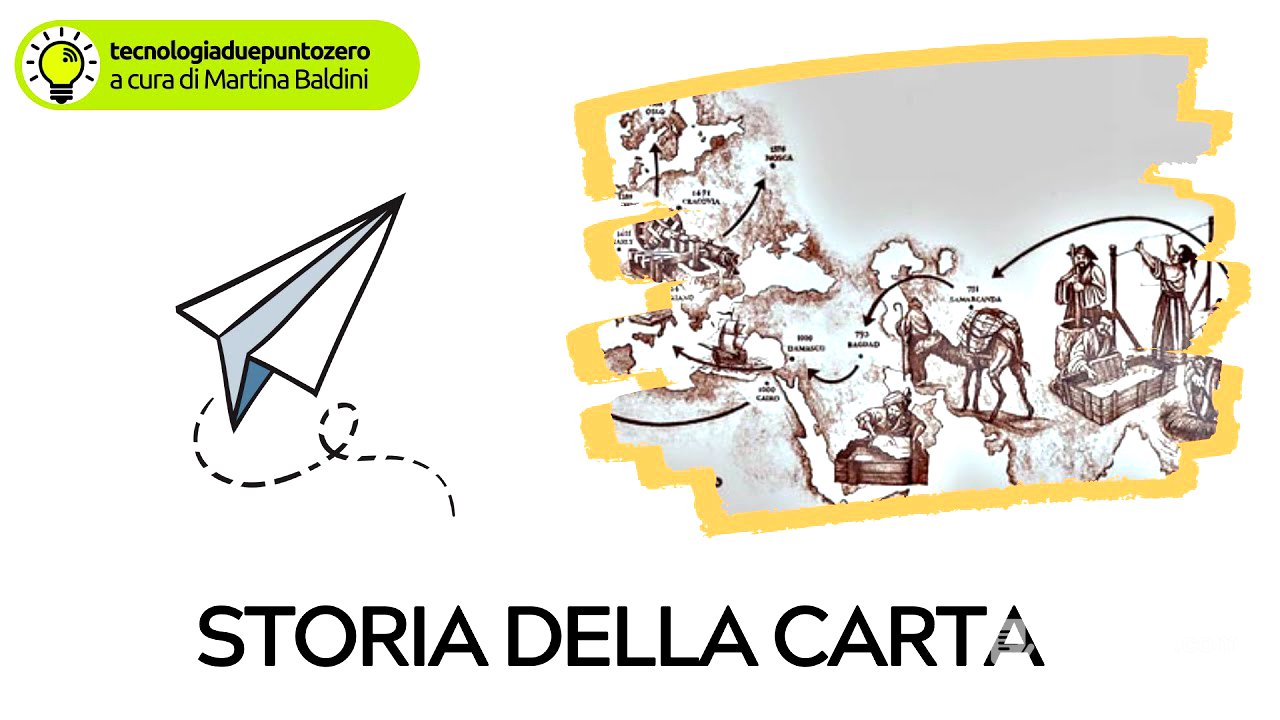
The technique of paper production remained a secret for nearly 700 years. The secret was revealed when some paper producers were captured by the Arabs in 751 AD during the Battle of Talas. New paper mills gradually emerged, first in Samarkand (present-day Uzbekistan), then in Iraq, Syria, North Africa, and eventually in Italy. In 1268, Fabriano, a small town between Ancona and Perugia, began producing paper using new technologies.
La produzione della carta oggi [3:52]
In 1798, a French inventor designed the first continuous machine for paper production, capable of producing sheets 12 to 15 metres long. In the 19th century, continuous technological improvements reduced production costs, but the limited supply of rags necessitated the search for new sources.
L'utilizzo di alberi per la produzione della carta [4:10]
The limited availability of rags led to the use of wood from specially grown trees. With the advent of wood pulp, paper production became mass production, leading to a drop in price and transforming paper into a widely consumed product.
L'importanza della carta [4:40]
Today, paper is an industrial product made with machines and processes that produce thin and flexible sheets. The invention of printing and the industrial production of paper have enabled the significant production of books and the consequent spread of education and culture, promoting what was probably the most important cultural revolution in human history.