TLDR;
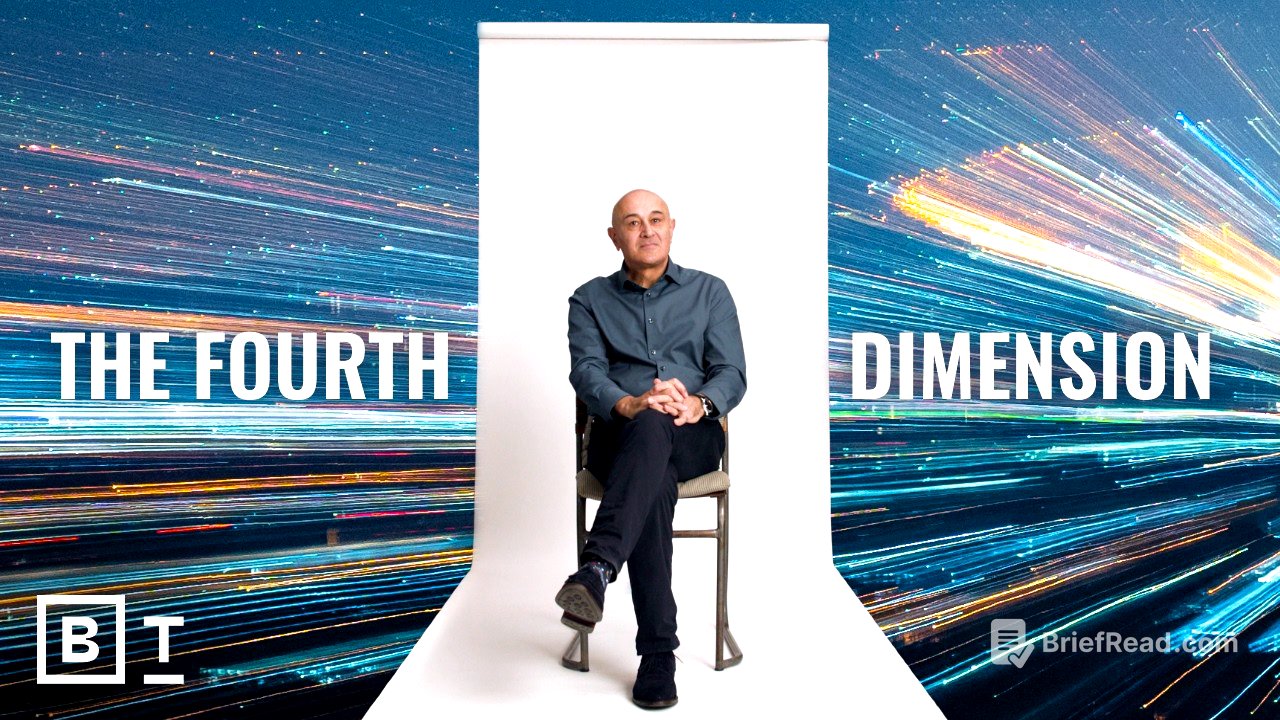
Jim Al-Khalili, an Emeritus Professor of Physics at the University of Surrey, explores the multifaceted concept of time in this video. He addresses several key issues surrounding time, such as its flow, its reconciliation with quantum physics and general relativity, and the nature of 'now'. He also discusses philosophical debates about time and presents empirical evidence for time dilation. The video culminates with intriguing considerations of time travel and the potential future of the universe.
- Time may flow in a psychological sense but has a different meaning in physics.
- Experiments show time dilates under certain conditions, and several theories exist regarding the existence and nature of time.
Does time flow? [0:00]
Jim Al-Khalili outlines the complexities of time, posing questions about its flow, how to reconcile quantum mechanics with general relativity, the significance of the present moment, and the directionality of time. He highlights the distinction between physical time and our psychological perception of time, introducing the term "manifest time" to capture this difference.
Why Time Feels Faster as We Age [2:42]
Al-Khalili explains why time seems to speed up as we grow older. He relates this phenomenon to the accumulation of new experiences that make longer periods during childhood feel extended while shorter periods during adulthood feel brief. He uses examples of enjoyable and tedious situations to illustrate how our perceptions of time can vary significantly, drawing upon historical perspectives from ancient Greeks who debated whether time is fundamental or merely a reflection of change.
Time and Change in Philosophy and Physics [3:56]
The chapter discusses philosophical and physical questions concerning time and change, emphasising the enduring debates among philosophers and scientists. Al-Khalili references Richard Feynman's view of time as a measure of nothing happening, contrasting it with Newton's idea of absolute time governed by an independent cosmic clock.
Einstein and the End of Absolute Time [5:28]
Al-Khalili describes how Einstein's theories of relativity transformed our understanding of time from being absolute and independent to being relative. This shift challenges our intuitive sense of time, as he discusses how our perception of past, present, and future persists despite the absence of a universal flow of time in the laws of physics.
Time in the Equations of Physics [6:19]
In this segment, he explains that in many physical equations, time is simply a variable that does not intrinsically change or flow. While physical systems can evolve over time, that time itself lacks an inherent change, raising questions about the real nature of time in the universe.
How do we reconcile quantum field theory with the general theory of relativity? [7:50]
Al-Khalili discusses the intricate challenges faced when trying to unify quantum field theory, which involves isolated systems, with general relativity, which necessitates an understanding of gravity and acceleration. He introduces the Wheeler-Dewitt equation, which intriguingly contains no time in its formulation, leading to a debate on whether time might be an emergent property.
Evidence for Time Dilation: Muons [12:10]
Here, he presents evidence for time dilation using the example of muons, particles produced in the atmosphere, that travel to Earth with a longer observed lifetime due to their high velocity. This phenomenon is used to illustrate how time can indeed be affected by speed, a central concept in Einstein's theories.
Gravity Slows Time: General Relativity [14:29]
Al-Khalili discusses the implications of gravity on time as articulated by Einstein in his general theory of relativity, where he presents the principle of equivalence—indicating that acceleration and gravity affect the passage of time. The practical implications of GPS satellites, which require adjustments for the different rates at which time passes based on gravitational strength, exemplify this concept.
Space-Time and the Block Universe [19:22]
This chapter explores the concept of a block universe, suggesting that all points in time exist simultaneously like slices in a book. Al-Khalili elucidates how our experience of moving through time could be represented as a world line within this block framework, which fundamentally alters our understanding of events and causality.
Does Time Really Exist? [21:55]
Al-Khalili introduces the philosophical discourse on the existence of time, referencing debates around eternalism—where all moments exist equally—and the notion that time could be an illusion derived from our perception. He discusses how differing philosophical views challenge our understanding of what time is.
The Debate: Eternalism vs Presentism [26:33]
Built on the earlier discussion, this section addresses the tension between eternalism—which posits that all times exist equally—and presentism, which asserts that only the present is real. Al-Khalili considers how these views relate to modern physics and whether there are implications for free will.
Chapter 3: Is There a “Now”? [34:12]
The chapter debates whether an absolute 'now' can exist given the relativity of simultaneity, proposing that two observers can experience events differently based on their movement. This relativity raises significant questions about the nature of the present moment and whether it can be defined in a universal context.
Chapter 4: Why Does Thermodynamics Have a Direction in Time? [40:40]
Al-Khalili examines why thermodynamics implies an arrow of time—pointing from past to future—despite the time-symmetry present in physical laws. He elaborates on the second law of thermodynamics and how entropy consistently increases, providing insight into the directionality of time, which conflicts with the symmetrical nature of fundamental physics.
Quantum Entanglement and the Direction of Time [49:38]
In this chapter, he touches on how quantum entanglement complicates our understanding of time, indicating that the entanglement of particles can bring about irreversibility in relationships between systems and influence our perception of time's direction.
Did Time Begin at the Big Bang? [55:10]
Here, Al-Khalili addresses whether time had a definitive beginning at the Big Bang, exploring concepts that question what 'before' the Big Bang even means when the current understanding of time requires a temporal framework to consider it.
Will Time End? [45:00]
This section considers the potential end of time through various theories, including the Big Crunch and heat death scenarios. Al-Khalili discusses current cosmological models and what they suggest about the future of the universe and the concept of time itself.
Chapter 5: Is Time Travel Possible? [1:05:40]
Al-Khalili concludes the video by discussing the feasibility of time travel. He differentiates between travelling to the future, which is theoretically plausible through relativistic effects, and the paradoxes that arise with time travel to the past. He presents various speculative theories, such as the possibility of multiple realities to resolve these paradoxes, while highlighting the unresolved nature of these discussions in modern physics.