TLDR;
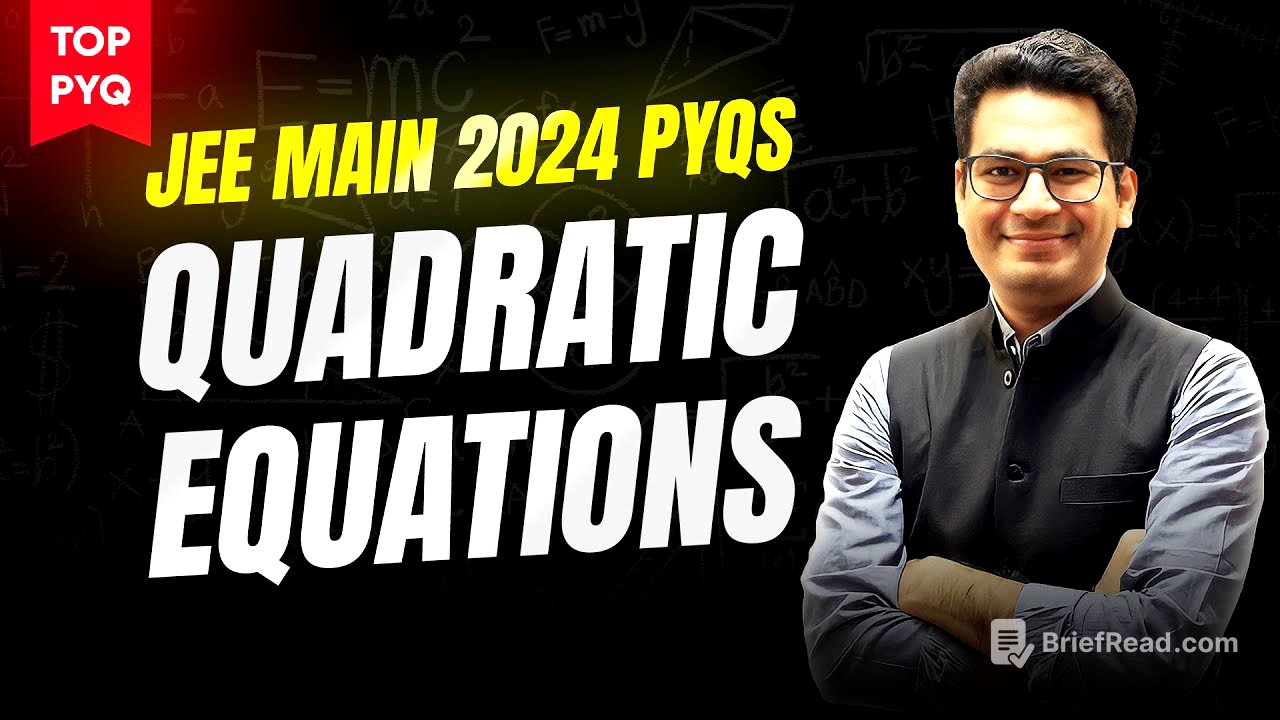
This YouTube video by MathonGo features a PYQ (Previous Year Questions) series for JEE Main 2024, focusing on quadratic equations. The presenter, Prince Sir, solves selected questions from the 2024 exam, aiming to cover major concepts and recent trends. The session also provides insights into the types of questions, difficulty levels, and important concepts frequently asked in the exam. Key points covered include:
- Solving quadratic equations using sum and product of roots.
- Applying Newton's Theorem to solve complex problems.
- Utilising the concept of complete squares to find minimum values.
- Analysing modulus-based equations and their graphical solutions.
Introduction [0:00]
The video introduces a PYQ series designed to maximise learning for the January attempt of JEE Main 2024. The series, led by Prince Sir from MathonGo, aims to cover a wide variety of predictable topics. The goal is to enhance learning by exploring multiple methods for solving each question, embodying what MathonGo terms the "learning mode." PDF slides of the session, including practice questions, will be available on the MathonGo app and website.
Top PYQs of JEE Main 2024: Quadratic Equations [1:49]
Prince Sir begins the session by stating that they will be solving selected questions from the JEE Main 2024 quadratic equations papers. The selection is designed to cover major concepts, although some topics like common roots and location of roots were not featured in the 2024 papers. Emphasis was placed on relation between roots and coefficients, and modulus-based questions. The session aims to provide insights into recent question types, difficulty levels, and frequently tested concepts.
Question 1: Roots and Quadratic Equation Formation [2:55]
The first question involves finding a quadratic equation given its roots, which are expressed in terms of α and β, the roots of another quadratic equation. Three methods to approach such problems are outlined: using the sum and product of roots, substituting the roots into the equation, and using factors of the polynomial. The presenter opts for the first method, using α + β and α * β to find the values of the new roots. Algebraic identities are used to calculate α^4 + β^4 and α^6 + β^6. The final step involves forming the quadratic equation using the sum and product of the new roots.
Question 2: GP and Roots of Quadratic Equation [7:07]
The second question involves α and β as roots of a quadratic equation, with the coefficients p, q, and r being consecutive terms of a non-constant GP. The condition p ≠ 0 is given to ensure the equation is quadratic. The problem requires finding the value of (α - β)^2. The presenter highlights the importance of checking for potential division by zero. The GP condition is used to express q and r in terms of p and a common ratio k (where k ≠ 1). The expression (α - β)^2 is then simplified using α + β and α * β, leading to a solution in terms of k.
Question 3: Natural Number Roots and Conditions [11:05]
The third question involves finding the minimum possible value of λ, given that α and β are natural number roots of a quadratic equation. Conditions are imposed: λ/2 and λ/3 are not natural numbers. The presenter initially considers integer root conditions (a=1, b and c are integers, discriminant is a perfect square) but finds this approach difficult. The presenter then uses α + β = 70 and α * β = λ to express λ in terms of a single variable. The presenter discusses methods to minimise λ, including differentiation and using the vertex formula, but notes these are unsuitable due to the constraints on α. The presenter uses the square completion method to find the minimum value of λ, considering the natural number constraint on α and the conditions on λ/2 and λ/3.
Question 4: Newton's Theorem Application [19:57]
The fourth question introduces Newton's Theorem. The presenter explains Newton's Theorem, which relates the coefficients of a quadratic equation to a recursive sequence defined by the roots of the equation. The presenter identifies the given expression as fitting the Newton's Theorem pattern. By applying Newton's Theorem and substituting n = 12, a relationship between p10, p11, and p12 is established. This relationship is used to simplify the expression to be found. Further application of Newton's Theorem with n = 11 leads to the final answer in terms of p9.
Bonus Question: Newton's Theorem with Coefficients [24:25]
The bonus question is another application of Newton's Theorem. The presenter highlights that Newton's Theorem is still applicable even with coefficients in front of the terms. The presenter provides a proof by showing that the recursive relation holds even when the terms are multiplied by constants p and q. The presenter applies the theorem to the given problem and finds the correct answer.
Question 5: Newton's Theorem and Minimum Value [25:55]
The fifth question involves finding the minimum value of an expression related to the roots of a quadratic equation, using Newton's Theorem. The presenter applies Newton's Theorem to establish a relationship between a2023, a2024, and a2025. The presenter finds the minimum value of the resulting quadratic expression. The presenter emphasises the importance of checking for restrictions on the variable and uses the square completion method to find the minimum value.
Question 6: Modulus Equation and Graphical Solution [31:38]
The sixth question involves finding the number of real solutions to a modulus equation. The presenter discusses two methods: solving by cases and using a graphical approach. The presenter explains the importance of checking the validity of solutions obtained from each case. The presenter opts for the graphical method, plotting the graphs of the left-hand side and right-hand side of the equation. The presenter uses the concept of slope to determine how the graphs intersect. The presenter uses symmetry to deduce the number of solutions.
Question 7: Exponential and Trigonometric Equation [43:37]
The seventh question involves finding the number of solutions to an equation involving exponential and trigonometric functions. The presenter identifies the repeating term e^(sin x) and substitutes it with t, transforming the equation into a quadratic. The presenter solves the quadratic equation and checks the validity of the solutions, considering the range of sin x and the approximate value of e.
Question 8: Roots of a Quartic Equation [46:26]
The eighth question involves finding the value of an expression given the roots of a quartic equation. The presenter discusses various approaches, including using the relation between roots and coefficients and reducing the quartic to a quadratic. The presenter opts for a transformation method, aiming to find a new equation whose roots are x1^2 + 4, x2^2 + 4, etc. The presenter highlights that the product of roots is the target. The presenter performs the transformation and simplifies the equation. The presenter uses the fact that the product of roots is e/a to find the required value. The presenter also introduces an alternative method using factors and substitution.
Question 9: Triangle Side Lengths and Equation [59:05]
The ninth question involves finding the possible values of x, given that a, b, and c are the side lengths of a triangle and satisfy a given equation. The presenter states that the sum of two sides is always greater than the third side. The presenter identifies the equation as having four unknowns and suggests looking for a trick to solve it. The presenter completes the square and finds that a, b, and c are in GP, with x being the common ratio. The presenter uses the triangle inequality to establish conditions on x. The presenter discusses the importance of considering only the relevant inequalities and solves the inequalities to find the possible values of x.
Bonus Question: Complete Squares in Sequence and Series [1:06:04]
The bonus question involves non-zero real numbers a, b, c, d, and p, satisfying a given equation. The presenter identifies the pattern of squares and recognises that the equation can be expressed as a sum of complete squares. The presenter equates each square to zero and finds that a, b, c, and d are in GP, with p being the common ratio.
Conclusion [1:07:34]
The presenter concludes the session, summarising the types of questions covered and highlighting key concepts. The presenter recommends the Marks app for topic-wise practice questions and mentions that the PDF of the session will be available in the description.