TLDR;
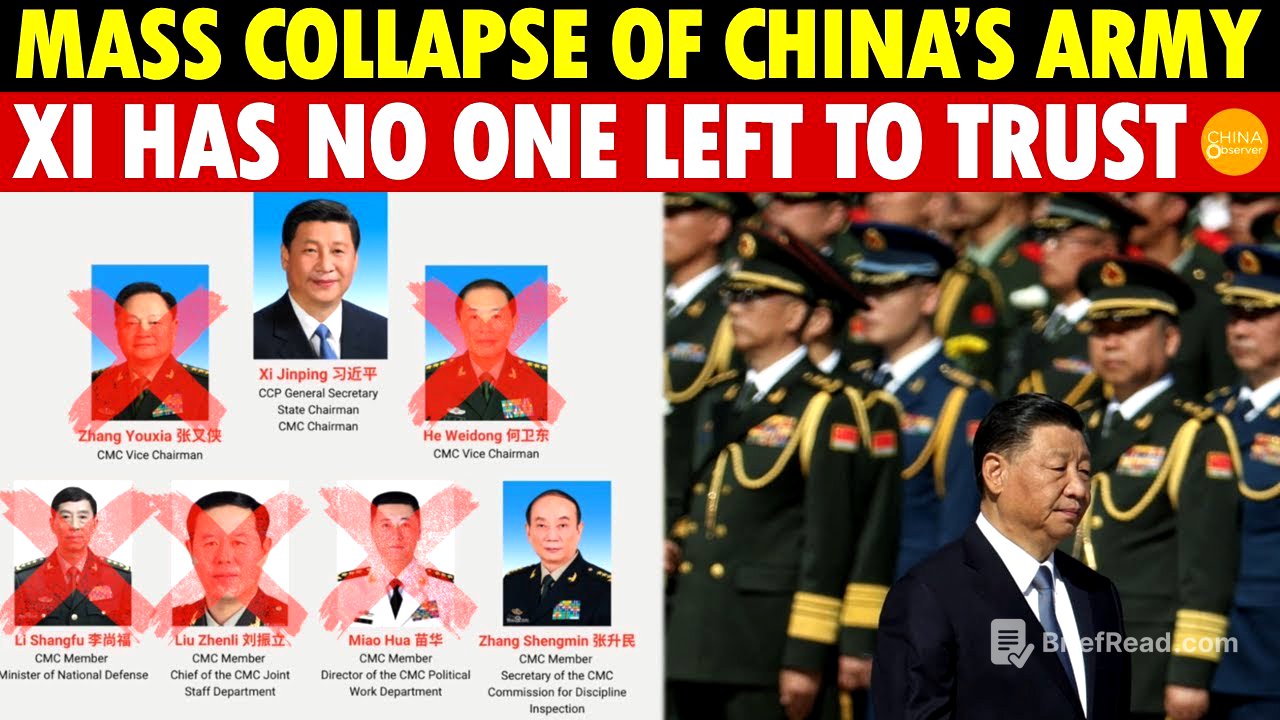
This video discusses the implications of the recent purges within China's Central Military Commission, focusing on the downfall of General Zhang Youxia and its impact on Xi Jinping's leadership and the overall strength of the People's Liberation Army (PLA). It argues that while these purges appear to consolidate Xi Jinping's power, they actually reveal his deep insecurity and are weakening the military from within, fostering a culture of fear and corruption.
- The removal of key figures like Zhang Youxia, a long-time ally of Xi Jinping, signals a crisis of trust within the Chinese leadership.
- The anti-corruption campaign and subsequent measures, including de facto martial law, highlight the government's anxiety and potential instability within the military.
- The purges have led to a "Tacitus Trap" where loyalty is feigned, corruption is rampant, and the military's ability to fight effectively is severely compromised.
Downfall of Key Military Figures [0:00]
The Chinese military confirmed the investigation of General Zhang Youxia, the second-highest-ranking official in the Central Military Commission (CMC), and Chief of Staff Lu Zen Lee. This event has caused significant upheaval in Chinese political circles and has global geopolitical implications. In just two years, the seven-member CMC now effectively consists only of Xi Jinping and the newly appointed Vice Chairman Dang Ming, who may also soon be removed. This extreme concentration of power suggests a deeper crisis, potentially hollowing out the military command structure and weakening its combat effectiveness.
Xi Jinping's Crisis of Trust [1:21]
The removal of Zhang Youxia, a long-time ally of Xi Jinping, indicates a severe crisis of trust at the highest levels of Chinese leadership. Despite appearing to be at the peak of his authority, Xi Jinping has few individuals left whom he can genuinely trust or depend on. This pattern is a common outcome for leaders seeking total control, creating a system that isolates them and increases their vulnerability. Japanese journalist Akio Yayita suggests this situation could deeply affect China's political, social, and military systems, potentially weakening the military due to Xi's extreme distrust.
Government Response and Military Unrest [2:36]
Following Zhang Youxia's downfall, the Chinese government initiated a major media campaign, publishing an editorial in the People's Liberation Army Daily condemning Zhang and Lu Zen Lee for damaging the military commission's system of accountability and weakening the party's leadership over the armed forces. The harsh language used in the editorial suggests anxiety at the top levels of government and uncertainty about managing the consequences. Former Inner Mongolia official Du Wen noted that the government's strong criticism has fuelled rumours of a coup and that the CMC is in a state of functional paralysis.
Martial Law Measures and Internal Divisions [4:15]
To prevent potential unrest within the military, the authorities have implemented measures resembling de facto martial law. These include irregular command structures with direct orders from the chairman's office, extreme controls on troops, and intense political pressure requiring personnel to study "Xi Jinping Thought" and demonstrate loyalty. Those connected to Zhang Youxia's group face two options: submit to investigation or risk a dangerous gamble, potentially leading to military mutiny. The real impact of the purge lies with those left behind, fostering an environment of fear and self-preservation rather than loyalty and cooperation.
Erosion of Military Capabilities [5:41]
The prevailing attitude within the military has shifted from loyalty to fear, obedience to self-protection, and honour to mere endurance. This shift results in a breakdown of trust, hindering cooperation and emptying the PLA of its spirit as a capable modern force. While the army may appear strong on the surface, it is weakened internally, potentially rendering it ineffective in actual combat. Xi Jinping's actions, intended to remove rivals, have damaged the core of the military, creating a force that appears loyal but lacks the ability to fight effectively.
Totalitarian Rule and Self-Consumption [7:02]
The situation reveals a pattern inherent in totalitarian rule, where the power structure becomes self-consuming. A dictator initially allies with supporters to remove rivals but eventually suspects and eliminates even close allies. Zhang Youxia's removal signals a new phase where every potential threat must be eliminated preemptively. His reputation, skill, and experience made him too risky to keep. This preemptive action, driven by fear, has ironically created the danger it aimed to prevent, leading to a "Tacitus Trap" where loyalty is feigned.
Tacitus Trap and Corruption [9:18]
The Chinese system has fallen into a "Tacitus Trap," where loyalty is only superficial, leading to exaggerated displays of devotion and empty political slogans replacing genuine discussion. Concerns about using force against Taiwan, like those reportedly voiced by Zhang Yong Shao, can be seen as disloyalty. Corruption spreads unchecked as the military becomes driven by personal gain rather than commitment to its mission. Scandals, such as faulty equipment in the rocket force and poor performance of Chinese-supplied weapons, expose internal decay.
Consequences of Corruption and Purges [10:43]
Military leaders who prioritise personal benefit over national defence allow the armed forces to weaken from within. Corruption is used as a tool for promotion and mutual protection within the CCP's military. Xi Jinping's lack of trust has driven him to launch a self-destructive purge, fostering a false loyalty culture and hollowing out the military, rendering it incapable of waging modern war. This conclusion is supported by the erosion of soldiers' fighting will, fragmentation of the command structure, and corruption affecting equipment quality.
Three Perspectives on Military Incapability [11:45]
The hollowing out of the military can be analysed from three perspectives: the erosion of soldiers' fighting will due to corruption and lack of belief in their leaders, the fragmentation of the command structure hindering seamless cooperation between military branches, and the corruption-related deficiencies in equipment quality. These factors undermine the PLA's ability to conduct complex operations and face battle-tested forces like the US military. Seemingly powerful numbers on paper will deflate under the stress of real-world combat, potentially leading to disastrous outcomes.
Xi Jinping's Insecurity and the Dictator's Dilemma [13:51]
Commentator Zang Tien Leyang argues that Zhang Youxia's downfall is a direct result of Xi Jinping's extreme insecurity and obsession with power, revealing how an authoritarian system driven by suspicion leads to self-consumption. By breaking term limits and eliminating collective leadership, Xi destroyed institutional checks and found himself trapped in the dictator's dilemma, unable to trust anyone. The endless cycle of suspicion has reached core figures like Zhang Youxia, ensnaring the regime in a "Tacitus Trap" where nothing they say or do can gain trust. While Xi may have secured absolute safety for himself, he has lost the trust of the military and the entire bureaucratic system, potentially ending up with a hollowed-out army incapable of fighting a real battle.