TLDR;
This lecture introduces the professional applications and skill set development in human movement science. It highlights the diverse fields where movement science is applicable, including sports science, physical rehabilitation, clinical movement analysis, occupational ergonomics, and academic research. The lecture also outlines the specific skills that the course aims to develop, such as biomechanics, kinesiology, functional anatomy, and physiology, and the basic mathematical and physics knowledge required.
- Application of movement science in various professional fields.
- Key skills to be developed: biomechanics, kinesiology, functional anatomy and physiology.
- Basic mathematical and physics knowledge required.
Professional Areas of Application [0:27]
Human movement science has numerous professional applications. In sports science and performance optimisation, it involves quantifying athlete movement to design effective training programmes, such as velocity-based training. In physical rehabilitation, understanding and quantifying movement patterns is crucial for assessing recovery from injuries like stroke or ACL tears, ensuring athletes can safely return to professional play. Clinical movement analysis uses gait analysis to assess neurological conditions, quantifying behaviours to evaluate the effectiveness of clinical interventions. Occupational ergonomics focuses on designing workspaces that align with human anatomy and physiology to prevent musculoskeletal injuries, particularly in roles involving repetitive tasks or heavy lifting. Academic research integrates movement science with fields like neuroscience to study brain activity during movement, aiming for mechanistic understandings beyond mere observation.
Specific Skills Development [4:53]
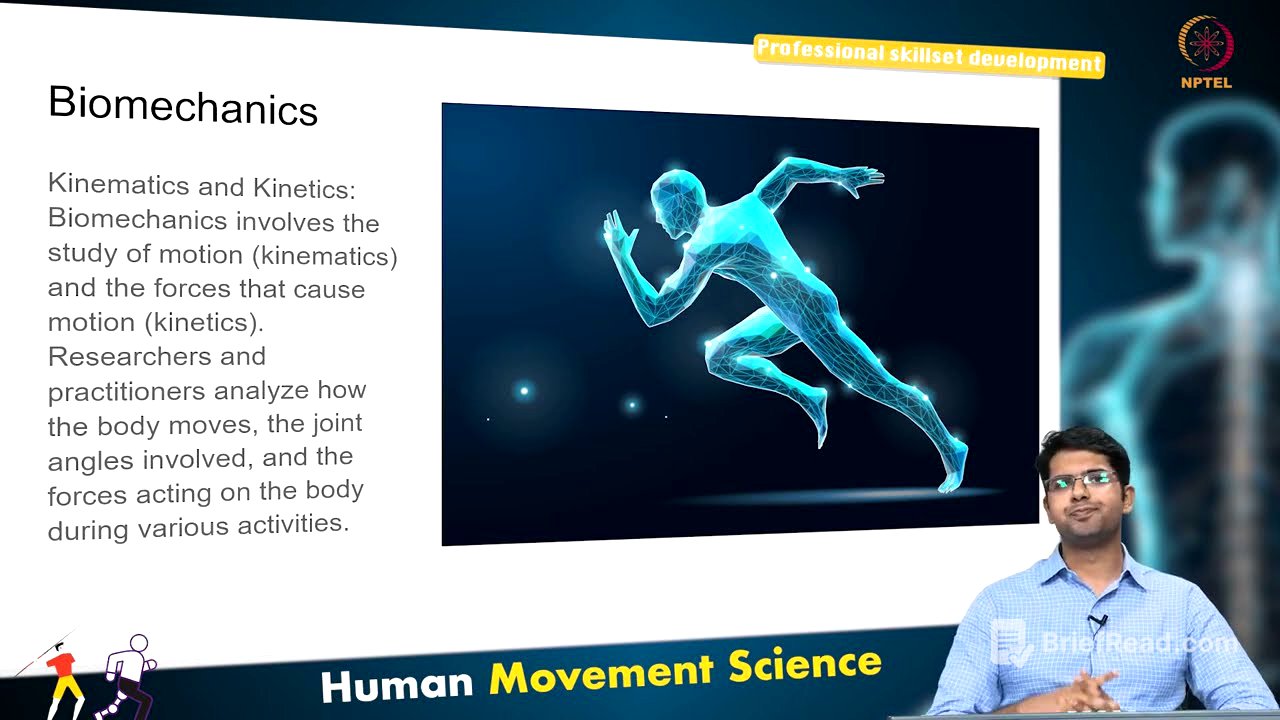
The course aims to develop specific skills, starting with quantification through biomechanics, which applies mechanical principles to human movement. This is useful in clinical settings for assessing gait in stroke patients and in sports science for biofeedback training and injury risk assessment. Kinesiology, functional anatomy, and physiology are also important for identifying optimal movement patterns in various contexts, such as differentiating between correct and incorrect deadlift postures to prevent injury. Muscular anatomy knowledge aids in designing training curricula, identifying over or under-training, and creating rehabilitation programmes. In clinical movement analysis, biomechanics principles are applied to gait analysis, using parameters like step width to identify potential neurological disorders and range of motion to design targeted training and stretching programmes post-injury.
Background Resources [9:33]
The course requires only basic mathematics, including trigonometry, geometry, and algebra, alongside a fundamental understanding of physics. This includes knowledge of forces, their actions, and planes of movement, focusing on the physical interaction of bodies with the world.