TLDR;
This video provides a detailed explanation of assimilation in phonology, a feature of connected speech where a sound changes to become more similar to a following sound. It covers assimilation within words and between words, illustrating various types of assimilation with examples and clear explanations of how and why these changes occur. The video also includes a test to check understanding.
- Assimilation is a sound change making it more similar to the next sound.
- It occurs within and between words.
- Examples include changes like 'n' to 'm' before 'b', 'm', or 'p', and 't' to 'tʃ' before 'j'.
What is assimilation? [0:00]
Assimilation is a feature of connected speech where a sound changes to become more similar to a following sound. There are several features of connected speech, including assimilation, elision and intrusion. Assimilation is when a sound becomes more similar to another sound. Assimilation can occur within a word or between words, across the word boundary.
Assimilation within a word [1:16]
Assimilation within a word is demonstrated using "handbag" as an example. In fast speech, "handbag" changes to "hambag". The 'n' in "hand" changes to 'm' because the following sound 'b' in "bag" is produced with both lips closed. This change helps speakers articulate faster as the lips are already prepared for the 'b' sound. This process happens naturally in fast speech.
Assimilation between words: n → m before b, m & p [4:33]
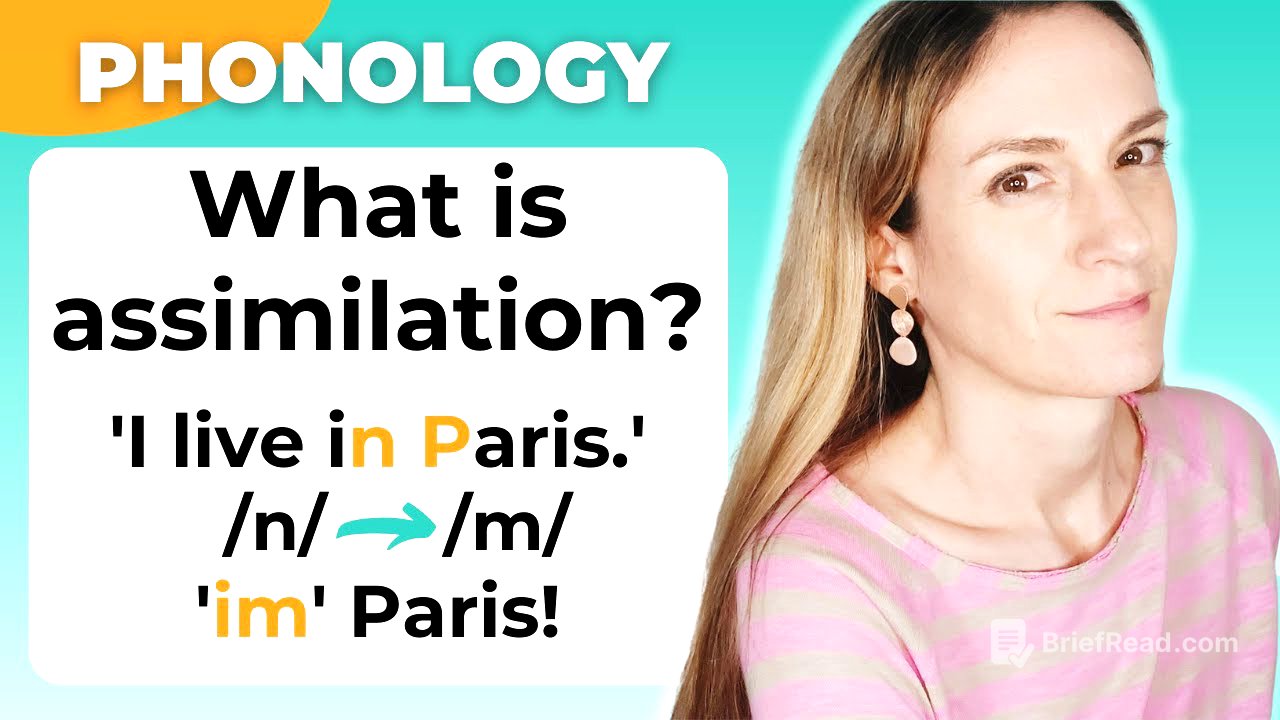
Assimilation between words is explained with the sentence "I live in Barcelona." The 'n' in "in" changes to 'm' before the 'b' in "Barcelona," resulting in "im Barcelona." This change occurs because 'm' and 'b' are both formed with the lips closed. This assimilation also happens when 'n' is followed by 'm' or 'p', as in "in Madrid" and "in Paris," where 'n' becomes 'm'.
Assimilation between words: n → ŋ before k & g [6:41]
The video explains that assimilation doesn't only occur from 'm'. In the sentence "There were ten kings," the 'n' in "ten" changes to 'ŋ' (the 'ng' sound) before the 'k' in "kings," pronounced as "teŋ kings." This happens because 'ŋ' is formed by moving the tongue back towards the throat, preparing for the 'k' sound. Similarly, in "ten girls," the 'n' changes to 'ŋ' before the 'g'.
Assimilation between words: s → ʃ before ʃ [10:00]
Assimilation can also occur with the fricative 's', which can change to 'ʃ' (sh) before another 'ʃ' sound. For example, in the phrase "nice shoes," the 's' in "nice" changes to 'ʃ', making it sound like "niʃ shoes." This merging of sounds occurs because the mouth is already in position to pronounce the 'sh' in "shoes".
Assimilation between words: θ → s before s [11:27]
Another example of assimilation involves the voiceless fricative 'θ' (as in "fourth") changing to 's' before a word starting with 's'. In the phrase "fourth Sunday," the 'θ' in "fourth" changes to 's', resulting in "fors Sunday." This change simplifies pronunciation and prepares the mouth for the 's' sound in "Sunday".
Assimilation between words: t followed by j → tʃ [13:04]
When the sound 't' is followed by 'j' (the 'y' sound), it often changes to 'tʃ' (ch). For example, in the phrase "nice to meet you," the "meet you" becomes "meet-chu". The 'you' is a weak form with a schwa sound. This assimilation doesn't always happen, but it is common.
Assimilation between words: d followed by j → dʒ [14:52]
Similarly, when 'd' is followed by 'j', it changes to 'dʒ' (j sound). For instance, "would you like to come" becomes "would-ja like to come". This also occurs in phrases like "need your help," which becomes "need-ja help," where 'd' and 'your' merge into 'dʒ'.
Test Yourself! [16:45]
The video concludes with a test to identify assimilation in sentences. Examples include "ten grams" where 'n' changes to 'm', "dress shop" where 's' changes to 'ʃ', and "want you" becoming "want-chu," illustrating the assimilation of 't' and 'j' into 'tʃ'.