TLDR;
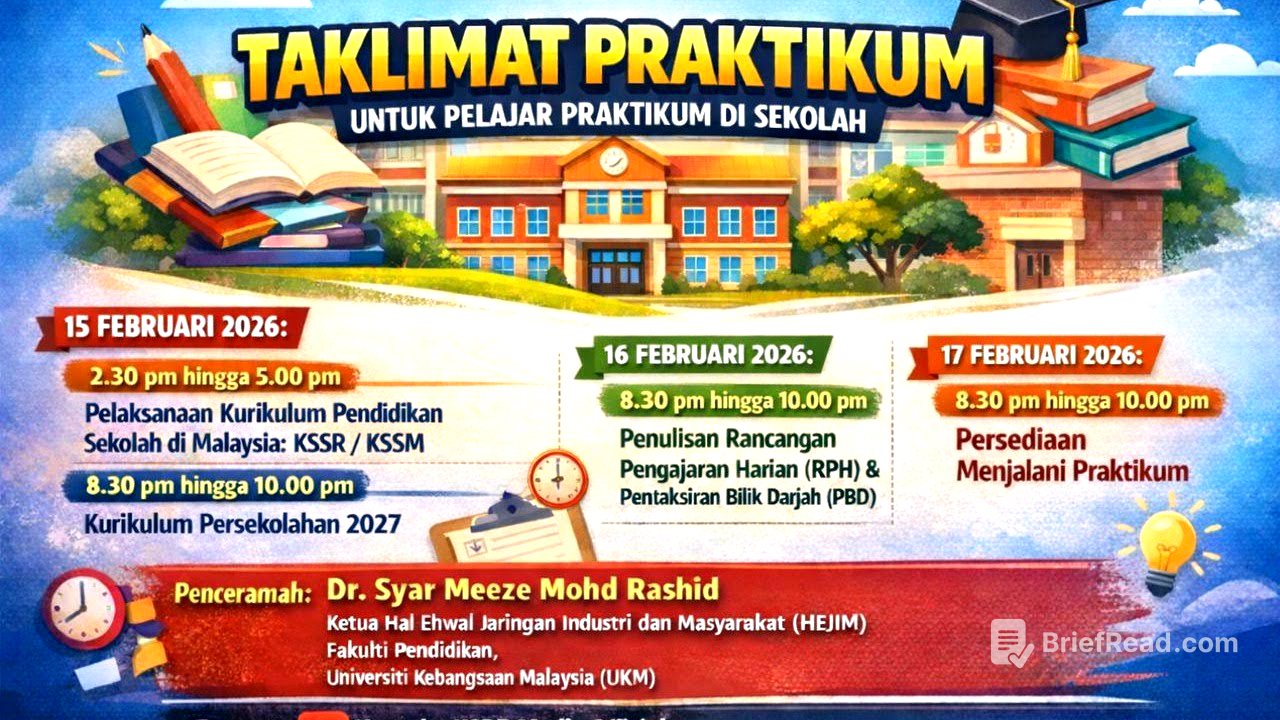
This YouTube video provides a comprehensive guide for trainee teachers in Malaysia on crafting effective lesson plans (RPH) and understanding classroom-based assessment (PBD). It emphasises the importance of aligning teaching practices with the national education philosophy and instilling patriotism in students. The video also covers practical aspects such as using the correct RPH template, incorporating elements of moral values and cross-curricular aspects, and leveraging assessment to understand student progress.
- Importance of aligning teaching with national education philosophy.
- Practical guidance on RPH and PBD.
- Emphasis on instilling patriotism and moral values.
- Use of appropriate RPH templates and assessment methods.
Opening Remarks and Introduction [0:34]
The video begins with an invocation and a welcome to education students. The speaker expresses gratitude for the attendees and apologises for using their holiday time for the briefing, explaining that it's to avoid disrupting Ramadan. The speaker introduces the song "Sejahtera Malaysia" and a Petronas video to illustrate the state of schools in Malaysia and the role of teachers in fostering patriotism among students.
The Role of Teachers in Malaysia [13:39]
The speaker stresses the importance of teachers spreading the Rukun Negara ideology to instil pride and a desire to contribute to the country. They express disappointment that some teachers only provide universal answers when asked about their role, lacking a deep understanding of their responsibilities in Malaysia. The speaker shares an emotional connection to the topic, acknowledging the sadness and heartfelt feelings associated with loving one's country.
Curriculum and the Importance of Iktisas [17:13]
The session transitions to discussing RPH (lesson plans) and PBD (classroom-based assessment). The speaker refers to previous discussions on the national school curriculum and encourages new viewers to watch the earlier briefing. They question the value of pursuing a Diploma in Education (DPP) or Bachelor of Education (ISMP) if teachers revert to basic "chalk and talk" methods, emphasising that qualified teachers should demonstrate a deeper understanding of educational goals and planning.
Understanding PBS and PBD [23:27]
The speaker introduces the PBD implementation guide and explains the difference between the old and new versions. They emphasise the importance of understanding PBS (School-Based Assessment) and PBD, especially with the upcoming 2027 curriculum. Teachers need to assess students' progress and mastery, not just teach. Traditional paper-based assessments are evolving to recognise diverse talents, leading to the creation of PBS.
Types of School-Based Assessments [25:55]
The speaker outlines the two main types of school-based assessments: academic and non-academic. Academic assessments include central assessments (like SPM) and classroom-based assessments (PBD). Non-academic assessments include PAJSK (Physical, Sports and Co-curricular Activities Assessment) and psychometric assessments. The speaker urges all teachers, regardless of their specialisation, to take Physical Education (PJ) seriously and avoid gender stereotypes in sports activities.
The Importance of Physical Education and Arts [27:32]
The speaker expresses strong disapproval of teachers who neglect or misuse PJ time, emphasising its importance in developing well-rounded individuals. They share personal experiences of not experiencing quality PJ during their school years and urge teachers to use PJ time for its intended purpose, including health education. The same importance is given to Visual Arts and Music.
Psychometric Assessments and PBD Characteristics [33:37]
The discussion moves to psychometric assessments, focusing on emotional aspects in primary schools and career guidance in secondary schools. The speaker highlights the key characteristics of PBD, including teacher-led planning, recording, and the use of formative and summative assessments. They stress the importance of creating assessment forms to document student progress, especially for observations and oral assessments.
Types of Classroom Assessments in PBD [37:22]
The speaker details the three types of classroom assessments in PBD: observation, oral, and written. While written assessments are familiar, observation and oral assessments often cause confusion. The speaker stresses the need for assessment forms for all assessment types, encouraging teachers to design their own based on the curriculum standards and their students' needs.
Moderation and Assessment Methods [40:33]
The speaker discusses professional judgement and moderation to ensure fair and equitable assessments. They mention that schools may have different approaches to PBD, including pre-designed forms or teacher-created forms. The speaker reiterates the importance of various assessment methods and the use of mid-term and end-of-term tests. The speaker emphasises the need for evidence-based assessment to determine student achievement levels accurately.
Practical Tips for PBD and Avoiding Uncreative Practices [44:06]
The speaker advises against relying solely on photocopied worksheets and encourages teachers to create their own materials. They suggest using digital platforms like Google Forms to make assessments more engaging. The speaker urges teachers to understand the various assessment types and actions within PBD, and to consult resources before becoming teachers.
Transition to RPH Discussion and Initial Steps [49:16]
The session transitions to discussing RPH (lesson plans). The speaker directs the audience to the Curriculum Development Division website to download the relevant curriculum documents (DSKP). They outline the initial steps to take when starting at a new school, including obtaining the school timetable, identifying subject teachers, and requesting the Rancangan Pengajaran Tahunan (RPT) or yearly lesson plan.
Navigating Different Teacher Attitudes and Observing the Classroom [52:39]
The speaker discusses the two types of teachers that trainee teachers might encounter: professional teachers who provide clear guidance and "acik-acik" teachers who are less helpful. The speaker advises trainee teachers not to adopt the "acik-acik" attitude. When entering a classroom, the speaker advises to observe the number of students, the subject time, student behaviour, cognitive level, and class size.
Key Observations and Preparing for RPH Development [58:29]
The speaker reiterates the five key observations to make in the classroom: subject time, number of students, student behaviour, cognitive level, and class size. These observations will inform the development of the RPH. The speaker references the earlier video featuring Cikgu Murni as an example of how to observe and understand a class.
RPH Template and Requirements [1:04:55]
The speaker emphasises that trainee teachers should use the UKM (Universiti Kebangsaan Malaysia) template for their RPH during their 12 practical teaching hours. Teachers already employed at the school should use the KPM template for the remaining hours. The speaker stresses that the UKM template must be used and that headteachers are aware of this.
Filling Out the RPH Template: Initial Sections [1:10:54]
The speaker guides the audience through filling out the RPH template, starting with basic information like subject, date, class, number of students, time, theme, and topic. The speaker advises to leave the "kemahiran fokus" (focus skill) section blank until the RPH is complete, then select a relevant 21st-century skill from the DSKP.
Standard Content and Learning Standards [1:16:18]
The speaker explains how to select appropriate learning standards based on student cognitive levels and available time. They emphasise that the learning standards should be copied and pasted exactly from the DSKP or RPT without any alterations.
Writing Objectives: Key Principles and Formula [1:19:51]
The speaker explains that learning standards often use abstract verbs, while objectives should use measurable verbs. They provide a formula for writing effective objectives: Person, Action, Word, Assessment Verb, Assessment Form, Connector, and Certainty. The speaker provides a template with words that can be used for writing objectives.
Examples and Clarifications on Objectives [1:27:49]
The speaker provides examples of objectives and clarifies that the number of objectives can vary depending on the learning standards and student needs. They reiterate that teachers should know their students and plan accordingly.
Criteria for Success: Linking to PBD [1:29:22]
The speaker explains that the criteria for success should detail the classroom-based assessment (PBD) that will be used. They provide a formula for writing criteria for success, including the target number, assessment method, and how the assessment will be conducted. The speaker provides examples and encourages teachers to design their own criteria based on their students' needs.
Focus, Teaching Strategies and Moral Values [1:38:30]
The speaker explains that the "focus" section should include the teaching strategy and moral values. They refer to a previous discussion on teaching strategies and explain that the chosen strategy should align with the activities in the lesson plan. The speaker emphasises that only one moral value should be included in each step of the lesson plan.
Elements Across the Curriculum (EMK) [1:41:39]
The speaker explains that the "elemen merentas kurikulum" (EMK) or cross-curricular element, is a commercial break. It involves incorporating other subjects or themes into the lesson. They advise choosing only one EMK and integrating it into one step of the lesson plan. The speaker provides examples of EMK, such as language, science, and patriotism.
Lesson Steps: Set Induction and Activities [1:41:52]
The speaker explains that the set induction and conclusion should be less than 5 minutes. The set induction should grab students' attention and end with the teacher linking the activity to the lesson topic. The speaker emphasises that only one moral value should be included in the set induction.
Implementing PBD and KBAT [1:55:28]
The speaker explains that lesson steps 2 and 3 are for implementing PBD. They emphasise the importance of including assessment forms and documenting the assessment process. The speaker explains that "kemahiran berfikir" (KBAT) or higher-order thinking skills, should be included in the lesson step where PBD is implemented.
Addressing Concerns and Emphasising the Importance of PBD [2:02:53]
The speaker addresses concerns about assessing large classes and emphasises that assessment can be done in groups or individually. They reiterate the importance of PBD and the need for assessment forms to demonstrate that the lesson objectives and criteria for success have been met.
Conclusion and Reflection [2:08:16]
The speaker concludes the discussion on RPH and encourages the audience to ask questions. They provide a summary of the key points and emphasise the importance of following the guidelines.
Introduction to Cikgu Mizi: An AI Assistant [2:08:44]
The speaker introduces "Cikgu Mizi," an AI assistant designed to help trainee teachers with their RPH. Cikgu Mizi can provide suggestions for activities, objectives, and criteria for success. The speaker emphasises that Cikgu Mizi will not write the RPH but will provide assistance and feedback.
Demonstration of Cikgu Mizi's Capabilities [2:11:55]
The speaker demonstrates Cikgu Mizi's capabilities by asking it to provide suggestions for a specific learning standard. Cikgu Mizi provides activities, objectives, and criteria for success. The speaker also demonstrates how Cikgu Mizi can review a completed RPH and provide feedback.
Additional Support and Encouragement [2:16:57]
The speaker encourages the audience to use Cikgu Mizi for support and guidance. They reiterate that Cikgu Mizi can help with various aspects of RPH development, including suggesting activities, providing feedback, and answering questions. The speaker concludes by providing additional information about practical training requirements and encouraging the audience to connect with UKM for further education.