TLDR;
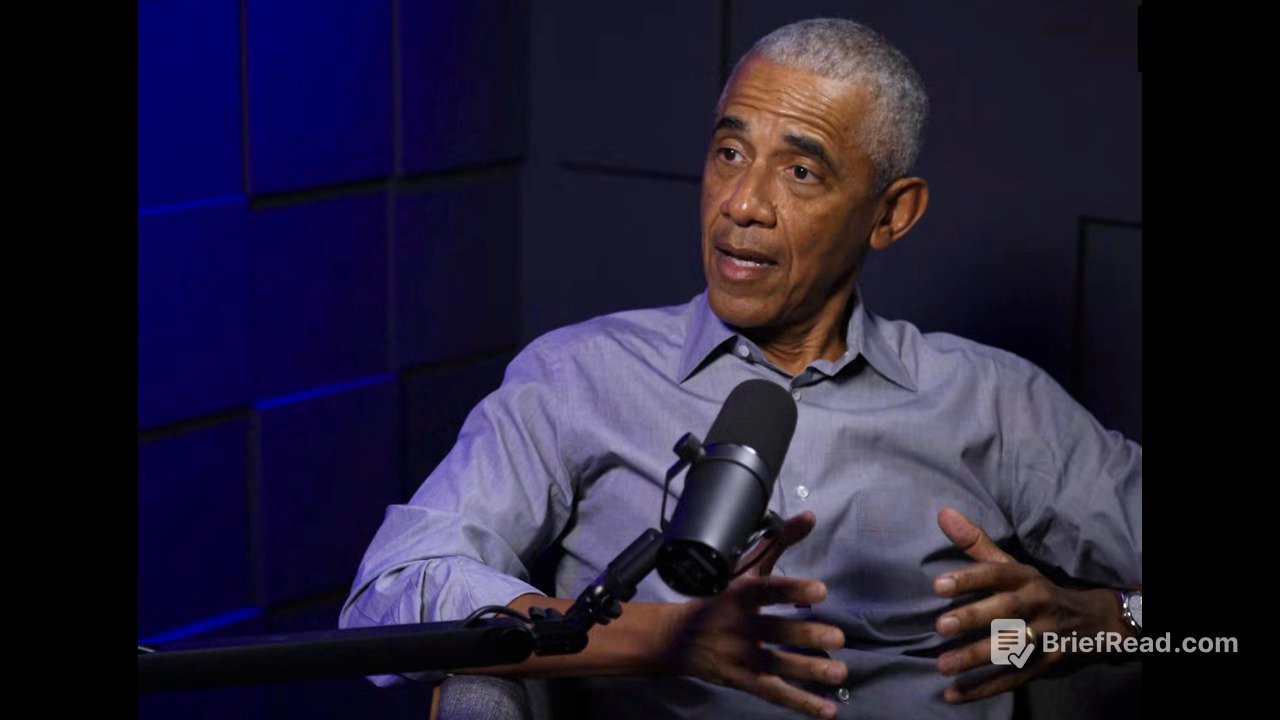
In this interview, Barack Obama discusses the current state of political discourse, the importance of community engagement, and the need for Democrats to balance idealism with practical politics. He also touches on the significance of inspiring young leaders and fostering a sense of unity and joy within the Democratic party.
- The majority of Americans are troubled by the current level of political discourse.
- Community engagement and citizen activism are crucial for restoring democracy and decency.
- Democrats need to be pragmatic and willing to challenge institutional barriers to achieve their goals.
- Inspiring and empowering young leaders is essential for the future of the Democratic party.
- Fostering a sense of community, joy, and inclusivity is key to mobilising voters.
Introduction [0:00]
Barack Obama joins the conversation to discuss the current state of political discourse and how to navigate the challenges it presents. The discussion begins by acknowledging the decline in political discourse, marked by increased cruelty and the normalisation of previously unacceptable behaviour. Examples include administration officials labelling victims of aggression as domestic terrorists and instances of dehumanising imagery.
The Role of the American People [0:47]
Obama emphasises that the majority of Americans find the current political behaviour deeply troubling, despite its prevalence in social media and television. He highlights the importance of recognising the unprecedented actions of ICE agents in Minneapolis, such as deploying agents without clear guidelines and using children to bait their parents. Obama praises the extraordinary community response in Minneapolis, where citizens organised to support their neighbours, provide groceries, and protect children. This collective action demonstrates that Americans are willing to fight back against behaviour reminiscent of authoritarian regimes, giving hope for restoring democracy, norms, and the rule of law through citizen engagement.
Democratic Strategy and Political Asymmetry [5:33]
Obama acknowledges the difficulty Democrats face in governing due to their belief in government as a tool for good, requiring them to build working majorities and consider the consequences of their actions. He contrasts this with the Republicans' approach of tearing things down, which he argues is easier. Obama points out that the Senate is structurally skewed and anti-majoritarian, compounded by the filibuster, which has historically blocked progress. He advocates for re-evaluating traditions that hinder effective governance and advancing an agenda that benefits ordinary people while upholding integrity and democracy. Obama reminds that Democrats have a harder job because they need to persuade and convince, unlike Republicans who can simply tear things down.
Persuasion and Party Divisions [14:21]
Obama addresses the divisions within the Democratic party, noting that they are often magnified in the media compared to other countries with multi-party systems. He stresses that Democrats share core values such as equality, non-discrimination, and a strong safety net. The differences, he argues, are primarily tactical, revolving around how to achieve these goals. Obama highlights the importance of not nationalising every issue and allowing for diverse campaign strategies that resonate with local contexts. He uses the example of affordable housing, suggesting that solutions require both increased spending and reforms to zoning laws. Obama underscores that it's possible to have a moral compass while recognising the need to build a working majority by shaping the agenda and message to gain broader support.
Re-mobilising Young Voters [26:27]
Obama discusses the challenges of re-mobilising young voters, acknowledging that he may have "aged out" of direct connection with their immediate struggles. He suggests that Democrats should choose candidates who are plugged into the current moment and the zeitgeist. Obama emphasises the importance of injecting joy and engagement into campaigns, empowering young people to take charge and create a sense of community. He also notes that Democrats sometimes come across as "scolds," creating a virtue signalling environment that alienates ordinary folks. Obama advocates for a more welcoming message that acknowledges everyone's imperfections and emphasises the good in all people, fostering a sense of social bonding and inclusivity.
The Role of Leadership and the Presidential Center [34:58]
Obama explains his decision to focus on lifting up the next generation of leaders through his foundation and the upcoming presidential centre. He believes that his role now is to inspire and motivate young people, empowering them to remake institutions in line with timeless values. The presidential centre will serve as a hub for activity, featuring a museum, music studio, podcast recording space, and a Chicago public library. It aims to build a community of activists, reminding them that they are not alone and providing them with the tools and resources to push back and create new solutions. Obama emphasises the importance of reinvigorating civic muscles and giving people a sense of agency to make a difference in their communities.
Lightning Round [43:55]
In a quickfire round of questions, Obama jokes about aliens, expressing his disappointment at not finding any evidence of them during his presidency. He shares his admiration for the new Pope, highlighting his background of working in communities that needed help. Obama speaks fondly of Angela Merkel, praising her integrity and problem-solving skills. He declines to name the world leaders he liked least. Obama denies any involvement in pranks during his time in the White House, citing the presence of the Secret Service and the seriousness of the job. Finally, he confirms that Tupac is "alive on my playlist."