TLDR;
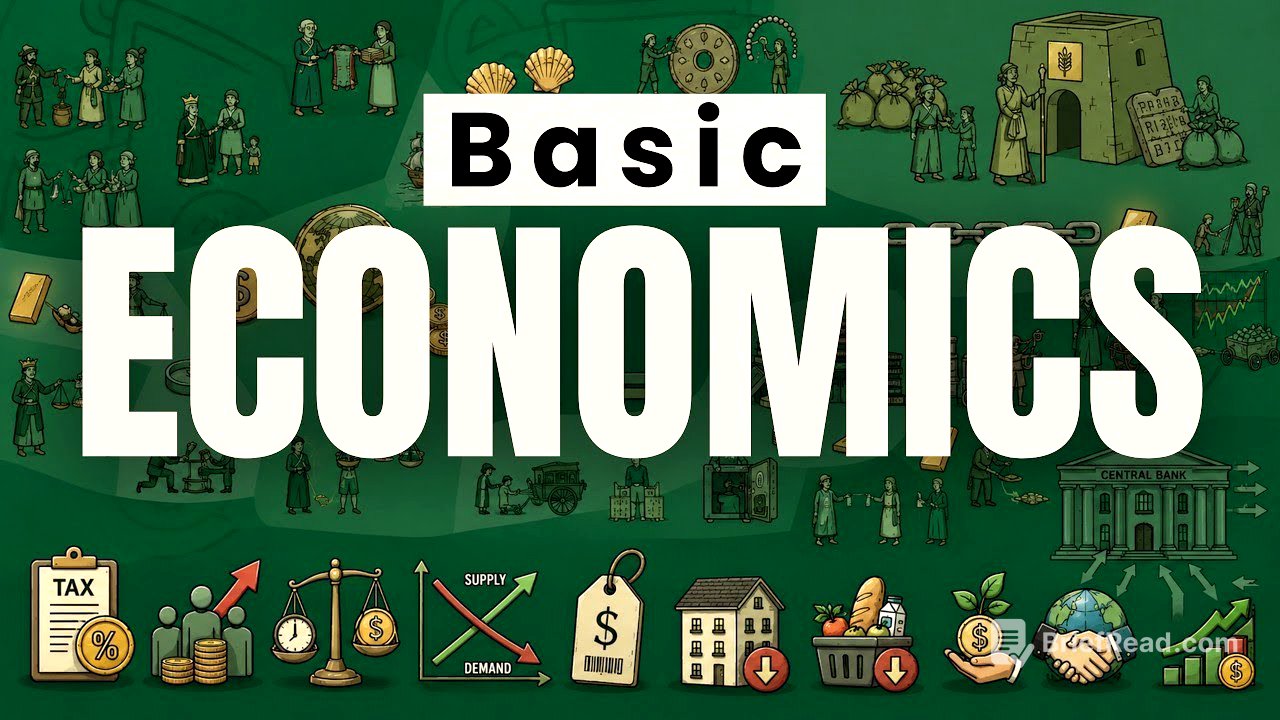
This video explains key economic concepts derived from Thomas Sowell's book "Basic Economics." It clarifies misunderstandings about taxation, costs, price signals, and trade-offs, showing how economic behaviour often contradicts popular beliefs.
- Taxing the rich can decrease overall tax revenue as wealthy individuals move away.
- Every choice has an opportunity cost that must be considered.
- Prices serve as signals in the economy, guiding supply and demand.
- Price controls can lead to shortages or surpluses, ultimately harming the intended beneficiaries.
- Profits and losses are indicators of success or failure in the marketplace, guiding resource allocation.
Taxation and Millionaires [0:42]
In 2008, Maryland attempted to tax rich individuals more, expecting to gain $106 million. However, after raising taxes, the number of millionaires dropped from 8,000 to 6,000, resulting in a loss of $257 million in revenue. This demonstrates that people respond to incentives rather than good intentions. When millionaires were taxed higher, many left the state along with their businesses, leading to fewer jobs and a decline in tax revenue.
The Cost of Choices [2:41]
Every choice has a cost, signifying trade-offs in economics. For example, with only $10, a person must choose between a Starbucks, a burger, and a movie ticket. Similarly, Venezuela has vast oil reserves yet struggles economically, while Switzerland has minimal natural resources but thrives. The essence of economics is not what you possess, but how you utilise your resources, emphasising that spending reflects sacrifices in other areas.
Prices as Signals [4:49]
The exchange of goods is efficiently managed by prices, as seen in a story about Soviet leader Gorbachev discussing food distribution with Margaret Thatcher. Prices convey information about scarcity and supply without central planning, ensuring that resources reach locations where they are needed most. A price increase prompts suppliers to produce more, while a price decrease signals saturation. Understanding prices as honest signals helps individuals navigate economic conditions effectively.
The Failure of Price Controls [7:10]
Price controls, as demonstrated by rent control in New York, create an imbalance where demand exceeds supply. Politicians often set caps on rents to help those struggling, yet this discourages landlords from maintaining properties. Consequently, abandoned apartments coexist with homelessness. Similarly, Zimbabwe's attempt to control prices during inflation resulted in devastating food shortages. Ultimately, manipulating prices leads to undesirable outcomes, disproportionately affecting weaker segments of society.
Understanding Profits and Losses [11:11]
Profits indicate successful ventures, while losses signal a need to change course. For example, if a trader can profit from selling fruit snacks but not raisins, the loss echoes a critical signal to stop the unprofitable venture. Government interventions to support "too big to fail" companies disrupt natural economic feedback, maintaining inneffective operations at the expense of taxpayers. Acknowledging both profits and losses as vital information aids in making informed business decisions.
Wages as Price Signals [13:38]
Wages reflect the value created by a worker. A business pays its employees based on the additional value brought to the company; if a job can only produce $10 an hour, paying $15 results in losses. Hence, to survive, businesses might reduce hiring or automate roles. This underscores that employers pay for results instead of time, highlighting the importance of enhancing skills and delivering value in the marketplace.
The Value of Trade [15:41]
Trade increases collective wealth without generating more resources, illustrated by an example of trading halves of sandwiches and pizzas for mutual satisfaction. Politicians often misconceive trade between nations as competition rather than cooperation, leading to harmful tariffs and resentment. Even if one country outperforms another in production, both can benefit from specialisation and trading, yielding increased overall resource availability.
Conclusion: Embracing Trade-offs [18:48]
The overall message emphasises understanding trade-offs in economics and life. Recognising that each choice pulls time or resources from other activities allows individuals to focus on what they excel at, ultimately leading to greater success. While economic knowledge doesn't guarantee wealth, it empowers individuals to make informed decisions and avoid being easily deceived by misconceptions.