TLDR;
This module introduces functional anatomy, focusing on how the body moves as a cohesive unit, rather than just individual components. It covers key terminologies for defining movements, including anatomical planes (sagittal, frontal, and transverse) and axes of motion (sagittal, frontal, and longitudinal). The module also explains anatomical directions using standardised terms to ensure clear communication among healthcare professionals and researchers. Practical examples, such as cycling and a golf swing, are used to illustrate movements in different planes.
- Functional anatomy relates to how the body moves as a cohesive unit.
- Key terminologies include anatomical planes and axes of motion.
- Standardised anatomical directions ensure clear communication.
Introduction to Functional Anatomy [0:00]
Functional anatomy is about how the body moves, not just its components. It examines how individual components like the skeletal, muscular, and neural systems work together. By the end of this module, you should be able to identify key terminologies used to define movements, understand anatomical planes and axes of motion, recognise major joint actions, explain the role of muscles in movement, and differentiate between static and dynamic posture.
Anatomical Planes [1:59]
Anatomical planes are imaginary flat surfaces used to describe the body's orientation and movements. There are three planes: sagittal, frontal, and transverse. The sagittal plane divides the body into left and right halves, with movements like flexion and extension occurring in this plane. The frontal plane divides the body into front and rear halves, and movements such as adduction (moving away from the body) and abduction (moving towards the body's centreline) occur here. The transverse plane divides the body into upper and lower halves, and rotational motions or twists typically occur in this plane.
Anatomical Axes of Rotation [4:51]
Anatomical axes of rotation are imaginary lines around which joints move. There are three principal axes corresponding to each of the planes: sagittal, frontal, and vertical (or longitudinal). The sagittal axis runs from front to back within the sagittal plane, facilitating adduction and abduction. The frontal axis is in the frontal plane, running from left to right, and is associated with flexion and extension. The longitudinal axis runs vertically from top to bottom, and rotations in the transverse plane are associated with it.
Anatomical Directions [6:34]
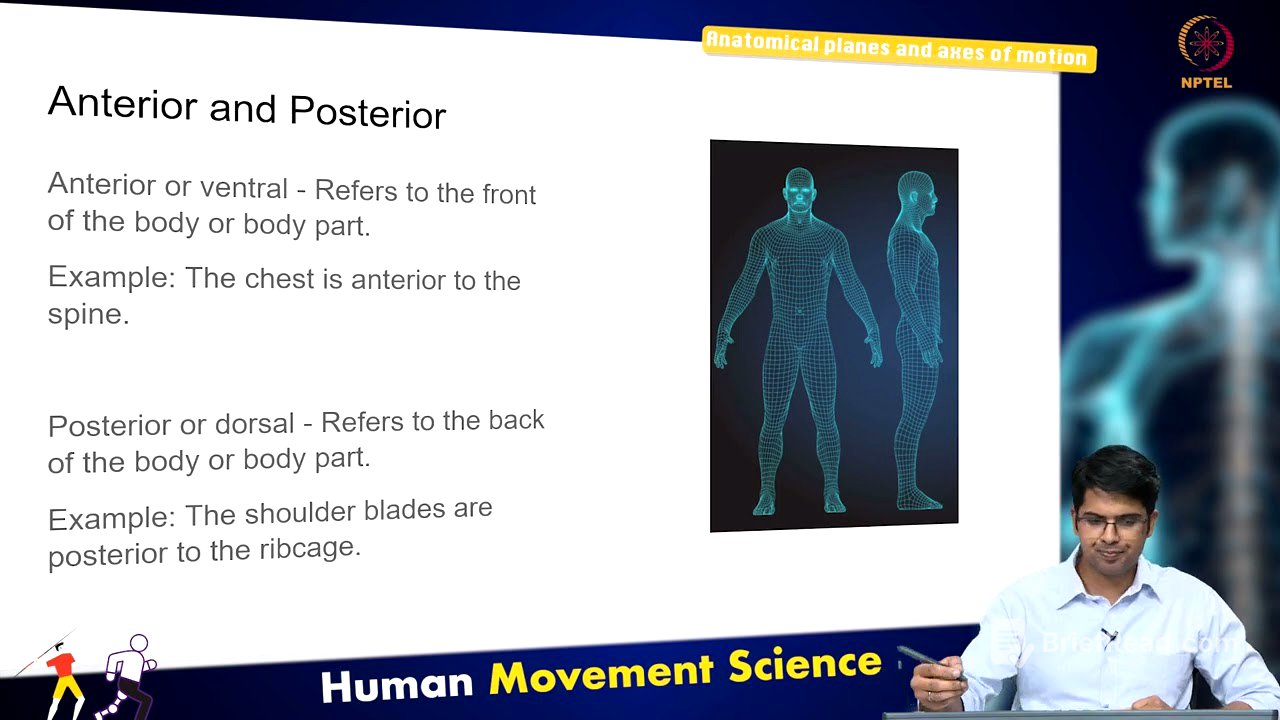
Anatomical directions use standardised terms to describe positions in the human body, ensuring clear communication among healthcare professionals and researchers. The anatomical position is defined as the body upright, facing forward, with palms facing forward and feet parallel. Medial refers to being closer to the body's centreline, while lateral means further away. Anterior refers to the front, and posterior refers to the rear. Superior (or cranial) indicates structures higher or above another, while inferior indicates structures below. Proximal and distal are used for appendages, with proximal referring to closer to the joint and distal referring to further away.
Practical Examples [15:17]
Practical examples illustrate movements in different planes. A person on a stationary bicycle primarily moves in the sagittal plane, with potential minor movements in the frontal plane for balance. A golf swing involves movements across all planes, with the primary movement possibly in the coronal plane, but also including components in the sagittal and frontal planes.