TLDR;
This lecture introduces kinetics, focusing on the causes of motion, contrasting it with kinematics, which only describes motion. It covers the concepts of force and torque, their effects on bodies, fundamental principles, free-body diagrams, and various types of forces encountered in biomechanical analysis. The lecture also details Newton's laws of motion and their implications, including inertia, acceleration, and reaction, and introduces concepts like momentum and ground reaction forces.
- Kinetics deals with the causes of motion, unlike kinematics.
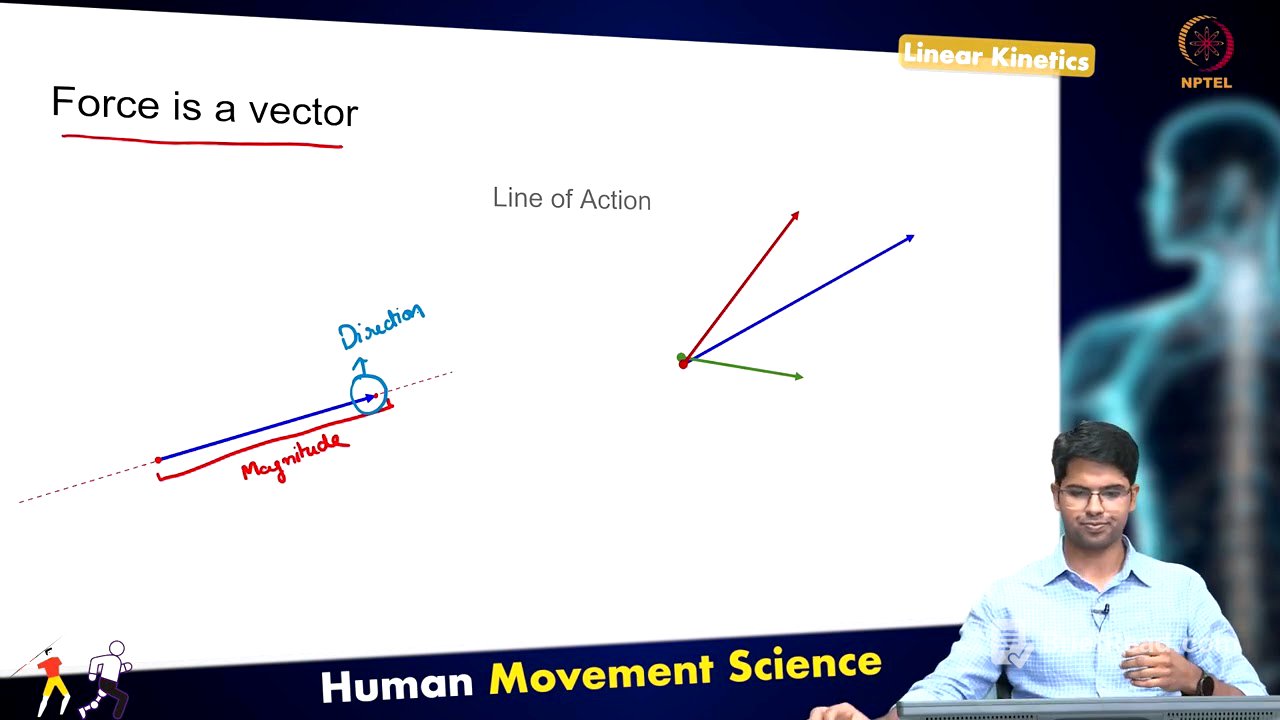
- Force is a vector quantity with magnitude and direction.
- Newton's laws of motion govern the interaction between force and movement.
- Momentum is mass in motion and is a vector quantity.
- Ground reaction forces are crucial in biomechanical analysis.
Introduction to Kinetics [0:00]
The lecture introduces kinetics as the study of the causes of motion, contrasting it with kinematics, which focuses solely on describing motion. The learning objectives include understanding force and torque, their effects on bodies, fundamental principles of kinetics, creating free-body diagrams, and identifying various forces in biomechanical analysis. Kinematics is recalled as the study of motion without regard to its cause, while kinetics examines the relationship between motion and its causes, such as forces.
Defining Force [2:37]
Force is defined as an external agent that influences a body's state of rest or motion. It is a vector quantity, possessing both magnitude and direction. Multiple forces acting on a body result in a net force, which can be determined by vector addition. Forces can be split into Cartesian components using a coordinate system, which is essential for biomechanics calculations, particularly in inverse dynamics.
Momentum Explained [11:25]
Momentum is introduced as "mass in motion," quantifying both the mass of a body and its velocity. Defined as p = mv, momentum is a vector quantity with the same direction as velocity. A light object moving fast can have high momentum, as can a heavy object moving slowly. This concept is crucial in understanding interactions, such as collisions in sports, where kinetics helps quantify these interactions.
Newton's First Law: The Law of Inertia [14:55]
Newton's laws of motion, which quantify the interaction between force and movement, are introduced. The first law, the law of inertia, states that a body remains in its current state of rest or motion unless acted upon by an external force. Inertia, represented by mass (measured in kilograms), is an intrinsic property of a body. The state of motion is described by momentum, and if no net external force acts on a body, there is no change in momentum.
Newton's Second Law: The Law of Acceleration [24:15]
The second law, the law of acceleration, states that an external force causes a body to accelerate in direct proportion to the force's magnitude and in the same direction. The lecture gives the example of a player applying a force to a ball, causing it to accelerate from an initial velocity of 0 to a final velocity of 2 meters per second in 1 second, resulting in an acceleration of 2 meters per second squared. The definition for this law is force equals mass times acceleration (F=ma), where the direction of acceleration is the same as the direction of the force applied.
Newton's Third Law: The Law of Reaction [30:59]
The third law, the law of reaction, states that when one body applies a force on another body, the second body applies an equal and opposite reaction on the first body. This principle is fundamental in biomechanics and is illustrated by ground reaction forces. When a person walks, the ground provides a reaction force, with vertical and horizontal components, that affects their movement and stability.
Types of Forces in Biomechanical Analysis [36:37]
The lecture identifies common types of forces encountered in biomechanical analysis, including gravitational force (weight) and ground reaction force. When a person stands still, the ground reaction force balances their weight, resulting in a net force of zero. Horizontal movement involves friction forces. Inertial forces, experienced during acceleration or deceleration (e.g., in an elevator), are also mentioned, represented by F - ma = 0, where -ma is the inertial force. The lecture concludes by setting the stage for the next topic: kinetics in rotational motion.