TLDR;
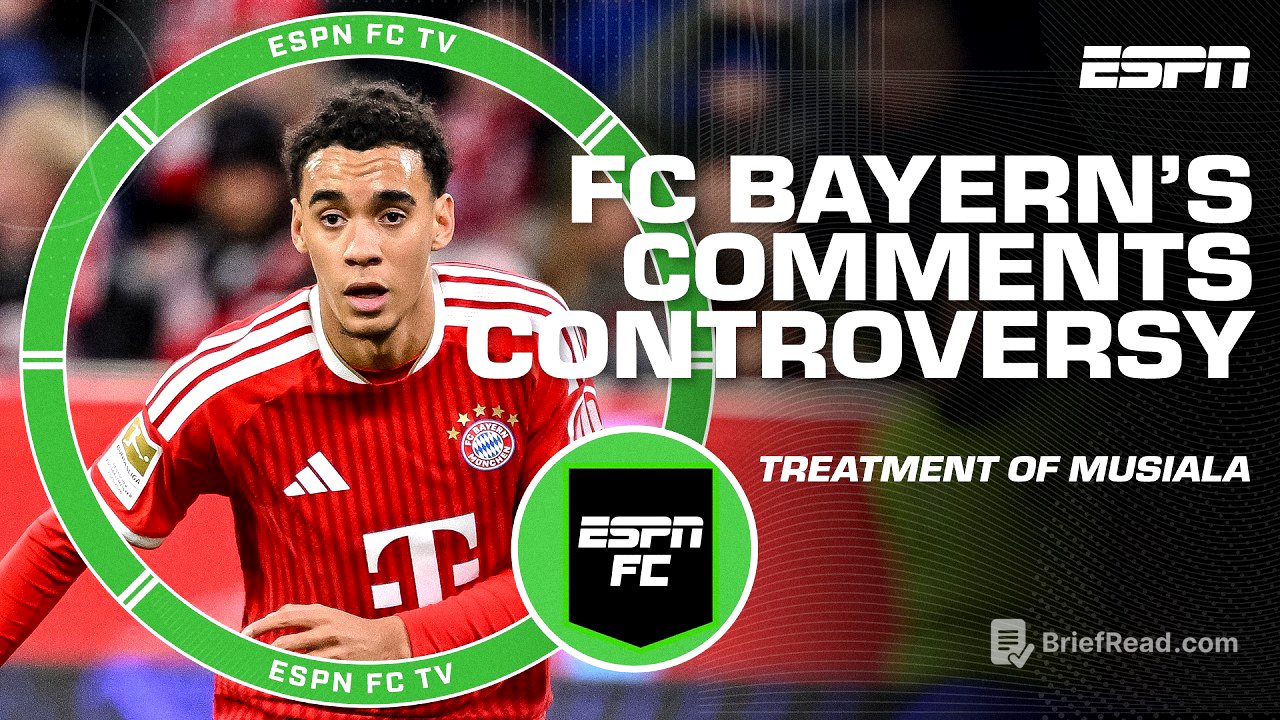
Bayern Munich are facing a growing injury list, but the discussion focuses on the club’s public comments about Jamal Musiala, who has a neurological condition diagnosed after he collapsed twice during pre-season. Bayern executives have questioned whether he can return to his previous level and raised concerns about his salary. The panel condemns these remarks as lacking empathy and argues that the club should prioritise Musiala’s wellbeing and support him privately.
- Bayern are two points ahead of the chasing pack after ten rounds, but Harry Kane is reportedly set for a lengthy spell out with an ankle injury.
- Musiala’s condition can be managed with medication, though his future performance level remains uncertain.
- Panellists criticise Bayern officials for discussing his health and contract publicly, saying clubs have a duty of care towards their players.
Bayern’s injuries and Musiala’s health [0:00]
After ten rounds, Bayern Munich are two points ahead of their nearest rivals. The club’s situation is complicated by a number of injuries: Harry Kane is reported to have torn an ankle ligament and could be out for at least three months following surgery. Other players sidelined or recovering include Ismael Saibari with an ankle problem, Serge Gnabry with a hamstring injury, Luis Díaz with a muscular issue, Alphonso Davies with a hamstring injury and Manuel Neuer with a foot problem.
The discussion then turns to Jamal Musiala, who was diagnosed during the summer with a neurological condition that causes absence seizures, a form of epilepsy. The diagnosis followed two collapses on the pitch within four days during pre-season. Bayern honorary president Uli Hoeness said the condition cannot simply be cured but can be managed to some extent with medication, while expressing uncertainty about whether Musiala will regain his previous performance level.
Bayern supervisory-board member Karl-Heinz Rummenigge also said that, based on experience with similar injuries, Musiala might struggle to return to his former level. He described the player’s high salary as unsustainable under the circumstances and said the club had to consider the financial implications, although discussions with Musiala’s representatives had not yet taken place.
Panel condemns Bayern’s public comments [2:06]
The panel argues that Musiala and Florian Wirtz were among the most valuable young talents in German football when Musiala signed his contract, and that Bayern agreed to the salary at the time. One panellist says it is unacceptable for senior figures to publicly question the future of a 23-year-old player who is dealing with a medical condition. Rather than raising the issue through the media, the club should speak privately with Musiala and his representatives.
FIFPRO, the international players’ union, has criticised the comments as a coordinated attempt to put pressure on Musiala and his representatives. It also stressed that clubs have a duty of care towards their players. The panel says public discussion of his health and wages treats him as a financial item rather than a person, reinforcing the feeling among players that clubs may not show loyalty when circumstances become difficult.
The speakers add that the lack of empathy is especially striking because Bayern have not publicly treated other players’ situations in the same way. They cite Manuel Neuer’s skiing accident, Leroy Sané’s poor form and Alphonso Davies receiving a major contract before being injured as examples. Bayern coach Vincent Kompany had recently praised Musiala’s training, saying he had never seen him look as good in training, which the panel says makes the executives’ remarks more troubling.
Calls for support and accountability [6:50]
The panellists describe Hoeness and Rummenigge’s comments as shameful and call for Bayern to support Musiala medically and mentally. They argue that the club has the resources to help him and should make clear that he remains part of Bayern’s identity, rather than publicly questioning whether his contract is justified.
They also emphasise that Musiala’s condition is not something he can control, and that his other injuries may be connected to limited playing time and disrupted match fitness. Discussing a player’s health so openly raises ethical concerns, they say, particularly when the club has not yet spoken with him or his representatives. The segment concludes with the panel condemning the decision to make public criticism the club’s first response and noting that they will follow any further statement from Bayern.