TLDR;
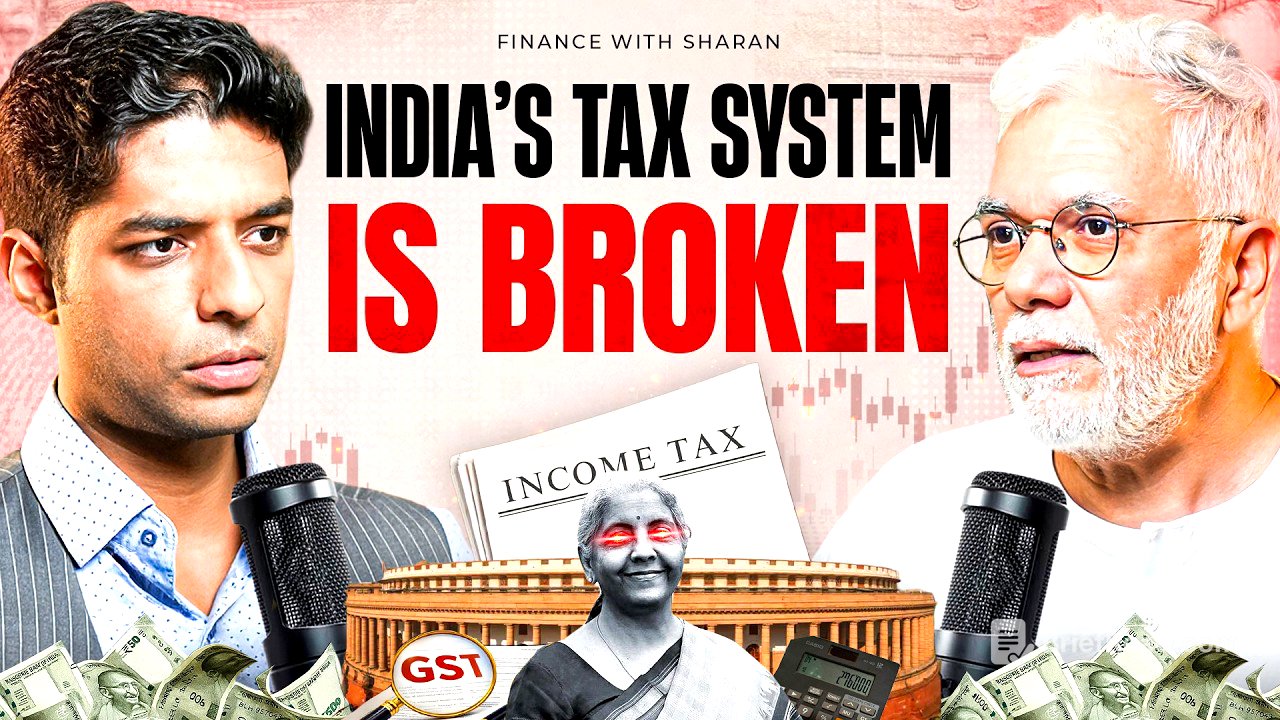
This video features an in-depth discussion with Dr. Ajay Shah, an economist with a background in aeronautical engineering and experience with the Ministry of Finance and the creation of the NIFTY 50 index. The conversation covers a range of topics, including Indian income tax rates, the Goods and Services Tax (GST), the impact of AI on jobs and investments, and the overall economic landscape of India. Key points include the argument for lower tax rates to incentivise wealth creation, the need for a simplified GST system, the importance of human skills alongside AI, and the potential threats and opportunities for India in the face of global economic changes.
- Indian income tax rates are excessively high and discourage wealth creation.
- The GST system needs simplification with a single, low rate and removal of input tax credit blockages.
- AI will transform jobs, but human skills like emotional intelligence and creativity will remain crucial.
- India's IT service export sector is vital but faces potential disruption from AI.
- Freedom is a key economic concept that Indians need to understand better.
Introduction [0:00]
The video begins by highlighting the potential for Indian talent to create significant global impact, referencing the example of Sundar Pichai. It suggests that one of the primary reasons why India isn't producing more global giants like Google is the disincentivising structure of the Indian state, which can instill fear and discourage ambitious ventures. The introduction sets the stage for a discussion on how Indian economic policies and laws, particularly income tax, impact the country's potential for innovation and growth.
Story of Our Guest : Dr. Ajay Shah [1:13]
Dr. Ajay Shah shares his journey from aeronautical engineering at IIT Bombay to becoming an economist. He explains that modern economics is quantitative but also deeply rooted in humanities, politics, and philosophy. Dr. Shah expresses his fascination with economics as a field that requires understanding how the world works and how progress is made. He recounts his return to India in 1993 and his involvement in the early stages of building the National Stock Exchange (NSE) and working with SEBI, describing it as a great privilege.
Dr. Ajay’s take on India’s Income Tax Rates [2:47]
Dr. Shah argues that income tax rates in India are unreasonably high and that lower rates would benefit the country. He points out that when corporation tax, personal income tax, and GST are combined, the total tax burden is excessive, approaching levels seen during Indira Gandhi's era. He explains that Indira Gandhi's policies were rooted in populism, which involves harnessing the anger of the poor against the elite, fostering hostility towards success and prosperity. Dr. Shah suggests that such high taxation destroys incentives for building businesses and discourages creativity and imagination due to excessive government interference and a lack of rule of law.
The Old-School Tax Era [6:47]
Dr. Shah shares a story about Jaswant Singh, who, as Finance Minister, stopped income tax raids, deeming them uncivilised. This boosted confidence and optimism in the private sector, contributing to India's significant growth from 1991 to 2011. He contrasts this approach with populist ideas around corruption and the need to investigate wealthy individuals, arguing that supporting success and creating safe conditions for the elite are essential for a country's progress.
One Nation, One Tax? [8:09]
Dr. Shah advocates for a simplified GST system with a single rate of 10% on all goods to eliminate classification disputes and reduce the incentive for corruption and lobbying. He explains that having different GST rates leads to companies trying to misclassify their products, requiring government intervention and creating an unhealthy dynamic between the state and the private sector. He believes that a healthy country is harmonious, with the private sector focused on serving customers and adopting technology rather than managing government relationships. He notes that the current Finance Minister believes Indian politics prevents having common rates on everything, as there's a perception that food should be taxed at a lower rate and luxury items like cell phones at a higher rate to gain votes.
Big Wins of the Current Government [14:01]
Dr. Shah identifies three significant achievements of the current government: inflation targeting, the bankruptcy code, and the GST. He explains that inflation targeting, with the RBI mandated to deliver predictable inflation, is crucial for maintaining the value of assets. While acknowledging that the GST was a major achievement, he notes that its implementation has been flawed, with many fundamental concepts not carried through, making it resemble the old excise system.
Surviving the AI Era: What You Need to Know [16:29]
Dr. Shah addresses concerns about the impact of AI on jobs and the economy. He advises focusing on developing knowledge, intellectual power, and skills, as these will remain valuable. He suggests that AI will replace mechanical and repetitive tasks, but human creativity and brilliance will not be replaced. He stresses the importance of continuous learning and adapting to new technologies, urging individuals to understand what AI can and cannot do.
Sharan’s 1% Club in Danger? [18:24]
Dr. Shah discusses the impact of AI on wealth management, suggesting that the role of a wealth advisor is becoming increasingly "AI-able" due to the codifiable nature of the job. However, he notes that the emotional and trust-based aspects of wealth advising, such as managing client anxieties and preventing speculative decisions, cannot be replaced by AI. He remains skeptical about AI's ability to consistently outperform the market in stock picking, arguing that market efficiency will eventually eliminate any AI-driven edge as more AI traders enter the market.
India’s Advantage against AI Boom [24:06]
Dr. Shah addresses concerns about potential layoffs in the Indian white-collar job market due to AI. He acknowledges the importance of India's IT service export sector, which generates a significant portion of the country's revenue. However, he remains relatively optimistic, suggesting that the full impact of AI will take time to materialise. He points out that many Indian businesses have yet to fully utilise even basic technologies like spreadsheets, implying that the adoption of AI will be a gradual process.
Rapid Fire Round [27:47]
In a rapid-fire round, Dr. Shah answers a series of quick questions:
- Investment Index: He recommends a broad market-cap-weighted index fund with around 250 stocks.
- Biggest Economic Shock: He identifies a Chinese invasion of Taiwan as the biggest potential shock, citing Taiwan's importance in semiconductor manufacturing and the likelihood of a large-scale war.
- Probability of World War III: He considers the probability of a full-scale world war to be low, as current conflicts do not yet constitute a global entanglement.
- Most Interesting Economic Growth (Besides India): He highlights Israel due to its brain power, cultivation of science and technology, and global integration.
- Most Overregulated Sector in India: He identifies banking and the broader finance sector.
- Economic Idea India Should Abandon: He suggests abandoning industrial policy, which involves the government picking winners and choosing specific technologies.
- Person to Have Dinner With: He chooses Jawaharlal Nehru, admiring his life, resilience, and contributions to India.
- Partnership Between India and Pakistan: He believes there are plenty of opportunities for partnership, highlighting even simple trade needs like the import of betel leaves from India to Pakistan.
- Economic Concept Indians Should Understand: He emphasises the importance of freedom and standing on one's own feet, rather than relying on government intervention.
The Easiest Way to Understand Economics [34:45]
Dr. Shah recommends three books for beginners interested in understanding economics:
- "A Random Walk Down Wall Street" by Burton Malkiel, which provides insights into how markets work and encourages skepticism about one's own market knowledge.
- "Stocks for the Long Run" by Jeremy Siegel, which makes the case for long-term equity investing.
- "In Service of the Republic" by Vijay Kelkar and himself, which offers a foundational understanding of India and its journey to growth and prosperity.
Closing Note [37:04]
The video concludes with the host thanking Dr. Shah for his insights and inviting viewers to share their thoughts and suggestions for future topics and guests. Dr. Shah recommends bringing on A. Patnaik, the chief economist of the Aditya Birla Group, to discuss the challenges faced by large complex firms in India.