TLDR;
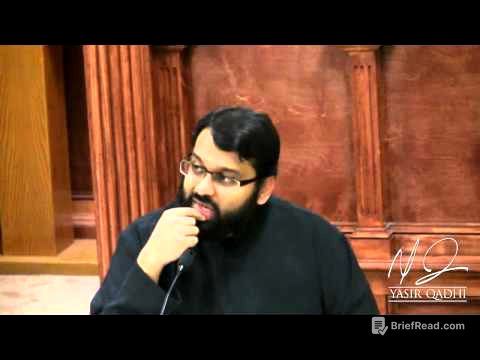
This video explores Surah An-Nasr, focusing on its linguistic nuances, historical context, and profound implications for believers. It highlights the importance of seeking Allah's help, obeying Him, and understanding the deeper meanings within the Quran. The discussion also covers the significance of gratitude, seeking forgiveness, and recognising the reality of human imperfection.
- Linguistic analysis of Surah An-Nasr
- Importance of seeking Allah's help and obedience
- Understanding gratitude (hamd) and seeking forgiveness (istighfar)
- Recognising human imperfection and the need for constant repentance
Introduction [0:11]
The video begins with a recitation from the Quran, setting the stage for a discussion about Surah An-Nasr.
Context and Meaning of Surah An-Nasr [0:45]
The speaker explains that Surah An-Nasr was revealed eight years after the Hijra, around the time of the conquest of Mecca. The surah speaks of Allah's help and the victory (Al-Fath) of Mecca. A key point is whether "Nasr" (help) is part of "Al-Fath" (victory) or if they are distinct, illustrating a concept in Arabic called "zikr al-khas ba'd al-'am," where something specific is mentioned after something general to emphasise its importance. An example of this is found in Surah Al-Qadr, where angels and the "Rooh" (believed to be Jibril) descend, highlighting Jibril's significance among the angels.
The Significance of Faith and Actions [5:55]
The discussion touches on the relationship between faith and actions, noting that scholars agree good deeds are part of faith. The Quran often mentions "those who believe and do good deeds" to emphasise the importance of actions, as faith should naturally lead to good deeds.
Attributing Help to Allah [7:13]
The speaker emphasises that all help comes from Allah. Verses in the Quran, such as those in Al-Imran and Al-Anfal, highlight that there is no helper except Allah. This understanding should lead believers to seek help only from Him, recognising that everyone else is weak and dependent on Allah.
Seeking Help from Allah and Obedience [11:05]
To succeed in any endeavour, one must consistently ask Allah for help and be obedient to Him. Disobeying Allah while asking for His help creates a barrier to the acceptance of prayers. The speaker references a hadith in Muslim about a man who consumes, drinks, and wears haram, questioning how his prayers could be answered.
Forms of Allah's Help [15:05]
Allah's help comes in many forms, not just through victory over enemies. One form is instilling fear in the hearts of the enemies, as mentioned in Surah Al-Ahzab. The Prophet Muhammad (peace be upon him) was aided by Allah in such a way that his enemies feared him from a distance of a month's journey. Another form of help is being guided to present compelling arguments in debates.
Honouring Oneself Through Obedience to Allah [18:59]
A key form of Allah's help is guiding someone towards obedience. There is no greater honour for a servant than obeying Allah, and no greater humiliation than disobeying Him. The speaker warns against being deceived by those who seem happy while disobeying Allah, as they are in a dire state. Seeing an enemy disobey Allah is a form of help for the believer.
Changing Perspectives on Injustice [22:37]
The speaker encourages a shift in perspective when facing injustice. Instead of feeling defeated, one should recognise that the unjust person is actually humiliating themselves through their disobedience to Allah. This perspective is illustrated with the story of Umar ibn al-Khattab, who saw the insults of disbelievers towards the Prophet as a sign of their impending defeat.
The Masses Entering Islam and the Completion of the Prophet's Mission [26:45]
The surah speaks of people entering Islam in groups, which occurred after the conquest of Mecca. This fulfilled the Prophet's mission, and Allah then instructed him to glorify Allah, praise Him, and seek His forgiveness.
Understanding the Instruction to Glorify and Seek Forgiveness [30:49]
Instead of simply thanking Allah, the surah instructs the Prophet to glorify Allah (tasbih), praise Him (hamd), and seek His forgiveness (istighfar). This is because the surah hints at the end of the Prophet's life. Ibn Abbas understood this, recognising that the surah was an announcement of the Prophet's impending death.
The Wisdom of Omar and Ibn Abbas [32:39]
The speaker highlights the wisdom of Omar ibn al-Khattab, who often consulted with companions, including the young Ibn Abbas, on important matters. Omar recognised Ibn Abbas's deep understanding of the Quran and his ability to read between the lines.
The Significance of Istighfar [42:04]
Ibn Abbas understood that the instruction to seek forgiveness was a sign of the Prophet's approaching death because istighfar is often done at the end of acts of worship. This understanding demonstrates a deep insight into the Quran.
The Meaning of Tasbih, Hamd, and Istighfar [46:30]
Tasbih means declaring Allah free from all defects. Hamd involves praising Allah with love and reverence. Istighfar is asking Allah to conceal and erase sins.
Benefits of Istighfar and Hamd [50:23]
The benefits of istighfar include increased strength, ease in affairs, expanded sustenance, and the blessing of children. The benefits of hamd include averting catastrophes and receiving additional blessings from Allah. Allah is satisfied with His servant who says "Alhamdulillah" after eating and drinking.
The Importance of Gratitude and Remembrance [59:33]
Saying "Alhamdulillah" fills the scales of good deeds. The speaker encourages frequent remembrance of Allah, noting that it can be done in any state and at any time.
The Imperfection of Human Actions and the Need for Istighfar [1:01:26]
Istighfar is essential because human actions are inherently imperfect. The goal is not to avoid sin entirely, which is impossible, but to minimise sins and return to Allah after each mistake.
The Key to Avoiding Sin and Loving Obedience [1:04:54]
The most effective way to avoid sin is for Allah to make you hate disobedience and love obedience. This is achieved through sincere supplication and effort in Allah's path.
The Prophet's Example and the Importance of Knowledge [1:08:35]
The Prophet Muhammad (peace be upon him) used to say "Subhanak Allahumma Rabbana wa bihamdik, Allahumma ighfirli" in his ruku and sujud, following the revelation of Surah An-Nasr. The speaker stresses the importance of knowing what the Prophet said in his prayers and after them, rather than focusing on less relevant issues.
Prioritising Beneficial Knowledge [1:12:59]
The speaker contrasts beneficial knowledge with less useful information, such as knowing the details of the Dajjal without knowing how to protect oneself from him. He emphasises that true knowledge leads to humility and a closer relationship with Allah.
The Miracle in Surah An-Nasr [1:19:43]
The miraculous aspects of Surah An-Nasr are that it foretold the mass conversion to Islam and hinted at the Prophet's impending death. It is the last surah that was revealed in its entirety to the Prophet Muhammad (peace be upon him).
Conclusion [1:22:35]
The video concludes with a reminder to glorify and praise Allah, seeking His forgiveness, and recognising the blessings He has bestowed upon us.