TLDR;
This video explores Friedrich Nietzsche's concept of the "free spirit" as presented in his works Human, All Too Human, Daybreak, and The Gay Science. It examines how Nietzsche challenges conventional values, morality, and the pursuit of truth, arguing that these are often illusions that hinder true freedom. The video further discusses how the free spirit can overcome nihilism by creating their own values and embracing life's inherent beauty, even in its most painful aspects.
- Nietzsche challenges conventional values and societal norms.
- The free spirit must create their own values to overcome nihilism.
- Embracing life's beauty, even in pain, is key to Nietzschean freedom.
Free Spirits [0:00]
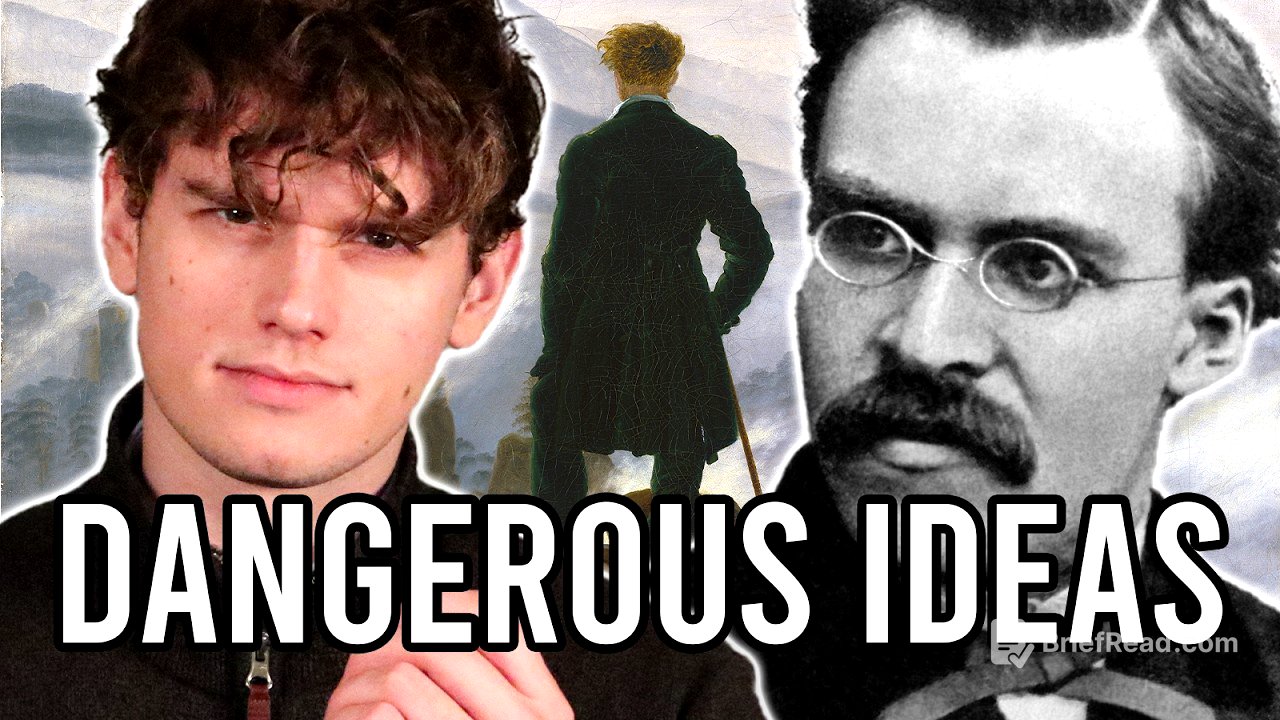
The video introduces Friedrich Nietzsche as a philosopher who embodies the concept of a "free thinker" by challenging deeply ingrained societal beliefs. Nietzsche questioned established ideas, deeming them false or harmful, making him a controversial figure. The video aims to explore Nietzsche's definition of a free thinker, drawing from his works Human, All Too Human, Daybreak, and The Gay Science, and to consider whether one should follow his path. The presenter acknowledges the influence of Nietzsche scholar Matthew Meyer on their interpretation of Nietzsche's works.
Freedom from Illusion [1:45]
Nietzsche's Human, All Too Human is presented as a departure from his typical style, employing a scientific lens to examine cherished human concepts. The goal is to dismantle old ideas, allowing free spirits to move forward without illusions. Nietzsche seeks to expose key ideas as empty or meaningless to achieve a greater sense of freedom. One example is his attack on the concept of free will, arguing for determinism, where choices are dictated by character and environmental factors, not a hovering soul. He believes the illusion of free will is maintained because it provides a sense of responsibility and meaning, fulfilling a psychological need for control. Nietzsche argues that without free will, moral responsibility is also undermined, rendering concepts of good and evil as mere superstitions. He acknowledges this truth is difficult to accept, as it flattens distinctions between people and removes the sense of striving for betterment. Nietzsche also dismisses metaphysics as pointless, arguing that any ultimate reality is inaccessible to us. He recognises that metaphysics provides solace and significance, but insists free spirits must discard it, along with religion, in the pursuit of truth. Nietzsche's aim is to reveal the unbearable truths of life by removing comforting concepts, even if it leads to despair. The free spirit is free from illusion and can ask new questions, such as the origins of moral concepts and the purpose of the idea of God.
Freedom from Society [11:26]
Nietzsche's focus on the individual is highlighted, with some critics suggesting he neglects the social aspect of humanity. This is presented as a deliberate choice, stemming from his scepticism towards the majority's thinking and its impact on free spirits. Nietzsche's ambivalence towards people is evident in Human, All Too Human, where he discusses the danger of public convictions to the pursuit of truth. The truths discovered by the free spirit can be harmful to society, potentially driving people to despair. Nietzsche acknowledges that these truths may be bad for society but presents his philosophical project as a solitary one, drawing inspiration from Montaigne's retreat into isolation for philosophical study. Nietzsche's questions examine society from an external perspective, exploring whether we can live without irrational concepts essential to happiness. He focuses on morality, analysing its psychological origins in Daybreak, which explores ethical systems, power, and social dynamics. Nietzsche views morality as a prejudice, aiming to reveal the irrational drives behind moral philosophies, such as habit, custom, and tradition. He believes that uncritically absorbing societal customs compromises one's ability to listen to their feelings and become who they are. The free spirit must free themselves from society because immersion in communities influences their thinking, making it harder to take an objective view of customs and morality. Nietzsche analyses feelings of moral superiority in terms of power, with moral descriptors reframing unpleasant feelings into pleasant ones. He presents morality not as a discovery of truth but as psychological plays for power that become calcified over time. Similarly, he analyses religion as instilling a feeling of power in the believer. While acknowledging the potential genetic fallacy in analysing the origins of God and morality, the presenter argues that Nietzsche's aim is to make these concepts less motivating by demystifying them and presenting them as crafted by ordinary people for human ends. By decoring these concepts, Nietzsche attempts to isolate the free spirit from their cultural context, freeing their emotions as well as their cognition.
Freedom from Truth [21:32]
Nietzsche's famous declaration "God is dead" is discussed, along with the remaining "shadows of God," one of which is the value of truth itself. The video questions whether truth is inherently good, noting that Nietzsche has implicitly raised this question throughout his works, pointing out the destructive potential of certain truths. Nietzsche challenges the assumption that truth is always valuable, arguing that we assign value to it. He undermines his original project by suggesting that the value of truth, like everything else, is human-derived. Combining this with his observations about metaphysics, he concludes that there is no valuable truth about ultimate reality, only appearances and predictions about those appearances. While many readily accept Nietzsche's dismissal of metaphysics, morality, and religion, they often resist his assertion that truth itself need not have any value. Nietzsche argues that our valuation of truth relies on the Socratic and Platonic idea that truth necessarily leads to human flourishing, a connection he rejects. He questions whether realising the universe is cold and uncaring would be helpful, suggesting it can make life seem not worth living. Nietzsche critiques the Enlightenment's emphasis on the pursuit of truth at all costs, arguing that this ultimately leads to devaluing truth itself. He agrees with religious thinkers who suggest that Enlightenment values are self-undermining without God, but he wants to move forward without reintroducing God. Questioning the value of truth is vital for the free spirit because it provides a way out of the despair caused by previous questioning. By abandoning the value of truth in itself, the free spirit rejects the authority of the world and claims that power for themselves, allowing their creative project to begin.
Freedom to Create [30:14]
Nietzsche's Thus Spoke Zarathustra outlines the three transformations of the Übermensch, with the final stage being the child, a creative spirit who overcomes nihilism by forging new values. In Beyond Good and Evil, his new philosophers serve a similar function, transcending existential despair by legislating values for a new world. Nietzsche suggests that our obsession with truth, morality, and God has led us to neglect our own wills, causing despair when these structures are removed. He argues that we can reject the craving for higher authority and forge our own path and values. This requires a strong, organised will, freeing the mind of internal divides. Nietzsche doesn't judge wills as good or evil but as organised or disorganised. An organised will considers its own desires inherently valuable and does not succumb to nihilism. Nietzsche doesn't provide a step-by-step guide but suggests directing all drives, including seemingly ugly ones like cruelty and the will to power. He emphasises the aestheticization of life, perceiving even its worst aspects as beautiful and valuable. This involves rejoicing in even the most painful parts of existence. The clearing of values, especially the value of truth, is crucial, as it reveals our power to potentially see anything as good or bad. Nietzsche suggests taking inspiration from tragic art, where even horrific stories possess a strange dignity and beauty. He emphasises an experimental attitude to life, where the philosopher tries on different ideas and values to see what fits their psychological setup. This encourages a lightheartedness of spirit, recognising that life is just a series of experiments. The ultimate aim is to achieve amor fati, the ability to love everything and desire that nothing should be different. This involves having the ability to love whatever comes to pass, whether it brings suffering, happiness, ease, or difficulty. Nietzsche concludes with a thought experiment: imagine being forced to live this life over and over again for eternity. If one can honestly wish for life's eternal recurrence, then they have learned to truly love it. For Nietzsche, this is genuine freedom: the freedom to know that the world gives us no values, yet to make life itself feel so valuable that one would happily go through it again and again for eternity.