TLDR;
This module explores the application of human movement science principles to exercise, focusing on functional anatomy, biomechanics, and coaching considerations. It defines exercise from a scientific perspective, emphasising its role in enhancing physical fitness and overall health. Key considerations for designing training programs, such as sport specificity, individual needs, flexibility, balance, recovery, and injury prevention, are discussed. The module also covers the importance of joint range of motion, individual variations, muscle activation, progression and regression, posture, alignment, and functional needs in exercise selection and execution.
- Exercise is defined as a planned, structured, and repetitive physical activity aimed at enhancing or maintaining physical fitness and overall health.
- Key considerations for exercise program design include sport specificity, individual needs, flexibility, balance, recovery, and injury prevention.
- Applying movement science principles involves understanding functional anatomy, biomechanics, and coaching considerations to optimise exercise benefits and minimise risks.
Introduction to Exercise and Human Movement Science [0:17]
The session introduces the application of human movement science principles to exercises, viewing them through the lens of functional anatomy, biomechanics, technique, and coaching. It outlines the learning outcomes, which include understanding exercises as functional strength blocks, categorising them based on functional characteristics, analysing their biomechanical aspects, and conducting movement analysis of common exercises.
Defining Exercise and its Importance in Sports [1:38]
Exercise is defined as a planned, structured, and repetitive physical activity performed to enhance or maintain physical fitness and overall health. These activities cater to various movements targeting specific muscle groups, promoting well-being, strength, flexibility, and endurance. Integrating these exercises into a well-rounded training program contributes to the overall development of an athlete by combining skill and strength building, ultimately enhancing physical capabilities and sport-specific skills.
Key Considerations for Designing Exercise Programs [3:45]
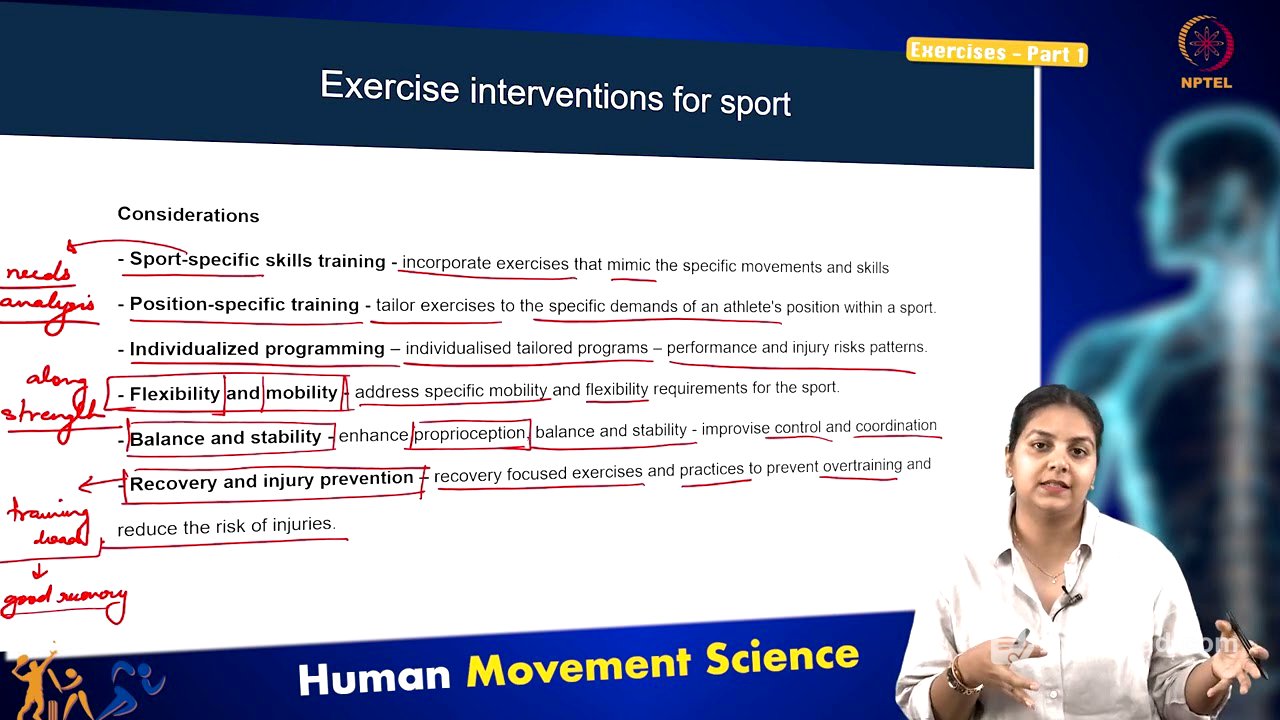
When designing exercise programs, several key considerations must be taken into account. These include sport-specific skill training, tailoring exercises to the demands of different athletic positions, and individualising programs based on the athlete's current level (beginner, intermediate, or advanced) and recovery status. Flexibility and mobility are crucial, as strength without the ability to execute movements through the required range of motion is ineffective. Balance and stability exercises are also important for enhancing proprioception and coordination. Finally, recovery and injury prevention strategies, including managing training load and incorporating recovery-focused exercises, are essential for preventing overtraining and reducing the risk of injuries.
Applying Movement Science Principles to Exercise [10:06]
Applying movement science principles to exercise involves integrating functional anatomy, biomechanics, and coaching considerations. Key factors include the number of exercises, repetitions, load, and intensity. It's crucial to ensure the athlete performs the desired joint range of motion, as reducing range of motion to increase weight or frequency diminishes the exercise's effectiveness. Individual variations in skeletal structure and anatomical alignment must also be considered when designing exercise protocols.
Joint Range of Motion and Individual Variations [11:42]
Maintaining a full joint range of motion is crucial during exercise to achieve the desired outcome. For example, in a shoulder press, the weight should be lowered to shoulder height and pressed overhead to complete the full range of motion. Individual anatomical variations, such as differences in skeletal structure or alignment (e.g., knee valgus or varus), must be considered when designing exercise programs. Modified exercise forms and equipment variations may be necessary to accommodate these individual needs. For instance, a box squat can be used instead of a traditional squat to reduce the load on the knees for individuals with knee concerns.
Muscle Activation and Recruitment in Exercise [17:25]
Understanding specific muscle activation patterns is essential for effectively targeting and strengthening muscle groups. Functional movement screening can help identify muscle weaknesses or restrictions in motion, informing the design of targeted training programs. For example, when performing a lat pull-down, retracting the shoulder blades before pulling the bar down ensures optimal activation of the latissimus dorsi muscle.
Progression and Regression in Exercise [20:15]
Progression involves increasing the intensity or load of an exercise, while regression involves reducing intensity, load, or frequency. These adjustments depend on the individual's fitness level and capabilities. For example, push-ups can be progressed from standard to decline push-ups to increase intensity, or regressed to knee push-ups for beginners or those with wrist discomfort. Strength building exercises for the wrist can address limitations preventing progression.
Posture and Alignment in Exercise [23:54]
Maintaining appropriate posture and alignment during exercise is crucial for balance, coordination, and injury prevention. An arched lower back during a squat can load the spine improperly, leading to muscular imbalances and increased joint stress. In exercises like deadlifts, maintaining a neutral spine is essential for efficient load transmission and core activation.
Functional Needs and Compound Exercises [26:28]
Exercises should serve a functional need, aligning with the individual's daily activities or sport-specific movements. Compound exercises, which target multiple muscles over multiple joints, are valuable for training movement patterns associated with these activities. For example, kettlebell swings are a good exercise for the posterior chain, engaging the glutes and hamstrings, which are essential for daily activities like lifting objects.