TLDR;
This video discusses the changing geopolitical landscape, particularly focusing on oil dependence and its impact on the Middle East and Islamic countries. It covers the implications of the US potentially controlling oil prices, the challenges faced by Saudi Arabia and the UAE due to dwindling oil reserves, and the reactions of figures like Mayor Zahran Mamdani to these shifts.
- The shift of oil dependence from Islamic to Christian countries could lead to significant global changes.
- Saudi Arabia and the UAE are facing challenges with oil production, impacting their economies.
- Figures like Mayor Zahran Mamdani are reacting to these geopolitical shifts, driven by underlying agendas.
Trump's Geopolitical Strategy [0:00]
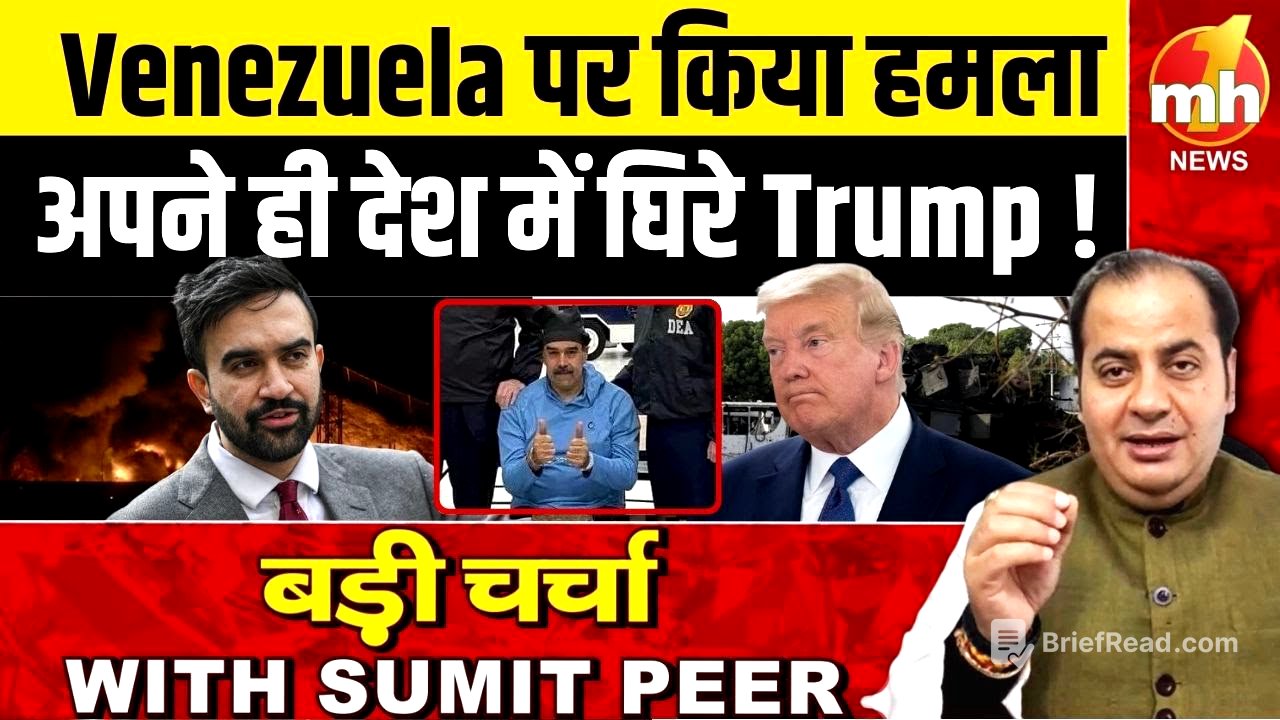
The speaker discusses how geopolitics have changed, emphasising a "might is right" approach where countries act without regard for international law. He uses the example of Venezuela, where the US intervened due to the country's lack of military strength. He suggests that if Venezuela had a military force comparable to India's, the US would not have dared to intervene. Trump is now threatening countries like Mexico, Cuba, and Cambodia. Russia's limited response is attributed to a deal with Trump regarding Ukraine. The speaker highlights that the US is threatening Iran and other countries, indicating a significant shift in the geopolitics of oil and the Middle East.
Shifting Oil Dependence [1:52]
The speaker discusses the current global dependence on Middle Eastern Islamic countries for oil. He points out that oil is their primary contribution, a resource they extract and sell. He contrasts this with Venezuela, which has substantial oil reserves, and notes that the US and Canada also possess significant oil resources, with Russia holding the largest reserves. The speaker suggests that the world's dependence on Islamic countries for oil is gradually shifting towards Christian-dominated countries. He predicts that once the world is no longer reliant on the Islamic bloc for oil, policies will shift against Islam and Islamic terrorism. Currently, political correctness is maintained due to the necessity of oil, which is a critical component of national security for every country.
Zahran Mamdani's Opposition [3:45]
The speaker addresses New York Mayor Zahran Mamdani's criticism of Trump, suggesting Mamdani is influenced by the Muslim Brotherhood and funded by Saudi and Qatari interests. He questions how Mamdani, who previously lived in a small apartment, became a prominent figure in US politics, implying external financial backing. The speaker claims that Islamic countries are using Mamdani to voice opposition against Trump, making it appear as though Americans are protesting American policies. He criticises Mamdani for questioning the President's foreign policy decisions so soon after taking office. The speaker accuses Mamdani of promoting a Muslim Brotherhood agenda and using his position to advance Islamic interests in America.
Oil Reserves and Economic Impact [6:15]
The speaker reveals that Saudi Arabia's last significant oil discovery was in 1939, and their economy heavily relies on oil revenues. He notes that Saudi Arabia needs oil prices above $92 a barrel to sustain its economy, including the expenses of its large royal family. He suggests that Trump's control over Venezuelan oil could drive prices down to $50 a barrel, which would negatively impact Russia and render the Middle East's oil program unviable. The speaker mentions that Saudi Arabia is currently losing money and relying on old reserves. He also points out that the UAE's last oil discovery was in 2017, located 10 miles underground and yielding only 500 barrels a day, making it unprofitable. This situation is driving the conflict in Yemen, where the UAE and Saudi Arabia are vying for control of limited oil resources.
Future Geopolitical Shifts [8:45]
The speaker concludes by stating that the influence of OPEC and the OIC is diminishing, and the dynamics of the oil market are set to change significantly by 2029. He suggests that Middle Eastern countries will soon face economic challenges. He also notes that Mayor Mamdani's opposition is a natural reaction to these shifts, as his backers are feeling threatened. The speaker implies that Mamdani's position as mayor is a result of these backers' influence.