TLDR;
This video explores different leadership methods and their impact on organisational effectiveness. It discusses autocratic, democratic, and non-directional leadership styles, highlighting the importance of context in choosing the most suitable approach. The video also differentiates between democracy and Shura in an Islamic context and uses real-life examples to illustrate the application and consequences of each leadership style.
- Autocratic leadership centres power around the leader, which can lead to weak interaction and morale.
- Democratic leadership encourages participation and knowledge sharing, fostering individual and organisational development.
- Non-directional leadership suits specialised environments, allowing individuals to work autonomously but can result in weak guidance and control.
Introduction to Leadership Methods [0:00]
The video begins by posing the question of what leadership methods can be used to enhance the leadership process and make it more effective. These methods are crucial as they dictate how an administrative leader interacts with others, especially during times of change. The discussion references "The Fundamentals of Management" by Najeeb al-Nimr and Saoud bin Mohammed Al-Nimr, which explores administrative works and their nature, emphasising that leadership behaviour is a response to internal and external pressures within an organisation. The leader's role is to balance these behaviours to positively affect the organisation's practical conduct.
Autocratic Leadership Style [1:25]
The autocratic method, also known as the authoritarian style, is centred around the leader, who is the core of all operations within the organisation. The leader believes they are the only one who can envision the plan, determine the goals, provide operational evidence, evaluate work, and determine work differences. In this style, all work is concentrated in the leader's office, leaving employees without a performance axis.
Democratic and Non-Directional Leadership Styles [2:11]
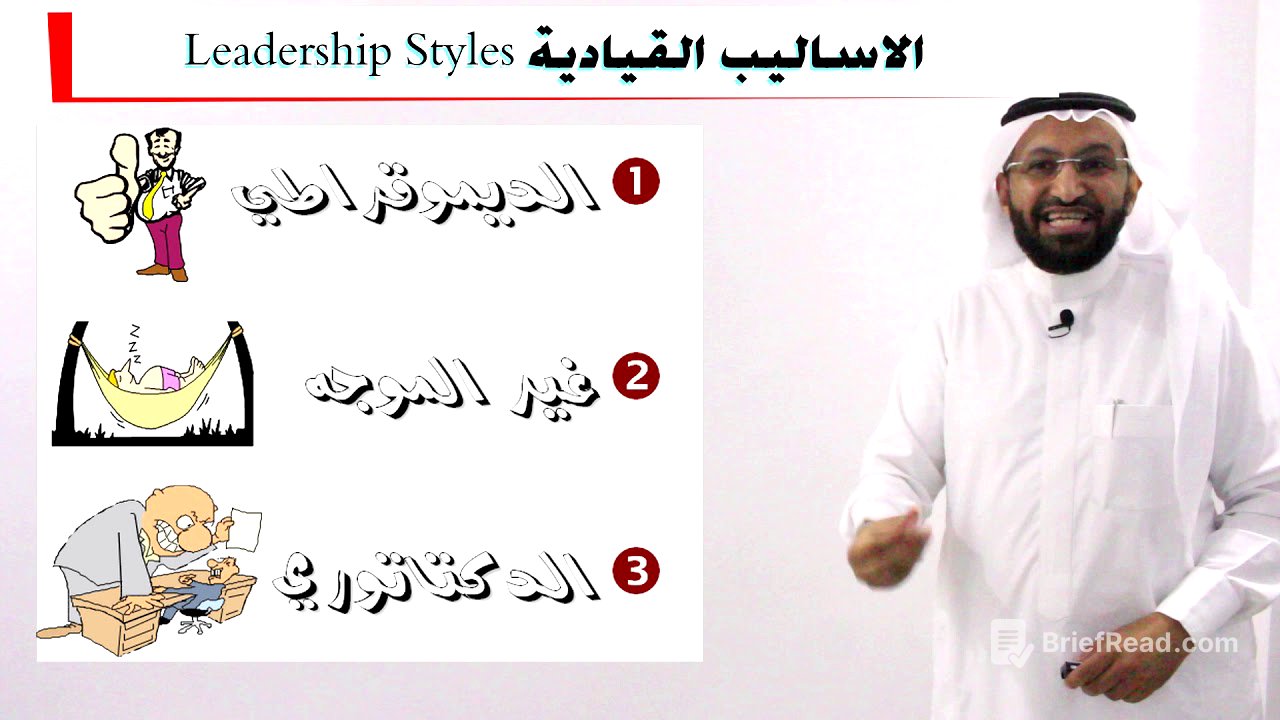
The democratic style involves participation from both the leader and the employees in decision-making. Conversely, the non-directional leadership style places all the burden on the employees, who are responsible for making decisions, setting the framework, and determining plans and procedures. The video then poses the question of which leadership style is the most suitable, contrasting democracy, non-direction, and dictatorship.
Democracy vs. Shura [3:31]
The video clarifies the difference between democracy and Shura, particularly in the Islamic context. Shura involves consultation with the presence of a text, where the leader consults advisors, but adherence to religious or legal texts is paramount. Democracy, on the other hand, relies on the majority opinion. The speaker uses the example of alcohol prohibition in the Quran to illustrate that democratic voting cannot override religious decrees. In administrative systems, democracy refers to decisions agreed upon by the group, while an autocratic regime may still utilise a council.
Illustrative Examples of Leadership Styles [4:45]
The speaker shares personal experiences from training courses given to officers to illustrate the three leadership styles. In the democratic system, the officer feigns seeking input but subtly directs the course of action, creating a facade of participation. In the non-directional approach, the officer is detached, allowing the participants to proceed with minimal interference. Conversely, the dictatorial model involves the officer asserting control, dictating expectations, and creating an environment of surveillance and fear.
Autocratic Leadership: Advantages and Disadvantages [8:58]
The video returns to discussing the autocratic leadership method, emphasising its focus on individual decision-making and policy development. This style can lead to weak interaction between individuals, a lack of moral spirit, and increased organisational conflict, resulting in a defensive weakness towards work.
Non-Directional Leadership: Advantages and Disadvantages [9:55]
Non-directional leadership, or "line on the side," is suitable for highly specialised environments like universities, where individuals are self-directed and require minimal guidance. However, this system can result in weak guidance and control, an absence of reliable surveillance, and the leader being distant from the group.
Democratic Leadership: Advantages and Disadvantages [10:42]
The democratic style encourages participation, knowledge sharing, and the development of individuals and organisations. However, it can also lead to an abundance of objections and suggestions, making decision-making difficult. The leader must be able to vary decision-making based on the context, fostering a team spirit and valuing the opinions of the group.
Comparing Democratic and Dictatorial Models [11:20]
The video compares the democratic and dictatorial models, asserting that both can be excellent depending on the context. The democratic model focuses on high quality but may sacrifice time and achievement, while the dictatorial model achieves results with lower quality. Democratic leadership fosters high employment satisfaction and consistent work ratios, whereas dictatorial leadership relies heavily on the leader's presence. The democratic model values input and long-term planning, while the dictatorial model prioritises the leader's vision without extensive explanation. The speaker concludes that these patterns control administrative and leadership behaviour.