TLDR;
The video discusses the escalating tensions between Japan and China, triggered by Japan's increased military presence near Taiwan and remarks on a potential Taiwan contingency. Japan is deploying missile systems and electronic warfare units on Yonaguni Island, extending its defensive reach. China has responded with military actions, including naval deployments and joint air patrols with Russia, creating a strategic encirclement of the Ryuku Islands. These actions have prompted a response from the US, including joint military exercises with Japan. The conflict has also extended to economic and social spheres, with China warning citizens against travelling to Japan and Japan ending a tax exemption policy for Chinese students.
- Japan is increasing its military presence near Taiwan, deploying missile systems and electronic warfare units.
- China has responded with military actions, including naval deployments and joint air patrols with Russia.
- The US has responded by conducting joint military exercises with Japan.
- The conflict has extended to economic and social spheres, with travel warnings and policy changes affecting students.
Japan's Military Buildup Near Taiwan [0:00]
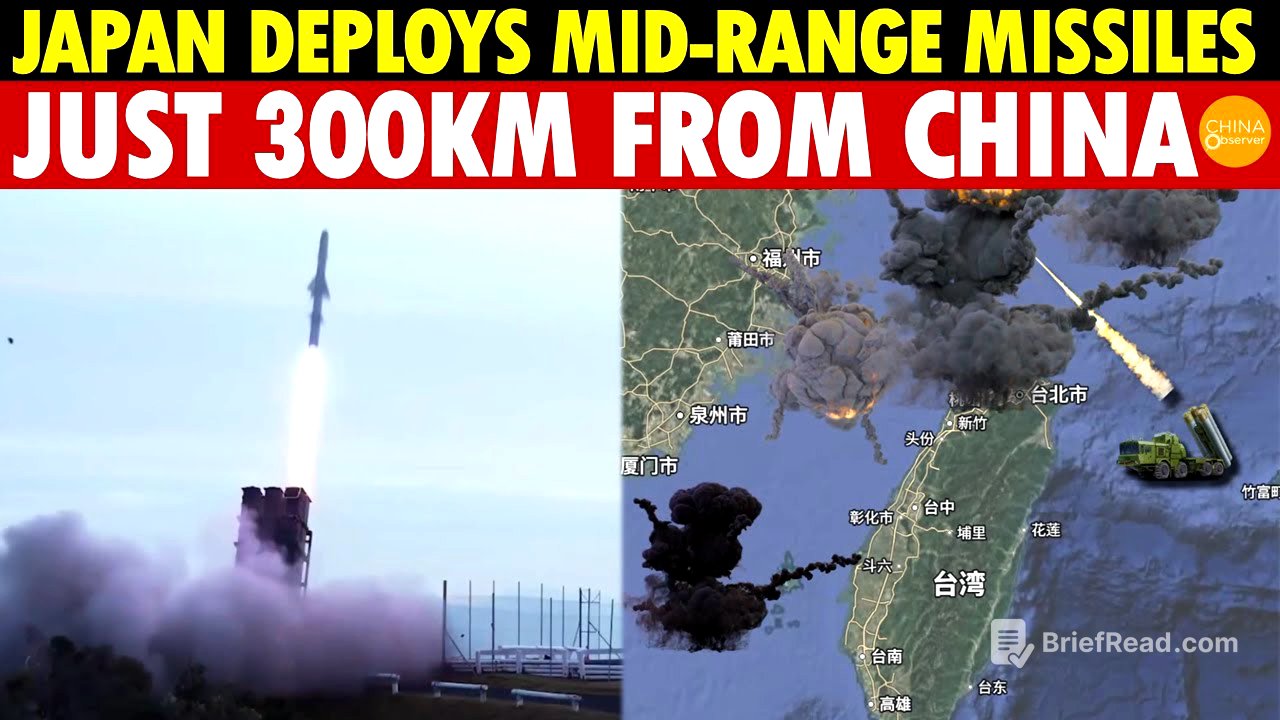
Japan is increasing its military presence on Yonaguni Island, which is close to Taiwan, by deploying Type 03 medium-range surface-to-air missiles and stationing more personnel. This move is part of a larger strategy to create a "missile archipelago" along the Ryuku Islands, which is Japan's most significant military buildup in over 40 years. The deployment aims to extend Japan's defensive reach and address potential Chinese military actions in the event of a Taiwan crisis. Military analysts note that Japan's actions, while seemingly defensive, are paving the way for intervention in a Taiwan crisis.
Japan's Missile Development and Deployment [2:05]
Japan is deploying Type 03 surface-to-air missiles and Type 12 anti-ship missiles on Yonaguni Island. The Type 03 missile system, developed by Mitsubishi Electric, can track up to 100 targets and intercept 12 simultaneously, with a range of up to 100 km. The upgraded Type 12 anti-ship missile has a range of 900 km, with plans to extend it to 1500 km. Japan has also stationed electronic warfare units on the island to disrupt enemy communication and guidance systems. This missile deployment, combined with the US Patriot 3 system, aims to create a deterrent in the East China Sea and the Western Pacific, forming a defence network with Taiwan's eastern air defence forces.
China's Military Response and Escalation [5:10]
China has responded to Japan's military buildup with naval deployments and joint air patrols with Russia. The Chinese Navy dispatched the Liaoning aircraft carrier to the southeastern waters of Okinawa, and Chinese fighter jets used fire control radar to lock onto Japanese aircraft. China and Russia conducted joint air patrols, including bombers and fighter jets, creating a three-pronged encirclement of the Ryuku Islands. These actions are seen as a way for China to pressure Prime Minister Takayichi to retract her statements about a Taiwan contingency.
US-Japan Alliance and Countermeasures [8:29]
The US has responded to China and Russia's provocations by deploying B-52H Stratofortress strategic bombers to a US military base in Japan and conducting joint air exercises over the Sea of Japan. This show of force signals that the US-Japan alliance will not back down under pressure. Additionally, a mystery aircraft was spotted on flight tracking charts, speculated to be dispatched for an emergency mission or strategic coordination. Experts believe that China's military pressure may have a counterproductive effect, increasing support in Japan for increased military spending.
Economic and Social Impacts of Tensions [10:28]
The tensions between Japan and China are escalating, extending to economic and social spheres. China has warned citizens to avoid travelling to Japan, causing a surge in tour cancellations. A tourist spot in China originally named Hokkaido style has been transformed into Soul Style, with Japanese elements replaced with Korean text. China has also cut off the only direct ferry service between China and Japan. Japan is responding by pushing to cancel a 42-year-old tax exemption policy for Chinese students in Japan, marking a profound shift in the mode of exchange between the two countries.